
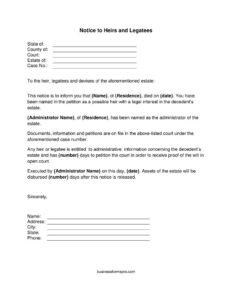
Notice To Heirs And Legatees
Download a free Notice to Heirs and Legatees template to formally inform beneficiaries of an estate and probate proceedings — free PDF and DOCX download.
PDF
DOCX
12 downloads
0
likes
Download Files
- DOCX
A Notice to Heirs and Legatees is a formal document used during the probate process to inform a decedent’s heirs, legatees, and devisees that an estate has been opened and that they may have a legal interest in it. It is most commonly used by an estate administrator or executor who is legally required to notify potential beneficiaries that probate proceedings have begun. You can download this template free in PDF and DOCX formats — no signup required.
What Is a Notice to Heirs and Legatees?
A Notice to Heirs and Legatees is a written communication that alerts the people named in (or potentially entitled to) a decedent’s estate that the estate is being administered through a court. It is typically issued by the appointed administrator or executor after a petition has been filed in probate court. The notice identifies the deceased person, the court and case number, the administrator handling the estate, and the deadlines within which an interested party may respond, petition the court, or contest the will. In short, it documents that affected parties were properly informed of the proceedings and given an opportunity to participate before assets are distributed.
When Do You Need a Notice to Heirs and Legatees?
This notice is used at the start of estate administration, when interested parties must be formally told what is happening. Common situations include:
- An administrator or executor has been appointed and must notify everyone who could inherit under the will or by law.
- A will has been submitted to probate and named legatees (those receiving specific gifts) need to be informed.
- There are devisees who would receive real property under the decedent’s will.
- Potential heirs cannot be easily reached and must be given formal written notice of the case number and court.
- The estate is preparing to disburse assets and must give interested parties their statutory window to respond.
- A court requires proof that all heirs and legatees were notified before approving distribution.
Heirs, Legatees, and Devisees: Knowing the Difference
Although the terms are often grouped together, they describe slightly different roles. An heir is a person entitled to inherit under intestacy law if there were no valid will. A legatee is someone who receives a gift of personal property or money under a will. A devisee traditionally refers to someone who inherits real property. This single notice is designed to reach all three groups at once, which is why the heading addresses “heirs, legatees and devises” together.
What a Notice to Heirs and Legatees Should Have
To be complete and useful, the notice should clearly identify the estate and the people involved. Key elements include the state, county, and court overseeing probate; the case number; the full name and residence of the decedent and the date of death; the name and residence of the appointed administrator; a statement that the recipient may be a possible heir or legatee; the number of days available to petition the court; and the timeframe before assets are disbursed. It should close with the sender’s full name, mailing address, city, state, and phone number so recipients know whom to contact.
How to Fill Out a Notice to Heirs and Legatees
- Enter the State of and County of where the estate is being probated.
- Write the name of the Court handling the matter and the Estate of the decedent.
- Add the Case No. assigned by the probate court so recipients can locate filings.
- In the body, insert the decedent’s {Name}, their {Residence}, and the {date} they died.
- Enter the {Administrator Name} and the administrator’s {Residence} to identify who is managing the estate.
- Specify the {number} of days an heir or legatee has to petition the court for proof of the will in open court.
- Add the date the notice is executed by {Administrator Name}, and the {number} of days after release before assets will be disbursed.
- Complete the signature block with the sender’s Name, Address, City, State, and Phone.
Delivering and Filing the Notice
How and when this notice must be served varies widely by jurisdiction. Many probate courts require that heirs and legatees be notified by mail, by personal delivery, or in some cases by publication when an interested party cannot be located. Courts often require the administrator to file proof that notice was given — sometimes called an affidavit or certificate of service — to confirm everyone was informed before the estate proceeds. Keep copies of every notice sent, along with mailing receipts or signed acknowledgments, in case the court asks for evidence later. Because deadlines for responding and contesting can be strict, recipients should act promptly rather than wait.
Common Mistakes to Avoid
- Leaving the case number, court name, or county blank, which makes it hard for recipients to find the filings.
- Listing the wrong date of death or misspelling the decedent’s name, creating confusion about which estate is involved.
- Forgetting to state the number of days to petition the court or the disbursement timeframe.
- Failing to notify every known heir, legatee, or devisee — overlooked parties can delay or reopen probate.
- Not keeping proof that notice was sent and received.
- Omitting the sender’s contact information so recipients have no way to ask questions or request documents.
Frequently Asked Questions
What is a Notice to Heirs and Legatees used for? It is used to formally inform a decedent’s potential heirs, legatees, and devisees that an estate has been opened in probate court. The notice provides the case number, the administrator’s identity, and the deadlines for responding or petitioning the court. It helps ensure interested parties are aware of the proceedings before assets are distributed.
Who sends this notice? The notice is typically sent by the administrator or executor appointed to manage the estate. In some cases an attorney handles the mailing on the administrator’s behalf. The signature block at the bottom identifies the sender and provides contact details for recipients.
Does the notice need to be notarized? The template itself does not require notarization, but many courts require an accompanying affidavit or proof of service that may need to be signed before a notary or filed in a specific format. Requirements vary by state and court, so check the local probate rules. When in doubt, confirm with the clerk of the court handling the estate.
How long do heirs have to respond? The notice includes a field for the number of days an heir or legatee has to petition the court, because deadlines differ by jurisdiction. The administrator should fill in the correct period required by the local probate court. Recipients should respond promptly to protect their interests.
Is this notice legally binding? The notice itself is informational rather than a contract, but serving it properly can satisfy a legal requirement of the probate process. Whether it carries legal weight depends on whether it meets your court’s service and content rules. Failing to give required notice can delay or invalidate parts of the administration.
How much does this template cost? This Notice to Heirs and Legatees template is completely free to download from Business Forms Pro in both PDF and DOCX formats. There is no signup or payment required. You can edit it to match your court’s specific requirements before sending.
This template is provided as a general example for informational purposes only and is not legal, financial, or tax advice. Probate notice requirements vary by state, county, and court. Consult a qualified attorney or your local probate court before relying on this document.
Related Forms
- Letter To Notify Creditors Of Death
- Demand Alimony Payment Letter
- Stolen Identity Report To FBI
- Stop Payment Check Recipient
- Child Visitation Letter
- Name Change Notification Letter
Browse more in Notifications.