
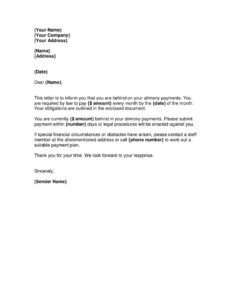
Demand Alimony Payment Letter
Use this free Demand Alimony Payment Letter template to formally request overdue spousal support payments — download in PDF and DOCX, no signup required.
PDF
DOCX
6 downloads
0
likes
Download Files
- DOCX
A Demand Alimony Payment Letter is a formal written notice telling a former spouse that they have fallen behind on court-ordered alimony and must bring the account current within a set number of days. People most commonly use it as a clear, documented first step before pursuing legal enforcement of unpaid spousal support. You can download this template free in PDF and DOCX formats, with no signup required.
What Is a Demand Alimony Payment Letter?
A Demand Alimony Payment Letter is a written communication, usually sent by the recipient of alimony (or their attorney or representative), notifying the paying party that their support obligation is past due. It states the monthly amount owed, the due date, the total arrears that have accumulated, and a deadline for payment. The letter references the underlying divorce decree or support order that created the obligation and warns that continued nonpayment may trigger legal procedures. Its purpose is twofold: to formally remind the obligor of their legal duty and to create a dated paper trail showing a good-faith attempt to resolve the matter before involving the courts.
When Do You Need a Demand Alimony Payment Letter?
This letter is useful any time spousal support payments stop arriving or arrive late and informal reminders have not worked. Common situations include:
- A former spouse has missed one or more monthly alimony payments outlined in a divorce decree.
- Payments have become chronically late and you want a documented record of the problem.
- The paying party has gone silent and you need to formally re-establish contact.
- You are preparing to file for enforcement and need to show the court you sent written notice first.
- Arrears have built up over several months and you want to state the exact balance owed.
- You want to offer a payment-plan option to a struggling obligor while still protecting your rights.
What a Demand Alimony Payment Letter Should Have
An effective demand letter is firm, factual, and free of emotion. It should clearly identify both parties, reference the support order, state the required monthly payment and its due date, specify the total amount currently overdue, and give a firm deadline for payment. It should warn that legal procedures may follow if payment is not received, while also providing a contact method so the recipient can discuss a payment plan if genuine financial hardship exists. Including a copy of the divorce decree or support order strengthens the letter and removes any doubt about the obligation being demanded.
How to Fill Out a Demand Alimony Payment Letter
- Enter {Your Name}, {Your Company} (if you are sending it through a law firm or office), and {Your Address} at the top so the recipient knows who to respond to.
- Add the recipient’s {Name} and {Address} — the former spouse who owes the support.
- Insert the {Date} the letter is written; this date matters because it anchors the deadline you set.
- Open with the salutation using the recipient’s {Name}.
- In the body, fill the required monthly {$ amount} and the {date} of the month it is due, matching the support order exactly.
- Note that the obligations are outlined in the enclosed document, and attach a copy of the decree or order.
- State the total {$ amount} the recipient is currently behind so the demand is unmistakable.
- Set the {number} of days for payment before legal procedures begin.
- Provide the {phone number} where the recipient can call to arrange a payment plan if hardship has arisen.
- Close and sign as the {Sender Name}.
Sending the Letter and Keeping Records
How you send this letter is as important as what it says. Send it by a method that produces proof of delivery — certified mail with return receipt is the most common choice, and many people also send a copy by regular mail and email. Keep a signed copy of the letter, the mailing receipt, and any delivery confirmation together with a record of the missed payments. This documentation becomes valuable evidence if the matter later proceeds to court, because it demonstrates that you notified the obligor, stated the exact amount owed, and gave a reasonable opportunity to pay before escalating.
Demand Letter Versus Court Enforcement
A demand letter is not itself a legal action — it is a notice that precedes one. Alimony obligations are set by a court order, and only a court can enforce them through remedies such as wage garnishment, contempt proceedings, or liens. The demand letter signals that you are serious and willing to use those tools, which often prompts payment without further steps. If the deadline passes with no response, the next stage typically involves filing a motion for enforcement or contempt in the court that issued the original order. Many people consult a family law attorney at that point, and the letter you sent becomes part of the record showing your good-faith effort to resolve the issue first.
Common Mistakes to Avoid
- Stating an arrears figure that does not match your payment records — always reconcile the exact amount owed before sending.
- Leaving out the reference to the divorce decree or support order, which is what makes the obligation legally binding.
- Using threatening, abusive, or harassing language instead of a calm, factual tone.
- Forgetting to set a clear deadline (the {number} of days), which weakens the demand.
- Sending it by a method with no proof of delivery, so you cannot later show the recipient received notice.
- Omitting a contact number, removing any chance for the obligor to arrange a workable payment plan.
Frequently Asked Questions
What is a Demand Alimony Payment Letter used for? It is used to formally notify a former spouse that they have missed alimony payments and to demand that they bring the balance current by a stated deadline. It documents the amount owed and serves as a record of your attempt to resolve the matter before pursuing court enforcement.
How do I fill out the letter? Enter your name and address, the recipient’s name and address, the date, the required monthly amount and due date, the total arrears, and the number of days you are allowing for payment. Attach a copy of the support order and sign at the bottom as the sender.
Does this letter need to be notarized or witnessed? A demand letter generally does not require notarization or witnesses, since it is a notice rather than a legal filing. Sending it by certified mail with a return receipt is more useful than notarizing it, because it proves the recipient received the letter.
Is a demand letter legally binding? The letter itself is not a legal order — the alimony obligation comes from the court’s divorce decree or support order. The letter simply notifies the obligor of that existing obligation and the consequences of ignoring it, and it can support a later enforcement action in court.
What happens if they still do not pay? If the deadline passes without payment, you may pursue enforcement through the court that issued the support order, which can include remedies like wage garnishment or contempt proceedings. Many people consult a family law attorney at this stage and present the demand letter as evidence of prior notice.
Is this template really free? Yes. You can download the Demand Alimony Payment Letter template free in both PDF and DOCX formats with no signup required, then customize every field to your situation before sending.
This template is a general example provided for informational purposes only and is not legal, financial, or tax advice. Alimony rules and enforcement procedures vary by jurisdiction, so consult a qualified family law attorney about your specific circumstances before relying on this letter.
Related Forms
- Stolen Identity Report To FBI
- Name Change Notification Letter
- Letter To Notify Creditors Of Death
- Child Visitation Letter
- Stop Payment Check Recipient
- Notice To Heirs And Legatees
Browse more in Notifications.