
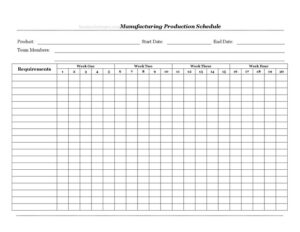
Manufacturing Production Schedule
Download a free Manufacturing Production Schedule template to plan products, dates, teams, and weekly tasks — free download in PDF and DOCX.
PDF
DOCX
5 downloads
0
likes
Download Files
- DOCX
A Manufacturing Production Schedule is a planning document that lays out exactly what will be produced, when work starts and finishes, who is responsible, and how the job breaks down week by week. Most teams reach for one when they need to coordinate a production run across people, machines, and deadlines without anything slipping through the cracks. It’s free to download here in both PDF and DOCX formats, with no signup required.
What Is a Manufacturing Production Schedule?
A Manufacturing Production Schedule is a structured timeline used by production managers, plant supervisors, and operations planners to map a manufacturing job from kickoff to completion. It documents the product being made, the overall date range, the people assigned, the requirements that must be met, and a week-by-week breakdown of the work. In practice it serves as a single reference point that keeps the shop floor, purchasing, and management aligned. Rather than tracking commitments in scattered emails or whiteboards, the schedule consolidates the plan into one document everyone can see. It helps balance workloads, anticipate material needs, and measure actual progress against the original plan so adjustments can be made early.
When Do You Need a Manufacturing Production Schedule?
This form is useful any time output has to be coordinated across time, people, and resources. Common situations include:
- Launching a new production run for a product and needing a clear start and end date for the floor.
- Fulfilling a large customer order that must be completed within a fixed delivery window.
- Assigning specific team members to stages of a build so responsibilities are never ambiguous.
- Breaking a four-week job into manageable weekly milestones to track progress.
- Communicating capacity and timing to purchasing so raw materials arrive before they are needed.
- Reviewing performance after a run by comparing what was planned each week against what was actually produced.
What a Production Schedule Should Have
A complete Manufacturing Production Schedule should clearly identify the product so there’s no confusion about what’s being built. It needs a defined date range — a start and an end — to anchor the timeline and set expectations. It should name the team members responsible so accountability is built in. A requirements section captures specifications, quantities, materials, or quality standards that the run must satisfy. Finally, a weekly breakdown (in this template, Week One through Week Four) translates the broad timeline into concrete, sequenced tasks. Together these elements turn a vague intention into an actionable plan that the floor can follow and managers can monitor.
How to Fill Out a Manufacturing Production Schedule
- Product: Enter the name or SKU of the item being manufactured. Be specific — include model numbers or variants if multiple versions exist.
- Start Date: Record the date production work officially begins. This is your baseline for measuring progress.
- End Date: Enter the target completion date. Work backward from any customer or shipping deadline to set a realistic finish.
- Team Members: List the individuals or teams assigned to the run, ideally noting their roles (assembly, inspection, packaging) so responsibilities are clear.
- Requirements: Document quantities, materials, tooling, quality standards, and any special instructions the run must meet.
- Week One: Outline the tasks, output targets, or setup activities planned for the first week.
- Week Two: List the second week’s goals — typically ramping production toward full capacity.
- Week Three: Note the third week’s planned tasks and any mid-run checks or quality reviews.
- Week Four: Record final-week activities such as finishing, inspection, packaging, and handoff to shipping.
Breaking the Run Into Weekly Phases
The week-by-week structure is the engine of this schedule. Treat each week as a milestone rather than a loose to-do list. A good practice is to attach a measurable target to every week — units completed, stages cleared, or percentages of the order finished. This lets you compare planned versus actual output at the end of each week and catch slippage before it compounds. For example, if Week Two falls behind, you can reallocate team members or add a shift in Week Three rather than discovering a shortfall only at the deadline. Front-load setup and material staging into Week One so the middle weeks run at full speed, and reserve Week Four for inspection, rework, and packaging so the product ships clean.
Coordinating People and Materials
A schedule only works if the resources it assumes are actually available. Cross-check the Team Members field against time-off calendars and other concurrent jobs so you don’t over-commit the same people. Use the Requirements section as a checklist for purchasing: every material listed there should have a confirmed delivery date that lands before the week it’s needed. Sharing the completed schedule with adjacent departments — maintenance, quality, and logistics — turns it from a planning artifact into a coordination tool. Keep one master copy and update it as the run progresses so everyone is always working from the current version rather than an outdated print.
Common Mistakes to Avoid
- Vague weekly entries: Writing “continue production” gives no way to measure progress. Use concrete targets instead.
- Ignoring lead times: Setting a start date before materials can realistically arrive guarantees delays.
- Overloading team members: Assigning the same people to multiple simultaneous runs without checking capacity.
- Skipping the requirements detail: Leaving out quantities or quality standards invites costly rework.
- Treating the schedule as static: Failing to update it as conditions change makes it useless within days.
- No buffer time: Packing all four weeks to 100% capacity leaves no room for machine downtime or rework.
Frequently Asked Questions
What is a Manufacturing Production Schedule used for? It is used to plan and track a production run by defining the product, the start and end dates, the assigned team, the requirements, and a week-by-week task breakdown. It keeps the shop floor, purchasing, and management aligned around one shared timeline.
How do I fill out the weekly sections? Break the overall job into four sequential phases and assign each week concrete, measurable goals such as units produced or stages completed. Front-load setup in Week One and reserve final inspection and packaging for Week Four so progress can be tracked at each milestone.
Is this template free to download? Yes. The Manufacturing Production Schedule is completely free to download in both PDF and DOCX formats, with no signup or payment required. You can edit the DOCX version to match your own products and timelines.
Can I customize the fields for my operation? Absolutely. The DOCX version is fully editable, so you can rename fields, add more weeks, include capacity columns, or insert your company logo. Adapt the requirements and team sections to reflect how your plant actually works.
What’s the difference between a production schedule and a work order? A work order authorizes a specific job and lists what to make and how, while a production schedule places that work on a timeline and assigns it across weeks and people. The two complement each other — the schedule shows when work happens, the work order shows the detailed instructions.
How far ahead should I plan a production schedule? Plan far enough out that materials and labor can be secured before each phase begins, which often means weeks ahead for items with long lead times. Review and update the schedule regularly as actual output is logged so the plan stays accurate.
This template is a general example provided for informational purposes only and does not constitute legal, financial, or operational advice. Manufacturing practices, safety requirements, and compliance standards vary by industry and jurisdiction — consult a qualified professional to ensure your production planning meets all applicable requirements.
Official resource: for the rules that apply to your situation, see the U.S. Small Business Administration.
Related Forms
- Appointment Book
- Hotel Reservation Form
- Venue Reservation Request
- Project Schedule
- Appointment Request Form
- Blue Appointment Reminder Card
Browse more in Office.