
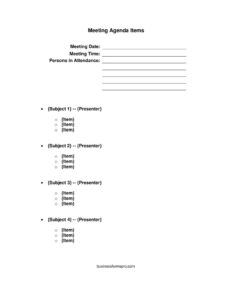
Meeting Agenda List
Download a free Meeting Agenda List template to organize topics, track attendance, and keep meetings on time — free download in PDF and DOCX.
PDF
DOCX
2 downloads
0
likes
Download Files
- DOCX
A Meeting Agenda List is a simple planning document that lists the topics, date, time, and attendees for an upcoming meeting so everyone arrives prepared and the discussion stays on track. The most common reason people use it is to set a clear order of business and avoid the rambling, time-wasting meetings that happen without structure. This template is free to download in PDF and DOCX, with no signup required.
What Is a Meeting Agenda List?
A Meeting Agenda List is a one-page outline of what a meeting will cover and who needs to be there. It is typically prepared by a meeting organizer, chairperson, team lead, or administrative assistant and circulated to participants before the meeting begins. The document records the meeting date and time, the persons in attendance, and a checklist of agenda items to be discussed in order. By putting topics in writing ahead of time, it gives attendees a chance to prepare, prevents important subjects from being forgotten, and helps the group manage the available time. It serves as both a planning tool before the meeting and a reference during it.
When Do You Need a Meeting Agenda List?
An agenda list is useful anytime more than a couple of people gather to make decisions or share updates. Common situations include:
- Weekly team check-ins where each project or person needs a defined slot so nothing is overlooked.
- Board or committee meetings that must follow a set order of business and document who attended.
- Client or vendor meetings where you want to cover specific deliverables, questions, and next steps efficiently.
- Department planning sessions to organize priorities, assign tasks, and review progress.
- Volunteer, club, or nonprofit gatherings that need a lightweight structure without formal minutes software.
- One-on-one reviews where listing topics in advance keeps both people focused and ensures key issues get raised.
In short, whenever a meeting has a purpose and a clock, an agenda list keeps it purposeful and on schedule.
What a Meeting Agenda List Should Have
A complete agenda list does not need to be complicated, but a few elements make it effective. It should clearly state the meeting date and time so attendees know when to show up and how long to plan for. It should record who is expected or present, which doubles as a simple attendance log. Most importantly, it should contain an ordered list of discussion items, ideally arranged from highest to lowest priority. Each item should be specific enough that participants understand what will be covered. Leaving a checkbox beside each item lets the chairperson mark topics as they are completed, keeping the meeting moving and providing a quick visual of remaining business.
How to Fill Out a Meeting Agenda List
- Meeting Date: Enter the calendar date of the meeting. If it recurs, note the specific date for this session.
- Meeting Time: Write the start time, and consider adding an end time or expected duration so the group can pace itself.
- Persons in Attendance: List the names of everyone expected at the meeting. You can fill this in beforehand from your invite list and adjust it at the start of the meeting to reflect who actually showed up.
- Item lines (the checklist): Use the blank item lines to write each topic to be discussed. The template provides multiple checkbox lines, so place your most important or time-sensitive subjects first. Keep each entry short and action-oriented — for example, “Approve Q3 budget” or “Review project timeline.”
- Order and check off: Number or arrange items logically, then tick the box beside each one as it is handled so you can see progress and confirm nothing was skipped.
- Distribute: Share the completed agenda with attendees ahead of time so they can prepare.
Tips for an Agenda That Actually Saves Time
The difference between a good agenda and a great one is usually the wording of the items. Phrase each line as an outcome or decision rather than a vague heading: “Decide on new vendor” tells people more than “Vendors.” Estimate how many minutes each item deserves and write that next to the topic so the group budgets its time consciously. Put quick informational updates near the end and decisions near the front, when energy and attention are highest. If an item runs long, the checklist makes it easy to defer it to the next meeting rather than derailing the whole schedule. Finally, leave the last item open for “any other business” so urgent topics still have a home.
Agenda List vs. Meeting Minutes
People sometimes confuse an agenda with meeting minutes, but they serve opposite ends of the meeting. The agenda list is created before the meeting and describes what you intend to discuss. Minutes are written during or after the meeting and record what was actually said, decided, and assigned. A well-built agenda list makes minutes far easier to take, because the note-taker can simply capture outcomes against each listed item. Many teams keep the agenda and minutes side by side as a complete record of the session.
Common Mistakes to Avoid
- Overloading the list with too many items for the time available — be realistic about what fits.
- Vague item names like “Marketing” that give attendees no idea what to prepare.
- Forgetting the time field or an end time, which lets meetings drift past their slot.
- Not sharing the agenda in advance, so people walk in unprepared.
- Leaving attendance blank, which means you lose a useful record of who participated in decisions.
- No prioritization — burying the most important topic at the bottom where it may never be reached.
Frequently Asked Questions
What is a Meeting Agenda List used for? It is used to plan and organize a meeting by listing the date, time, attendees, and the topics to be discussed. It helps everyone arrive prepared and keeps the conversation focused so the meeting finishes on time.
How do I fill out the Meeting Agenda List? Enter the meeting date and time at the top, list the people who will attend, and then write each discussion topic on its own checkbox line. Arrange the items from most to least important, and tick each box as the topic is covered during the meeting.
How many agenda items should a meeting have? There is no fixed rule, but most effective meetings cover only a handful of focused items so each gets real attention. Match the number of items to the available time, and move anything that does not fit to the next session.
Is this template the same as meeting minutes? No. The agenda list is prepared before the meeting to outline what you plan to discuss, while minutes are written during or after to record what was actually decided. The two complement each other and are often kept together.
Can I edit the template to add more items or columns? Yes. The DOCX version is fully editable, so you can add more checkbox lines, insert time estimates, assign an owner to each item, or include a notes column to suit your team’s needs.
Is the Meeting Agenda List free to download? Yes, this template is completely free to download in both PDF and DOCX formats with no signup required. You can reuse it for every meeting and customize it as often as you like.
This Meeting Agenda List template is provided as a general example for informational purposes only and does not constitute legal, financial, or professional advice. Organizational and recordkeeping requirements vary by company and jurisdiction, so consult a qualified professional if you need guidance for formal or regulated meetings.
Official resource: for the rules that apply to your situation, see the U.S. Small Business Administration.
Related Forms
- Meeting Agenda Landscape
- Lobby Hours
- Annual Salary Increase
- Bank Holidays
- Project Schedule
- Market Map Services
Browse more in Office.