
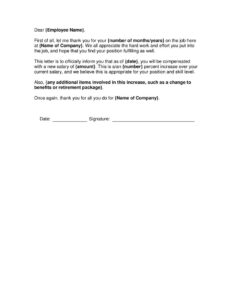
Annual Salary Increase
Download a free Annual Salary Increase letter template in PDF and DOCX to formally notify an employee of a new salary and pay raise — no signup needed.
PDF
DOCX
2 downloads
0
likes
Download Files
- DOCX
An Annual Salary Increase letter is a formal document an employer gives an employee to confirm a pay raise, stating the new salary amount, the percentage increase, and the date it takes effect. The most common reason people use it is to put a yearly raise in writing after a performance review or merit cycle. You can download this Annual Salary Increase template for free in both PDF and DOCX formats — no signup required.
What Is an Annual Salary Increase Letter?
An Annual Salary Increase letter is a short, formal notice issued by an employer — typically a manager, HR representative, or business owner — to an employee. It documents a raise to the employee’s base compensation and the effective date of the change. Beyond confirming the new figure, the letter usually thanks the employee for their contributions, references the percentage increase over their current salary, and notes any related changes to benefits or retirement contributions. While it is often friendly and appreciative in tone, it also serves as an official record for payroll and personnel files, giving both parties a clear written reference for what was agreed and when it begins.
When Do You Need an Annual Salary Increase Letter?
This letter is useful whenever a raise needs to be formally communicated and documented. Common situations include:
- Annual merit cycles — after yearly performance reviews when raises are awarded based on results.
- Cost-of-living adjustments — when across-the-board increases are applied to keep pace with inflation.
- Promotions or role changes — when an employee moves into a higher position with greater responsibility.
- Retention efforts — when a company increases pay to keep a valued team member from leaving.
- Milestone anniversaries — recognizing long tenure with a scheduled pay bump.
- Adjusting for new certifications or skills — rewarding an employee who has expanded their qualifications.
In each case, a written letter prevents confusion, gives the employee something to keep, and creates a paper trail that payroll and HR can rely on.
What an Annual Salary Increase Letter Should Have
A complete salary increase letter should clearly identify the employee and the company, state the new salary amount in plain numbers, and specify the effective date so payroll knows exactly when to apply the change. It should express the percentage increase relative to the current salary for transparency, and note any additional adjustments — such as changes to health benefits, bonus eligibility, or retirement contributions. A genuine note of appreciation strengthens the message, and a signature line with a date makes the document official. Keeping it concise and unambiguous ensures there is no room for misinterpretation about what is changing.
How to Fill Out an Annual Salary Increase Letter
- Address the employee directly by entering their full name in the {Employee Name} field after the greeting.
- Fill in the {number of months/years} field to acknowledge how long they have been with the organization.
- Enter the {Name of Company} where the employee works — this appears more than once, so update each mention.
- Specify the {date} the new salary becomes effective, so payroll can apply it correctly.
- Write the new compensation in the {amount} field, stated clearly as an annual or hourly figure.
- Add the {number} percent value to show the size of the increase over the current salary.
- Use the {any additional items} field to describe related changes, such as a new retirement match, updated benefits, or a revised bonus structure. If none apply, you can remove this sentence.
- Finish by entering the Date and adding a Signature from the manager or authorized representative.
Review every placeholder before sending so no bracketed field is left unfilled.
Tips for Delivering the Letter
Whenever possible, pair this letter with a brief in-person or video conversation rather than letting it land cold in an inbox. A face-to-face moment lets you explain the reasoning behind the raise, connect it to specific accomplishments, and answer questions about how benefits or take-home pay may change. Hand or email the signed letter immediately afterward so the employee has the details in writing. Keep a copy in the personnel file and forward the relevant figures to payroll so the new amount is reflected on the correct pay date. Consistency matters too: applying the same clear format across your team signals fairness and professionalism.
How It Differs From an Offer Letter or Contract
An Annual Salary Increase letter is not the same as a job offer or an employment contract. An offer letter establishes the original terms of employment for a new hire, while a contract may set out detailed obligations, duration, and termination conditions. By contrast, a salary increase letter simply amends one existing term — pay — for someone already employed. It generally supplements, rather than replaces, the original agreement. If a raise comes with significant changes to duties, title, or terms, some employers issue a separate updated agreement and reference it within or alongside the increase letter.
Common Mistakes to Avoid
- Leaving placeholders unfilled — sending a letter with {amount} or {date} still in brackets looks careless and creates confusion.
- Mismatching the percentage and the dollar figure — double-check that the stated percent increase actually matches the new and old salary numbers.
- Forgetting the effective date — without it, payroll may not know which pay period to update.
- Omitting benefit changes — if the raise affects retirement or insurance, failing to mention it can lead to surprises later.
- Not signing or dating the letter — an unsigned notice carries less weight as an official record.
- Using vague language — avoid phrases that could imply guaranteed future raises unless that is genuinely intended.
Frequently Asked Questions
What is an Annual Salary Increase letter? It is a formal written notice from an employer confirming a raise to an employee’s pay. It states the new salary, the percentage increase, the effective date, and any related changes to benefits, serving as an official record for both the employee and the company’s files.
How do I fill out the salary increase letter? Replace each bracketed placeholder with the correct details: the employee’s name, their tenure, the company name, the effective date, the new salary amount, and the percentage increase. Add any benefit changes in the additional-items section, then date and sign the letter before delivering it.
Does an Annual Salary Increase letter need to be notarized? No, this type of letter typically does not require notarization or witnesses. It is an internal personnel document, so a signature from the manager or authorized company representative is generally sufficient to make it official.
Is a salary increase letter legally binding? A signed letter documents a commitment to pay the stated salary from the effective date and can be treated as part of the employment record. However, the exact legal weight depends on your existing agreements and local employment laws, so review it carefully if there are other contracts in place.
How much does this template cost? Nothing — this Annual Salary Increase template is completely free to download here in both PDF and DOCX formats, with no signup or payment required. You can edit the DOCX version to match your company’s wording and branding.
Should I state the percentage, the dollar amount, or both? Including both adds transparency and helps the employee understand the change clearly. Make sure the percentage you list accurately reflects the difference between the current and new salary so the figures don’t contradict each other.
This template is a general example provided for informational purposes only and is not legal, financial, or tax advice. Employment and compensation requirements vary by jurisdiction and by individual circumstances — consult a qualified professional or your HR and legal advisors before relying on this document.
Official resource: for the rules that apply to your situation, see the U.S. Small Business Administration.
Related Forms
- Appointment Book
- Appointment Change Form
- Red Appointment Reminder Card
- Meeting Agenda Simple
- Meeting Agenda Landscape
- Beauty Salon Appointment
Browse more in Office.