
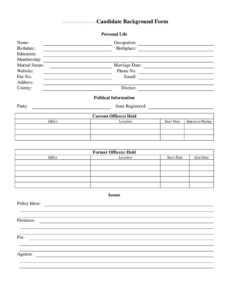
Candidate Information Form
Download a free Candidate Information Form template in PDF or DOCX to collect candidate details for ballots, party records, and campaign filings.
PDF
DOCX
2 downloads
0
likes
Download Files
- DOCX
A Candidate Information Form is a standardized document used to collect the essential personal, contact, and eligibility details of a person seeking elected office or a position on a slate or ballot. Political parties, election committees, and local organizations rely on it to keep accurate candidate records, and it is free to download here in both PDF and DOCX formats with no signup required.
What Is a Candidate Information Form?
A Candidate Information Form is a structured intake document that gathers the key facts about a candidate in one place. It is typically issued by a political party, an election or nominating committee, an endorsement body, or a community organization that needs to verify and publish candidate details. The form documents who the candidate is, the office they are pursuing, how to reach them, and their relevant background. Once completed, it becomes part of the official candidate file used for ballot preparation, voter guides, party newsletters, endorsement decisions, and internal record-keeping. Because it centralizes scattered information, it reduces back-and-forth and helps ensure every candidate is evaluated against the same set of questions.
When Do You Need a Candidate Information Form?
This form comes into play any time an organization must collect consistent, comparable details from one or more candidates. Common situations include:
- A political party registering candidates running under its banner for an upcoming primary or general election.
- A local election committee or club compiling profiles for a candidate forum or voter guide.
- An endorsement organization screening applicants before deciding which campaigns to support.
- A campus, union, or homeowners-association election requiring each nominee to submit standardized information.
- A nonprofit or trade group selecting candidates for a board of directors or officer position.
- A campaign staff onboarding a candidate and assembling a master profile for press kits and social media.
What a Candidate Information Form Should Have
A complete Candidate Information Form should capture identity, contact, and qualification details clearly enough that anyone reviewing the file can act on it without follow-up. Core elements usually include the candidate’s full legal name and any name they prefer on the ballot, the specific office or position sought, the election or term in question, full contact information, and a brief biography or statement of qualifications. Many versions also collect party affiliation, residency or district, prior offices held, education and employment background, campaign contact or website, and a signature confirming the information is accurate. Adding a date and an authorization line strengthens the record and signals that the candidate stands behind what they submitted.
How to Fill Out a Candidate Information Form
Work through the form one section at a time and answer every field, since blanks slow down review:
- Candidate name: Enter your full legal name, then add the exact name you want displayed on the ballot or in published materials if it differs.
- Office or position sought: State the specific seat — for example, city council district, school board, or party committee role.
- Election and term: List the election date or cycle and the term length if applicable.
- Party or affiliation: Note your party or, for nonpartisan races, write “nonpartisan” or “independent.”
- Residential address and district: Provide your home address and the district or jurisdiction you are running in.
- Contact details: Add phone, email, and campaign website or social media so the organization can reach you.
- Background: Summarize education, occupation, and any prior public service or relevant experience.
- Candidate statement: Write a short statement of priorities or qualifications if the form allows it.
- Signature and date: Sign and date to certify the information is true and complete.
Tips for Submitting Accurate Information
Treat the form as a public-facing document, because much of what you enter may appear in voter guides, on a ballot, or on a party website. Spell your ballot name exactly as you want voters to see it, since corrections later can be difficult or impossible once printing deadlines pass. Keep biographical claims truthful and verifiable; organizations and opponents may fact-check education, job titles, and prior offices. If a field asks for a district or precinct, confirm the boundaries before answering, as redistricting can change which seat covers your home. Finally, save a copy of your completed form so you can reuse consistent wording across other materials.
How This Differs From Official Filing Paperwork
It is important to understand that a Candidate Information Form collected by a party, club, or committee is usually not the same as the legal nomination paperwork required by an election authority. Government election offices typically require their own official forms — such as a declaration of candidacy, nomination petitions with verified signatures, and campaign finance registrations — often with strict deadlines and filing fees. This template is designed for internal and organizational use: building profiles, screening for endorsements, and keeping records. Always check separately with your local or state election office to confirm the official documents, deadlines, and eligibility rules that govern actually appearing on the ballot.
Common Mistakes to Avoid
- Using an inconsistent name: Listing a nickname on one document and a legal name on another creates confusion across ballots and records.
- Leaving fields blank: Missing contact details or district information forces reviewers to chase you down and can delay your file.
- Overstating qualifications: Exaggerated job titles, degrees, or experience can be challenged and damage credibility.
- Confusing this with official filings: Submitting only this form and assuming you are on the ballot — without filing the required government paperwork.
- Forgetting the signature and date: An unsigned form may not be accepted as a certified record of your information.
- Ignoring deadlines: Even internal forms often feed into printed guides with cutoff dates; late submissions may be excluded.
Frequently Asked Questions
What is a Candidate Information Form used for? It is used to collect standardized personal, contact, and qualification details from people seeking an elected or appointed position. Parties, committees, and organizations use it to build candidate profiles, prepare voter guides, screen for endorsements, and maintain accurate records.
Is this the same as filing to run for office? No. This template is for organizational and internal use. To officially appear on a ballot you typically must file separate paperwork with your election authority, such as a declaration of candidacy and nomination petitions, by specific deadlines.
Does a Candidate Information Form need to be notarized? Generally no. Most parties and organizations accept a signed and dated form as a certification of accuracy. Official government filings, however, may require notarization or witnesses, so check the requirements of the body requesting your form.
What information should I be ready to provide? Have your full legal and ballot name, the office sought, election cycle, party affiliation, residential address and district, contact details, and a brief summary of your background and priorities ready before you start filling it out.
Is this form legally binding? The form is primarily a record and a certification that the details you provided are accurate. It does not by itself create legal candidacy or obligations, but submitting false information may carry consequences under an organization’s rules or applicable law.
How much does this template cost? It is completely free to download here in PDF and DOCX formats with no signup or payment required. You can fill it out digitally or print it, and edit the DOCX version to match your organization’s needs.
This Candidate Information Form template is a general example provided for informational purposes only and is not legal, financial, or election-compliance advice. Election rules, filing requirements, and deadlines vary by jurisdiction and organization — consult your local election authority or a qualified professional before relying on this document.
Related Forms
- Electorate Information
- Endorsements Tracker
- Media Contacts
- Sponsorships Tracker
- Campaign Endorsement Request Letter
- Voting Demographics By Affiliation
Browse more in Political.