
Property Appraisal Form
Download a free Property Appraisal Form template in PDF and DOCX to document a property's value, location, and market details — free download, no signup.
PDF
DOCX
31 downloads
0
likes
Download Files
- DOCX
A Property Appraisal Form is a structured document used to record a professional assessment of a property’s value, physical characteristics, and market context. People most often use it when a lender, buyer, or owner needs a written record of what a property is worth and why. You can download this Property Appraisal Form free in both PDF and DOCX formats — no signup required.
What Is a Property Appraisal Form?
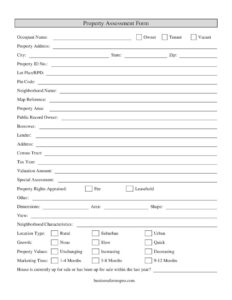
A Property Appraisal Form is a one-page assessment document that captures the key facts an appraiser, lender, or real estate professional needs to estimate a property’s market value. It identifies the property by address and parcel data, describes the lot and its surroundings, notes the rights being appraised, and records the final valuation amount. Typically the form is completed by a licensed appraiser or assessor, but it can also be used by lenders, brokers, and owners to standardize how property information is collected. The completed document serves as a reference for loan underwriting, tax assessment, sale negotiations, or internal record-keeping, tying a specific dollar value to a clearly described property.
When Do You Need a Property Appraisal Form?
This form is useful any time someone needs a documented, consistent snapshot of a property’s value and characteristics. Common scenarios include:
- Mortgage lending — a lender orders an appraisal before approving a loan, recording the borrower, lender, and valuation amount.
- Property tax assessment — a municipality or assessor documents the tax year, valuation, and any special assessment.
- Buying or selling a home — buyers and sellers want an objective value before agreeing on a price.
- Refinancing — an updated appraisal confirms current value when an owner refinances.
- Estate, divorce, or partnership settlements — a neutral valuation helps divide or account for real estate fairly.
- Insurance and investment analysis — owners and investors track value, location type, and market trends over time.
What a Property Appraisal Form Should Have
A complete appraisal form combines identification details with descriptive and market data. At minimum it should clearly identify the property and occupant, list parcel and tax references, describe the lot’s physical traits, characterize the neighborhood and market, state the property rights being appraised, and present a final valuation amount. It should also note whether the property is currently for sale, since active listings affect the analysis. The goal is that anyone reading the form later — a lender, a tax authority, or a future appraiser — can understand exactly what was valued, where it sits, and on what basis the figure was reached.
How to Fill Out a Property Appraisal Form
- Identify the occupant and status. Enter the Occupant Name and mark whether the property is Owner-occupied, Tenant-occupied, or Vacant.
- Record the location. Fill in the Property Address, City, State, and Zip.
- Add parcel and reference data. Enter the Property ID No., Lot Plan/RPD, Pin Code, Neighborhood Name, and Map Reference.
- List ownership and loan parties. Record the Public Record Owner, Borrower, Lender, and the relevant Address.
- Enter tax and valuation figures. Note the Census Tract, Tax Year, Valuation Amount, and any Special Assessment.
- State the rights appraised. Check Fee or Leasehold under Property Rights Appraised, or specify Other.
- Describe the site. Record Dimensions, Area, Shape, View, and Neighborhood Characteristics.
- Characterize the market. Select the Location Type (Rural, Suburban, Urban), Growth (None, Slow, Quick), Property Values trend (Unchanging, Increasing, Decreasing), and Marketing Time bracket.
- Note listing status. Indicate whether the house is currently up for sale or has been within the last year.
Understanding the Market and Neighborhood Fields
The descriptive fields are where an appraisal becomes more than a number. Location Type distinguishes rural, suburban, and urban settings, which heavily influence comparable sales and demand. Growth reflects whether the area is developing, recording None, Slow, or Quick. The Property Values field captures whether prices in the area are unchanging, increasing, or decreasing — context that signals trend risk to a lender. Marketing Time estimates how long a property like this typically takes to sell, broken into 1–4, 5–8, or 9–12 month brackets. Together, these entries explain the reasoning behind the valuation, not just the result. Filling them out thoughtfully makes the form far more defensible if it is ever questioned during underwriting, a tax appeal, or a dispute.
Appraisal vs. Assessment vs. Inspection
These terms are often confused. An appraisal estimates market value for lending, sale, or settlement purposes. A tax assessment determines a value used to calculate property taxes and may differ from market value. A property inspection evaluates physical condition and safety rather than value. This form blends appraisal and assessment elements — capturing both a Valuation Amount and a Tax Year with Special Assessment — so it can support either purpose. When using it, be clear about your intent, because a value recorded for tax purposes may not be appropriate to cite during a sale, and vice versa.
Common Mistakes to Avoid
- Leaving parcel data blank — without the Property ID No., Lot Plan/RPD, or Pin Code, the form may not reliably tie to the correct parcel.
- Confusing owner fields — the Public Record Owner, Occupant, and Borrower can differ; record each accurately.
- Skipping the rights appraised — failing to mark Fee versus Leasehold changes what value actually means.
- Ignoring the listing question — not noting an active or recent sale listing can undermine the analysis.
- Mismatching tax year and valuation — pairing a valuation with the wrong Tax Year creates confusion later.
- Guessing market trends — base Growth, Property Values, and Marketing Time on real local data, not assumptions.
Frequently Asked Questions
What is a Property Appraisal Form used for? It is used to document a property’s estimated value along with its location, lot characteristics, ownership, and market conditions. Lenders, assessors, owners, and buyers rely on it for loans, tax matters, sales, and record-keeping. The form provides a standardized way to record both the valuation amount and the reasoning behind it.
Who fills out a property appraisal? A licensed appraiser or assessor typically completes the valuation portions, since estimating market value requires training and access to comparable data. That said, lenders, brokers, and owners often use the form to gather and organize property information. For any value relied upon in a transaction, a qualified appraiser is generally expected.
Does a Property Appraisal Form need to be notarized? Notarization is usually not required, since the form documents an assessment rather than a binding contract. Some institutions or jurisdictions may ask for a signature or certification from the appraiser instead. Check the requirements of the lender, tax authority, or party requesting the document.
Is an appraisal the same as the tax assessed value? No. An appraisal estimates market value, while a tax assessment sets a figure used to calculate property taxes, and the two can differ significantly. This form records both a Valuation Amount and Tax Year details, so be clear about which value applies to your purpose.
How much does this Property Appraisal Form cost? The template is completely free to download here in PDF and DOCX with no signup. Note that hiring a professional appraiser to actually perform the valuation is a separate service with its own fee. The form itself simply gives you a clean structure to record the results.
Can I edit the form to fit my property? Yes. The DOCX version is editable, so you can add fields for additional parcel references, extra valuation notes, or specific neighborhood details. Keep the core identification, rights appraised, and valuation fields intact so the document remains complete and clear.
This Property Appraisal Form template is provided as a general example for informational purposes only and is not legal, financial, tax, or professional appraisal advice. Valuation standards and reporting requirements vary by jurisdiction and by lender or tax authority. Consult a qualified licensed appraiser or relevant professional before relying on any property valuation.
Official resource: for the rules that apply to your situation, see HUD.
Related Forms
- Tenant Lease Renewal Letter
- Rental Agreement
- Intent To Vacate Apartment
- Inspection Checklist
- Neighborhood Checklist
- Covid Tenant Rent Extension Request
Browse more in Rental and Real Estate.