
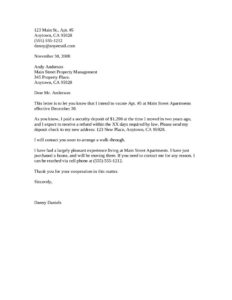
Intent To Vacate Apartment
Download a free Intent to Vacate Apartment letter template in PDF and DOCX to notify your landlord, request your deposit, and move out the right way.
DOCX
2 downloads
0
likes
Download Files
- DOCX
An Intent to Vacate Apartment letter is a written notice you give your landlord or property manager to formally announce that you plan to move out of your rental and end your tenancy. People most often use it to satisfy the notice period in their lease and to put their move-out date and deposit refund request in writing. You can download this Intent to Vacate Apartment template free in both PDF and DOCX, with no signup required.
What Is an Intent to Vacate Apartment Letter?
An Intent to Vacate Apartment letter is a dated, signed notice from a tenant to a landlord or property management company stating that the tenant will leave the rental unit on a specific date. It documents that you provided proper notice, identifies the apartment in question, and typically reminds the landlord of the security deposit that should be returned. Unlike a casual phone call or text, the letter creates a paper trail that protects both parties. It is commonly required by month-to-month agreements and fixed-term leases that ask for advance written notice — often 30 or 60 days — before the tenancy ends.
When Do You Need an Intent to Vacate Apartment Letter?
This letter comes into play whenever you are ending a rental arrangement and want it documented. Common situations include:
- Moving at the end of a lease term — confirming you will not renew and will surrender the unit on the final day.
- Ending a month-to-month tenancy — giving the required notice (frequently 30 days) before vacating.
- Buying a home, as in the sample letter, where you are transitioning from renting to ownership.
- Relocating for a job or moving to a different city and needing a clean exit from your current apartment.
- Upgrading or downsizing to a different unit and wanting to formally close out the old lease.
- Requesting your security deposit back and providing a forwarding address so the refund check reaches you.
What an Intent to Vacate Letter Should Have
A complete notice is short but specific. It should include your current address and unit number, the date you are writing, and the name and address of the landlord or property manager. The body must clearly state the effective move-out date and reference the lease notice requirement. If you paid a security deposit, name the amount and request its return within the timeframe required by law. Provide a forwarding address for the refund check and a phone number or email where you can be reached. Finally, sign and date the letter so there is no question about when notice was given.
How to Fill Out an Intent to Vacate Apartment Letter
- Add your contact block. At the top, list your current street address and apartment number (e.g., 123 Main St., Apt. #5), city, state, ZIP, phone number, and email.
- Date the letter. Enter the date you are sending it — this starts the clock on your notice period.
- Address the recipient. Write the landlord or manager’s name (e.g., Andy Anderson), the company name (Main Street Property Management), and their full mailing address.
- State your intent. Open with a sentence confirming you intend to vacate your specific unit and the effective move-out date (e.g., December 30).
- Reference your deposit. Note the security deposit amount you paid (e.g., $1,200) and request a refund within the number of days required by law in your area.
- Give a forwarding address. Provide the new address where the deposit check should be mailed.
- Offer a walk-through. Mention that you will arrange a move-out inspection and provide a cell number for contact.
- Sign off. Close with “Sincerely,” then your signature and printed name.
How to Deliver the Notice Properly
Sending the letter the right way matters as much as writing it. Check your lease for how notice must be delivered — some require certified mail, others accept email or hand delivery. Whatever method you choose, keep proof: a certified mail receipt, a saved email, or a dated copy signed by the office. Send the letter so it arrives with the full required notice period intact; counting backward from your intended move-out date helps you avoid being a few days short. Keep a copy of everything for your own records in case a dispute arises about timing or the deposit.
Protecting Your Security Deposit
One of the most valuable functions of this letter is setting up the return of your deposit. State the original deposit amount and ask for it back within the legally required window, which varies by state — many fall in the range of 14 to 30 days after move-out. Offering to schedule a walk-through inspection lets you document the unit’s condition together with the landlord, reducing disagreements over damage. Take dated photos of the cleaned, empty apartment before you hand over the keys, and always provide a forwarding address so the refund check has somewhere to go.
Common Mistakes to Avoid
- Giving too little notice — failing to meet the 30- or 60-day requirement in your lease can cost you extra rent.
- Leaving out the move-out date, which makes the notice ambiguous and hard to enforce.
- Forgetting your forwarding address, so the deposit check has nowhere to be sent.
- Not keeping a copy or proof of delivery if a timing dispute comes up later.
- Skipping the walk-through, which is your chance to dispute unfair deduction claims in person.
- Forgetting to sign and date the letter, which weakens its value as formal notice.
Frequently Asked Questions
What is an Intent to Vacate Apartment letter? It is a written notice from a tenant to a landlord stating the intention to move out on a specific date. It satisfies lease notice requirements and creates a record of when you gave notice. The letter also typically requests the return of your security deposit.
How much notice do I have to give before vacating? Most leases require 30 or 60 days’ written notice, but the exact amount depends on your lease and local law. Always read your rental agreement and count the days backward from your planned move-out date. When in doubt, give more notice rather than less.
Does an Intent to Vacate letter need to be notarized? No, this type of letter does not require notarization or witnesses. A clear, dated, signed notice delivered according to your lease is sufficient. Keeping proof of delivery is more important than any formal signing ceremony.
Will this letter guarantee I get my deposit back? The letter requests your deposit and provides a forwarding address, but the actual return depends on the unit’s condition and your local laws. Document the apartment with photos and request a walk-through to support your claim. Landlords may deduct for damage beyond normal wear and tear.
How do I deliver the notice to my landlord? Follow the delivery method specified in your lease, which may be certified mail, email, or hand delivery. Always keep proof, such as a mail receipt or saved email, and a copy of the letter. This protects you if there is later a dispute over timing.
Is this template free to download? Yes, this Intent to Vacate Apartment template is completely free to download in PDF and DOCX formats with no signup required. You can edit the DOCX version to fit your address, dates, and deposit details. Simply customize it, sign it, and deliver it to your landlord.
This template is a general example provided for informational purposes only and is not legal advice. Landlord-tenant rules, notice periods, and deposit return timelines vary by state and locality. Consult a qualified attorney or your local housing authority for guidance specific to your situation.
Official resource: for the rules that apply to your situation, see HUD.
Related Forms
- Apartment Hunting Checklist
- Covid Tenant Rent Extension Request
- Property Management Agreement
- Tenant Lease Renewal Letter
- Lease Extension Approval
- Lease Extension Rejection
Browse more in Rental and Real Estate.