
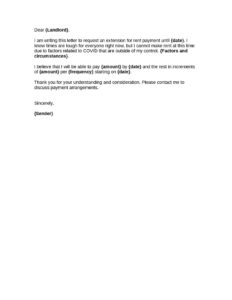
Covid Tenant Rent Extension Request
Use a free Covid Tenant Rent Extension Request template to formally ask your landlord for more time to pay rent — easy PDF and DOCX free download.
DOCX
0
likes
Download Files
- DOCX
A Covid Tenant Rent Extension Request is a written letter a renter sends to a landlord or property manager asking for additional time to pay rent due to financial hardship connected to the COVID-19 pandemic. People most often use it when illness, job loss, reduced hours, or business closures have made it temporarily impossible to pay rent in full and on time. You can download this template free in both PDF and DOCX formats — no signup required.
What Is a Covid Tenant Rent Extension Request?
A Covid Tenant Rent Extension Request is a formal communication from a tenant to a landlord that documents a request for a delayed payment deadline or a temporary payment arrangement during pandemic-related hardship. It is typically issued by the renter and addressed to the landlord, property management company, or leasing office. The letter records who is asking, which property and lease it concerns, the reason for the hardship, the amount owed, and the proposed new timeline for payment. Although it is not a court order or an automatic right, it creates a clear paper trail showing the tenant acted in good faith and communicated openly. That written record can be valuable if a dispute, eviction filing, or negotiation arises later.
When Do You Need a Covid Tenant Rent Extension Request?
This letter is useful any time a renter needs to formally ask for breathing room rather than simply paying late without explanation. Common situations include:
- You lost your job or had your hours cut because of pandemic-related business slowdowns or closures.
- You or a household member became ill with COVID-19 and faced medical bills or missed income during recovery.
- You were waiting on unemployment benefits, stimulus payments, or rental assistance funds that had not yet arrived.
- Your small business or self-employment income dropped sharply, leaving you short for one or more months of rent.
- You needed to stay home to care for children or family members during school or facility closures.
- You want to propose a structured repayment plan for back rent instead of paying a large lump sum all at once.
In each case, sending a clear, dated request is far stronger than an informal text message or a verbal conversation that no one wrote down.
What a Covid Tenant Rent Extension Request Should Have
A complete and persuasive request includes several core elements. Start with the date and your full name and contact information, followed by the landlord’s or property manager’s name and address. Identify the rental property by its full address and reference the lease agreement. State the rent amount due and the month or months affected. Explain the specific COVID-19 hardship briefly and honestly. Then make a concrete proposal — a new payment date or a repayment schedule — so the landlord knows exactly what you are asking for. Close with a respectful request for a written reply and your signature. Keeping the tone cooperative and the facts specific makes the landlord far more likely to agree.
How to Fill Out a Covid Tenant Rent Extension Request
- Date the letter. Add the date you are sending it; this anchors your timeline and shows you communicated before the rent went seriously past due.
- Add your details. Write your full legal name, the rental unit address, and your phone number and email so the landlord can respond quickly.
- Address the recipient. Enter the landlord’s or property manager’s name and mailing address exactly as they appear on your lease.
- Identify the property and lease. Reference the rental address and your lease so there is no confusion about which tenancy is involved.
- State the amount and period. List the monthly rent owed and the specific month(s) you need more time to cover.
- Explain the hardship. Describe your COVID-19-related circumstances in a sentence or two — job loss, illness, reduced income, or delayed assistance.
- Propose your plan. Specify the new payment date you are requesting or outline a repayment schedule with amounts and dates.
- Request a reply and sign. Ask for written confirmation, thank the landlord, and sign and print your name.
Documenting Your Hardship and Following Up
While this letter does not require attachments, supporting your request with documentation strengthens it considerably. Keep copies of layoff or furlough notices, reduced-hours statements, medical records, or proof that you applied for unemployment or rental assistance. Send the request in a way you can prove — certified mail, email with a read receipt, or your property’s tenant portal — and save a copy for your own records. If the landlord agrees, ask them to confirm the new arrangement in writing, ideally as a signed payment agreement or a short addendum to your lease. A verbal “yes” is easy to forget or dispute later, so written confirmation protects both sides and prevents misunderstandings about what was promised.
How This Differs From a Lease Amendment or Eviction Defense
It is worth understanding what this request is and is not. A Covid Tenant Rent Extension Request is the opening move — it asks for a delay or a plan. It does not by itself change your lease, forgive any rent, or stop an eviction. If the landlord agrees, the resulting deal should be captured in a separate written agreement. Pandemic-related tenant protections, moratoriums, and assistance programs have varied widely by state, county, and city and have changed over time, so this letter does not replace knowing your local rights. Many areas also offer rental assistance funds and free housing counseling that can help you pay what you owe.
Common Mistakes to Avoid
- Waiting until rent is badly overdue before reaching out — send the letter early, ideally before the due date.
- Being vague about the hardship or the amount instead of giving specific months, figures, and reasons.
- Failing to propose a concrete new date or repayment plan, which leaves the landlord guessing.
- Relying on a phone call or text and never putting the request in writing.
- Forgetting to keep a copy of the letter and proof that you sent it.
- Assuming the request automatically protects you from eviction or cancels the rent you owe — it does neither.
Frequently Asked Questions
What is a Covid Tenant Rent Extension Request? It is a written letter in which a tenant asks a landlord for extra time to pay rent because of a COVID-19-related financial hardship. It documents the amount owed, the reason for the delay, and a proposed new payment timeline. It serves as a good-faith record of your communication.
How do I fill it out? Add the date, your name and contact details, and the landlord’s information, then identify your rental address and lease. State the rent amount and the months affected, briefly explain your hardship, propose a new payment date or repayment plan, and sign it. Keep the tone respectful and the details specific.
Does this letter need to be notarized or witnessed? No. A rent extension request is a letter, not a sworn legal document, so it generally does not require notarization or witnesses. What matters most is that it is dated, signed, and sent in a way you can prove, such as certified mail or email.
Is the landlord required to grant my request? Not automatically. The landlord can accept, negotiate, or decline your proposal unless a specific local law or program requires otherwise. Sending the request shows good faith and opens the door to a workable arrangement, but any approved plan should be confirmed in writing.
Does sending this letter stop an eviction? Sending the letter does not by itself halt an eviction or cancel the rent you owe. Protections vary by jurisdiction and have changed over time, so check your local rules and consider contacting a housing counselor or legal aid office if you are facing eviction.
How much does this template cost? Nothing — this Covid Tenant Rent Extension Request template is completely free to download in PDF and DOCX, with no signup required. You can edit it to match your situation and reuse it as needed.
This template is a general example provided for informational purposes only and is not legal, financial, or tax advice. Tenant rights, pandemic-related protections, and rental assistance programs vary by state and locality and change over time. Consult a qualified attorney, housing counselor, or your local housing authority for guidance on your specific situation.
Official resource: for the rules that apply to your situation, see HUD.
Related Forms
- Property Management Agreement
- Lease Extension Rejection
- Real Estate Listing Tracker
- Open House Sign In Sheet
- Tenant Lease Renewal Letter
- Inspection Checklist
Browse more in Rental and Real Estate.