
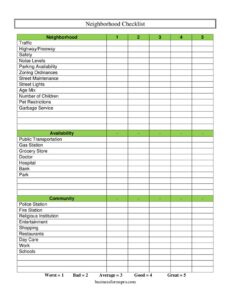
Neighborhood Checklist
Use our free Neighborhood Checklist template to evaluate safety, noise, amenities, and commute before buying or renting — free download in PDF and DOCX.
PDF
DOCX
1 downloads
0
likes
Download Files
- DOCX
A Neighborhood Checklist is a simple evaluation tool that helps you rate and compare the area around a home before you buy or rent. The most common reason people use one is to avoid surprises — uncovering noise, traffic, safety, or amenity issues that a quick showing never reveals. It’s free to download here in both PDF and DOCX, with no signup required.
What Is a Neighborhood Checklist?
A Neighborhood Checklist is a structured worksheet that prospective renters and buyers use to score the surroundings of a property rather than the property itself. It is typically filled out by the person considering the move, sometimes alongside a real estate agent or family members. The document captures observations about safety, noise, traffic, parking, zoning, nearby services, and the local community. Because emotions run high when you fall for a house, this checklist keeps your assessment objective and consistent. By recording the same factors for every place you visit, you create an apples-to-apples comparison that makes a confident decision far easier when you have several candidates competing for your attention.
When Do You Need a Neighborhood Checklist?
This worksheet earns its keep any time the location matters as much as the four walls. Common situations include:
- House hunting in an unfamiliar city — when you don’t know which streets are quiet and which back onto a busy highway or freeway.
- Comparing several rentals or homes — touring three or four properties in a weekend and needing a way to remember which had better parking, street lights, or garbage service.
- Relocating for work — verifying commute times to your job and the proximity of schools, day care, and a grocery store.
- Buying your first home — checking zoning ordinances, pet restrictions, and street maintenance before committing to a long-term mortgage.
- Moving with children or pets — confirming the age mix, number of children nearby, parks, and pet rules suit your family.
- Downsizing or retiring — prioritizing access to a doctor, hospital, bank, and a walkable community over square footage.
What a Neighborhood Checklist Should Have
A complete checklist groups the surrounding factors into categories you can score quickly. The strongest versions cover three buckets: environmental conditions (traffic, noise levels, safety, street lights, street maintenance), community and rules (zoning ordinances, pet restrictions, age mix, number of children, garbage service), and nearby amenities (grocery store, doctor, hospital, bank, park, schools, work, and entertainment). Leaving space for a rating — such as good, fair, or poor — beside each item lets you total the results across properties. A notes column for specifics, like “freeway noise audible at night” or “no on-street parking after 6 p.m.,” turns vague impressions into useful data you can revisit later.
How to Fill Out a Neighborhood Checklist
Walk through the form field by field while you are physically in the area, ideally at different times of day:
- Write the Neighborhood name or street address at the top so each sheet is clearly identified.
- Assess Traffic and proximity to a Highway/Freeway — note congestion and whether ramps are nearby.
- Rate Safety and observe Noise Levels from roads, trains, or nightlife.
- Check Parking Availability, Zoning Ordinances, Street Maintenance, and whether Street Lights are present and working.
- Note the Age Mix, Number of Children, and any Pet Restrictions that affect your household.
- Confirm services: Garbage Service, nearest Gas Station, Grocery Store, Bank, Doctor, and Hospital.
- Record community resources — Park, Community feel, Police Station, Fire Station, and Religious Institution.
- Finally, score lifestyle and logistics: Entertainment, Shopping, Restaurants, Day Care, distance to Work, and quality of nearby Schools.
How to Get the Most Reliable Results
The single biggest improvement you can make is to visit the same neighborhood more than once. A street that feels peaceful at 11 a.m. on a Tuesday can be very different during the Friday evening commute or a weekend block party. Drive through after dark to test how well the street lights perform and how safe you feel. Time your actual drive to work during rush hour rather than relying on a midday estimate. Where possible, talk to a resident or two — they will tell you about garbage service reliability, parking enforcement, and noise long before any listing does. Bring a separate copy of the checklist for each candidate property so your comparisons stay clean and honest.
Pairing the Checklist With Your Search
This worksheet complements, rather than replaces, the documents you’ll handle inside the home. Use it alongside a property condition checklist or a rental application so that you evaluate both the dwelling and its surroundings. For buyers, the zoning ordinances and street maintenance notes can prompt smart follow-up questions for your agent or the municipality. For renters, the pet restrictions and parking observations help you confirm details before signing a lease. Treating the neighborhood as part of the property — not an afterthought — protects you from the costly regret of loving a house in a location that doesn’t fit your daily life, your family, or your commute.
Common Mistakes to Avoid
- Visiting only once, at one time of day — you miss rush-hour traffic, weekend noise, and how the area feels after dark.
- Trusting the listing instead of observing — verify amenities like the nearest grocery store, hospital, and schools yourself.
- Ignoring zoning ordinances and pet restrictions — these can block a home business, a fence, or your dog.
- Forgetting to time the commute to work — a short distance on a map can be a long drive in reality.
- Skipping the notes column — ratings alone fade from memory; specifics keep the comparison meaningful.
- Not using a fresh sheet per property — mixing observations leads to confusion when you finally choose.
Frequently Asked Questions
What is a Neighborhood Checklist used for? It is used to evaluate and compare the area surrounding a home — covering safety, noise, traffic, amenities, and community — before you rent or buy. The goal is to make a location decision based on consistent observations instead of first impressions. It is especially useful when comparing several properties.
How do I fill out a Neighborhood Checklist? Visit the area in person, write the neighborhood name at the top, and work through each field — traffic, safety, noise, parking, amenities, and schools — rating each one. Add notes about anything specific you observe. Use a separate copy for every property you consider.
Is a Neighborhood Checklist a legal document? No. It is a personal evaluation and planning tool, not a contract or binding agreement. Nothing on it obligates you or the seller, so you can be completely candid in your ratings and notes.
How much does this Neighborhood Checklist cost? It is completely free to download from Business Forms Pro in both PDF and DOCX formats, with no signup or payment required. You can print copies or edit the DOCX version to add factors that matter to you.
When is the best time to use it? Use it during property tours and, ideally, on repeat visits at different times of day. Checking the area in the evening and during rush hour reveals noise, lighting, and traffic patterns a single daytime showing won’t.
Can I customize the checklist for my needs? Yes. Download the DOCX version to add, remove, or reorder items — for example, public transit stops, walkability, or proximity to family — so the checklist reflects your personal priorities. A rating column and notes field make it easy to total scores across homes.
This Neighborhood Checklist template is a general example provided for informational purposes only and is not legal, financial, or real estate advice. Zoning rules, local ordinances, and disclosure requirements vary by jurisdiction — consult a qualified real estate professional or your local authorities before making a purchase or rental decision.
Official resource: for the rules that apply to your situation, see HUD.
Related Forms
- Open House Sign In Sheet
- Closed Sales Tracker
- Home Showing Tracker
- Property Management Agreement
- Real Estate Listing Tracker
- Apartment Hunting Checklist
Browse more in Rental and Real Estate.