
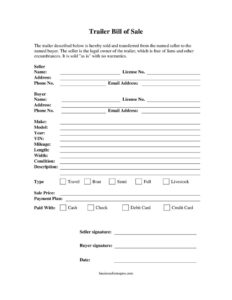
Trailer Bill Of Sale
Download a free Trailer Bill of Sale template in PDF and DOCX to document the legal sale and transfer of any trailer between a seller and buyer.
PDF
DOCX
4 downloads
0
likes
Download Files
- DOCX
A Trailer Bill of Sale is a written document that records the sale and transfer of a trailer from a seller to a buyer, capturing the price, condition, and full description of the unit. People most often use it to create proof of ownership when buying or selling a trailer privately and to support title transfer and registration. You can download this Trailer Bill of Sale free in PDF and DOCX formats, with no signup required.
What Is a Trailer Bill of Sale?
A Trailer Bill of Sale is a legal record showing that a specific trailer has been sold and transferred from one party to another for an agreed amount. It is typically created and signed by the seller, who confirms they are the legal owner and that the trailer is free of liens and other encumbrances. The document identifies the trailer by make, model, year, VIN, and dimensions, states the sale price, notes how payment was made, and confirms the sale is made “as is” with no warranties. Both buyer and seller keep a signed copy as evidence of the transaction. It is commonly required by motor vehicle agencies when registering or titling a newly purchased trailer.
When Do You Need a Trailer Bill of Sale?
This form is useful whenever ownership of a trailer changes hands. Common situations include:
- Selling or buying a utility, cargo, or flatbed trailer between private parties.
- Transferring a boat trailer, travel trailer, or livestock trailer along with or separately from its cargo.
- Registering a recently purchased trailer at the DMV, which may require proof of purchase.
- Documenting the agreed sale price for tax or sales-tax purposes.
- Selling a semi or commercial trailer and recording an “as is” condition to limit future disputes.
- Providing a paper trail when a trailer is sold under a payment plan rather than paid in full upfront.
Types of Trailers This Form Covers
One Trailer Bill of Sale works across many trailer categories because the template lets you specify the Type. You can use it for boat trailers, livestock trailers, travel trailers, semi or commercial trailers, and general utility or cargo haulers. Whatever the style, the key identifying details — make, model, year, VIN, length, and width — remain the same, which is why a single, well-completed form serves nearly every private trailer sale.
What a Trailer Bill of Sale Should Have
A complete Trailer Bill of Sale should clearly identify both parties, describe the trailer in enough detail to distinguish it from any other, and state the financial terms. The essential elements include the seller’s and buyer’s names and contact information, a full description of the trailer (make, model, year, VIN, type, and dimensions), the sale price, the payment method, the condition and “as is” language, the date of sale, and the signatures of both parties. The seller’s statement that they are the legal owner and that the trailer is free of liens is what gives the document its weight as proof of clean transfer.
How to Fill Out a Trailer Bill of Sale
- Enter the Date of the sale at the top of the form.
- Fill in the Seller Name and the Buyer Name exactly as they appear on official identification.
- Add contact details — the Address, Phone No., and Email Address — so both parties can be reached if questions arise.
- Describe the trailer: select the Type (such as Boat, Livestock, Travel, or Semi) and record the Make, Model, Year, and VIN.
- Note physical details, including Length, Width, Mileage (if applicable), License No., and a written Description and Condition.
- Enter the Sale Price and indicate how it was Paid With — Cash, Check, Credit Card, Debit Card — and whether the amount was paid in Full or under a Payment Plan.
- Both parties review the “as is” terms, then add the Seller Signature and Buyer Signature to finalize the transfer.
Title Transfer and Registration Notes
A Trailer Bill of Sale is proof that a transaction occurred, but on its own it does not always transfer legal title. In most jurisdictions, you will also need to sign over the trailer’s title certificate (if one is issued) and submit registration paperwork to your local motor vehicle agency. Some states issue titles only for trailers above a certain weight, so smaller utility trailers may register on the strength of the bill of sale alone. Requirements vary by state, so check with your local DMV before completing the sale.
Tips for Sellers and Buyers
Sellers should confirm the VIN on the document matches the VIN stamped on the trailer frame, and should keep a signed copy in case of later disputes. Buyers should inspect the trailer thoroughly before signing, because the “as is” clause means the seller makes no warranties about condition or future performance. Filling in the Condition and Description fields honestly and in detail protects both parties by setting clear expectations at the moment of sale.
Common Mistakes to Avoid
- Leaving the VIN blank or copying it incorrectly, which can stall registration.
- Forgetting to record the Sale Price, which is often needed to calculate sales tax.
- Not specifying whether payment was made in Full or under a Payment Plan.
- Skipping the Seller Signature or Buyer Signature, leaving the document unenforceable.
- Omitting the Type and dimensions, making it hard to identify the exact trailer sold.
- Failing to give both parties a signed copy for their records.
Frequently Asked Questions
What is a Trailer Bill of Sale? It is a document that records the sale of a trailer from a seller to a buyer, describing the unit and stating the price and terms. It serves as proof of ownership transfer and is often used when registering the trailer. Both parties keep a signed copy.
How do I fill out a Trailer Bill of Sale? Enter the sale date, the names and contact details of both parties, and a full description of the trailer including make, model, year, VIN, type, and dimensions. Add the sale price and payment method, then have both the seller and buyer sign. Our free template guides you field by field.
Does a Trailer Bill of Sale need to be notarized? Most states do not require notarization for a trailer bill of sale, but a notary’s stamp can add an extra layer of verification. Some jurisdictions or higher-value sales may call for it. Check your local DMV or motor vehicle agency requirements before finalizing.
Is a Trailer Bill of Sale legally binding? Yes, once both the seller and buyer sign, it generally becomes a binding record of the transaction. The “as is” language means the trailer is sold without warranties unless stated otherwise. Keeping a signed copy protects both parties if a dispute arises.
Do I need a Trailer Bill of Sale to register a trailer? Many motor vehicle agencies request a bill of sale to register or title a newly purchased trailer, especially for private sales. For smaller utility trailers, it may be the primary proof of purchase. Requirements differ by state, so confirm what your local office needs.
How much does this Trailer Bill of Sale template cost? Nothing — this template is completely free to download in PDF and DOCX formats. There is no signup, subscription, or payment required. You can fill it out digitally or print it and complete it by hand.
This Trailer Bill of Sale template is a general example provided for informational purposes only and is not legal, financial, or tax advice. Requirements for trailer sales, titling, and registration vary by jurisdiction. Consult a qualified professional or your local motor vehicle agency to ensure your document meets applicable rules.
Official resource: for the rules that apply to your situation, see your state DMV.
Related Forms
- Sports Memorabilia Bill Of Sale
- Bill of Sale for Parts Only
- Golf Cart Bill Of Sale
- Firewood Bill Of Sale
- Business Bill of Sale
- Antique Bill of Sale
Browse more in Bills of Sale.