
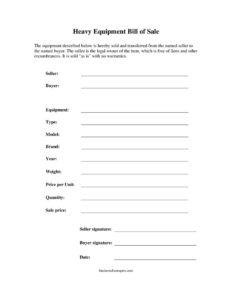
Heavy Equipment Bill of Sale
Download a free Heavy Equipment Bill of Sale template in PDF or DOCX to document the sale and transfer of machinery quickly and clearly — free download.
PDF
DOCX
8 downloads
0
likes
Download Files
- DOCX
A Heavy Equipment Bill of Sale is a written record that confirms the sale and transfer of machinery — such as an excavator, loader, dozer, or generator — from a seller to a buyer. People most often use it to prove ownership has legally changed hands and to document the exact terms of an “as is” sale. You can download this template free in PDF or DOCX, with no signup required.
What Is a Heavy Equipment Bill of Sale?
A Heavy Equipment Bill of Sale is a transaction document that records the transfer of ownership of a piece of industrial or construction equipment from the named seller to the named buyer. It is typically created and signed by both parties at the time of the sale. The form identifies the equipment in detail, states the agreed price, and confirms that the seller is the legal owner and that the item is free of liens or other encumbrances. Because heavy machinery is often sold “as is” with no warranties, the document also serves to set expectations about condition. In short, it protects both sides by creating a clear paper trail of who sold what, to whom, and for how much.
When Do You Need a Heavy Equipment Bill of Sale?
This form is useful any time ownership of valuable machinery changes hands. Common situations include:
- Selling a used excavator, backhoe, skid steer, or loader to another contractor or business.
- Buying a tractor, forklift, or generator and needing proof of purchase for your records or insurance.
- Liquidating equipment when a construction or landscaping company closes or downsizes.
- Transferring machinery between related businesses, partners, or family-owned operations.
- Purchasing multiple identical units, where price per unit and quantity must be documented.
- Settling a private cash sale where neither party wants future disputes over condition or terms.
What a Heavy Equipment Bill of Sale Should Have
A complete bill of sale leaves no ambiguity about the transaction. The strongest versions include the full legal names of both the seller and buyer, a precise description of the equipment (type, brand, model, year, and weight), and any serial or identification numbers if available. It should clearly state the agreed sale price, and where applicable the price per unit and quantity. The document should declare that the seller is the rightful owner and that the equipment is free of liens. An “as is” statement clarifies that no warranties apply. Finally, the signatures of both parties and the date of sale make the record binding evidence of the agreement.
How to Fill Out a Heavy Equipment Bill of Sale
- Seller: Enter the full legal name and address of the person or business selling the equipment.
- Buyer: Enter the full legal name and address of the person or business purchasing it.
- Equipment: Describe the item being sold in plain terms, for example “hydraulic excavator” or “diesel generator.”
- Type: Note the category or class of machine, such as earthmoving, lifting, or power generation.
- Model: Record the manufacturer’s model designation as shown on the data plate.
- Brand: Enter the manufacturer or make, such as Caterpillar, John Deere, or Komatsu.
- Year: Add the model or manufacture year of the equipment.
- Weight: List the operating or shipping weight, useful for transport and identification.
- Price per Unit: Enter the agreed price for a single unit of the equipment.
- Quantity: Indicate how many units are being sold in this transaction.
- Sale price: State the total amount paid, which should equal price per unit multiplied by quantity.
- Signatures and Date: Both seller and buyer sign, and the date of the sale is recorded.
Types of Equipment Commonly Sold This Way
The same form works across a wide range of machinery because it relies on flexible description fields rather than fixed categories. Sellers use it for earthmoving equipment like excavators, bulldozers, and graders; material-handling machines such as forklifts and telehandlers; and power and pumping equipment like generators and compressors. It also fits attachments and implements sold separately, such as buckets, augers, and hydraulic hammers. By filling in the type, brand, model, year, and weight fields accurately, you can adapt the template to virtually any heavy or industrial item without needing a separate document for each category.
Understanding the “As Is” Clause
This template states that the equipment is sold “as is” with no warranties. That language means the buyer accepts the machine in its current condition, including any wear, defects, or mechanical issues, and the seller makes no promises about future performance. For buyers, this is a strong reminder to inspect the equipment thoroughly — or have a mechanic do so — before signing. For sellers, the clause helps limit liability after the sale is complete. Both parties benefit from being honest about known issues, since accurate descriptions reduce the chance of disputes. Some jurisdictions or financed sales may require additional disclosures, so check your local rules if the transaction is complex.
Common Mistakes to Avoid
- Leaving the equipment description vague — always include brand, model, year, and weight so the item is clearly identifiable.
- Forgetting to record the serial or VIN where one exists, which is the surest way to prove identity.
- Mismatched math, where the sale price does not equal price per unit times quantity.
- Skipping the lien and ownership statement, leaving the buyer exposed to third-party claims.
- Failing to date the document or collect both signatures, which weakens its value as proof.
- Not keeping copies — each party should retain a signed original for records, taxes, and insurance.
Frequently Asked Questions
What is a Heavy Equipment Bill of Sale used for? It documents the sale and transfer of machinery from a seller to a buyer, recording the equipment details, price, and the date ownership changed hands. It serves as proof of purchase for the buyer and proof of sale for the seller. It is commonly used for insurance, tax records, and resolving any later disputes.
Does a Heavy Equipment Bill of Sale need to be notarized? Notarization is not always required, but it can add an extra layer of authenticity and is sometimes requested for high-value transactions. Requirements vary by state and by the type of equipment, so check your local rules. Even when not required, having the signatures witnessed or notarized can strengthen the document if questions arise later.
Is this bill of sale legally binding? Once both the seller and buyer sign and date the form, it generally becomes a binding record of the agreed transaction. To hold up well, it should accurately describe the equipment, state the sale price, and confirm the seller’s ownership. Keeping a signed copy is essential to enforcing or proving the terms.
What does “sold as is” mean on this form? It means the buyer is purchasing the equipment in its present condition with no warranties from the seller. The seller is not promising the machine will perform a certain way or be free of defects after the sale. Buyers should inspect carefully before signing because they accept the equipment’s condition once the deal is done.
Can I use this form to sell multiple machines at once? Yes. The form includes price per unit, quantity, and total sale price fields, which let you document a sale of several identical units in one place. For mixed equipment of different types, it is often clearer to list each item separately or use additional copies.
How much does this template cost? This Heavy Equipment Bill of Sale template is completely free to download from Business Forms Pro in both PDF and DOCX formats. There is no signup, subscription, or hidden fee required. You can edit the DOCX version to fit your specific transaction before printing and signing.
This template is a general example provided for informational purposes only and is not legal, financial, or tax advice. Requirements for documenting equipment sales vary by jurisdiction and circumstance. Consult a qualified professional to ensure your bill of sale meets all applicable requirements.
Official resource: for the rules that apply to your situation, see your state DMV.
Related Forms
- Trailer Bill Of Sale
- Collateral Receipt
- Snowmobile Bill Of Sale
- Firewood Bill Of Sale
- Dog Bill of Sale
- Canoe Or Kayak Bill Of Sale
Browse more in Bills of Sale.