
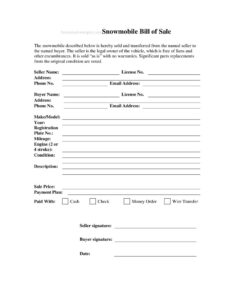
Snowmobile Bill Of Sale
Download a free Snowmobile Bill of Sale template to record the sale of a snowmobile, protect buyer and seller, and simplify registration — free download.
PDF
DOCX
2 downloads
0
likes
Download Files
- DOCX
A Snowmobile Bill of Sale is a written record that documents the sale and transfer of ownership of a snowmobile from a seller to a buyer. People most often use it to prove a legal change of ownership for registration, titling, and insurance purposes. You can download this template free in both PDF and DOCX formats, with no signup required.
What Is a Snowmobile Bill of Sale?
A Snowmobile Bill of Sale is a simple legal document that confirms one party sold a snowmobile and another party bought it for an agreed price on a specific date. It is typically created and signed by both the seller and the buyer at the time of the transaction. The form documents the machine being sold, the amount paid, the condition of the sale, and the identities of everyone involved. For the seller, it provides proof that ownership and responsibility for the snowmobile passed to the buyer. For the buyer, it serves as a receipt and a key piece of paperwork when registering the snowmobile with a state agency or department of natural resources.
When Do You Need a Snowmobile Bill of Sale?
This document is useful any time a snowmobile changes hands, especially in private transactions where no dealership paperwork exists. Common situations include:
- Selling a used snowmobile to a private buyer and wanting a paper trail of the sale price and date.
- Buying a snowmobile from a private seller and needing proof of purchase to register it.
- Transferring a snowmobile between family members or friends, even at a reduced price or as a gift.
- Trading in or trading sleds with another rider and documenting any cash difference paid.
- Selling a snowmobile “as-is” and wanting written confirmation that no warranties were promised.
- Settling an estate or dividing property where ownership of a snowmobile must be formally recorded.
What a Snowmobile Bill of Sale Should Have
A complete and useful bill of sale should clearly identify the people, the machine, and the terms of the deal. At minimum it should include the full names and addresses of both the buyer and seller, the sale date, and the purchase price. It should describe the snowmobile in detail — the make, model, year, vehicle identification number (VIN), engine or serial number, and color. It should state the payment method and whether the sale is “as-is” or includes any guarantees. Finally, it should provide signature lines for both parties, and space for witnesses or a notary if your state requires them. Including odometer or hour-meter readings, if available, adds clarity.
How to Fill Out a Snowmobile Bill of Sale
Follow these steps to complete the form accurately:
- Enter the date of sale. Write the exact day the transaction takes place, since this establishes when ownership transferred.
- Identify the seller. Fill in the seller’s full legal name and current mailing address.
- Identify the buyer. Add the buyer’s full legal name and address so both parties are clearly named.
- Describe the snowmobile. Record the make, model, model year, color, VIN, and engine or serial number. Copy these directly from the machine and any existing title or registration to avoid errors.
- State the purchase price. Enter the agreed amount in numbers and, where space allows, in words. Note if the snowmobile is a gift or sold for nominal value.
- Specify payment details. Indicate how payment was made — cash, check, or money order — and whether it was paid in full.
- Add sale conditions. Mark whether the snowmobile is sold “as-is” with no warranty, which is standard for private sales.
- Sign and date. Both buyer and seller sign and print their names. Add witness or notary signatures if your state requires them, then give each party a copy.
As-Is Sales and Why They Matter
Most private snowmobile sales are conducted “as-is,” meaning the buyer accepts the machine in its current condition with all faults, and the seller makes no promises about future performance. Including a clear as-is clause protects the seller from later claims that the snowmobile broke down or had hidden problems. Buyers should treat an as-is purchase as a signal to inspect the sled thoroughly before paying — check the track, skis, suspension, belt, and starting condition, and ask to hear the engine run. If the seller does make any specific promise, write it directly into the document so both parties share the same understanding.
Registration, Titling, and Next Steps
After the sale, the buyer usually needs to register the snowmobile with the appropriate state agency, often the department of motor vehicles, department of natural resources, or a parks and recreation office. The bill of sale typically supports this process alongside any existing title or prior registration. Rules vary widely: some states title snowmobiles like cars, while others only require registration and a decal. The seller should keep their copy in case questions arise about liability after the sale date, and should notify their insurance company that they no longer own the machine. The buyer should arrange insurance and complete registration promptly before riding on public trails.
Common Mistakes to Avoid
- Leaving the VIN or serial number blank — this is the single most important detail for proving which machine was sold.
- Forgetting to record the exact sale date, which determines when liability transfers.
- Not specifying “as-is,” leaving the seller exposed to later complaints about condition.
- Failing to make two copies so both buyer and seller keep a signed original.
- Writing an unclear or rounded price when the actual amount paid differs.
- Skipping notarization or witnesses when the buyer’s state requires them for registration.
Frequently Asked Questions
What is a Snowmobile Bill of Sale used for? It is used to document the sale and transfer of ownership of a snowmobile between a seller and a buyer. It serves as a receipt for the buyer and proof of transfer for the seller, and it is commonly needed to register or title the machine with a state agency.
Does a Snowmobile Bill of Sale need to be notarized? Notarization is not required in every state, but some jurisdictions ask for a notarized or witnessed bill of sale before they will register the snowmobile. Check your local registration office’s requirements, and if there is any doubt, having the document notarized is a safe choice.
Is a Snowmobile Bill of Sale legally binding? Yes. Once both the buyer and seller sign it voluntarily and the document accurately reflects the agreed terms, it is generally a legally binding record of the transaction. Keeping a signed copy protects both parties if a dispute arises later.
How much does this template cost? Nothing — this Snowmobile Bill of Sale template is free to download here in both PDF and DOCX formats, with no signup or payment required. You can edit the DOCX version in your word processor or print the PDF to fill out by hand.
Can I sell a snowmobile without a title? In many states snowmobiles are registered rather than titled, so a title may not exist. A completed bill of sale, along with any prior registration documents, is often enough to prove ownership, but you should confirm what your state requires before completing the sale.
Do both the buyer and seller need a copy? Yes. Each party should keep a signed copy of the bill of sale. The buyer needs it for registration and insurance, and the seller needs it as proof that ownership and liability transferred on the sale date.
This Snowmobile Bill of Sale template is provided as a general example for informational purposes only and is not legal, financial, or tax advice. Registration and ownership transfer requirements vary by state and jurisdiction, so consult your local agency or a qualified professional before relying on this document.
Official resource: for the rules that apply to your situation, see your state DMV.
Related Forms
- Bill of Sale Vehicle Parts
- Bike Bill of Sale
- Collateral Receipt
- Business Bill of Sale
- Antique Bill of Sale
- Boat Bill of Sale
Browse more in Bills of Sale.