
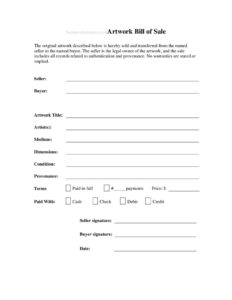
Artwork Bill Of Sale
Download a free Artwork Bill of Sale template in PDF or DOCX to document the sale of paintings, sculptures, or art and transfer ownership clearly.
PDF
DOCX
3 downloads
0
likes
Download Files
- DOCX
An Artwork Bill of Sale is a written record that documents the sale and transfer of a piece of art from a seller to a buyer. People most often use it to prove ownership of a painting, sculpture, print, or other original work after a private sale. You can download this Artwork Bill of Sale free in PDF or DOCX, with no signup required.
What Is an Artwork Bill of Sale?
An Artwork Bill of Sale is a legal document that records the details of a transaction involving a work of art and confirms that ownership has passed from one party to another. It is typically created by the seller and signed by both the seller and the buyer at the time of sale. The form documents who sold the piece, who bought it, what the artwork is, how much was paid, and the date of the exchange. Artists, galleries, collectors, estate administrators, and private individuals all use it. Beyond proving ownership, it helps establish provenance — the documented history of an artwork — which can significantly affect a piece’s value and authenticity over time.
When Do You Need an Artwork Bill of Sale?
This form is useful any time a piece of art changes hands and both parties want a clear record. Common situations include:
- An artist selling an original painting or sculpture directly to a collector at a studio sale or art fair.
- A private collector selling a piece from their collection to another individual without going through an auction house.
- A gallery completing a sale and providing the buyer with documentation of the purchase and provenance.
- Settling an estate, where heirs or an executor sell or distribute artwork and need a record of each transfer.
- Selling a print, photograph, or limited-edition work where the edition number and authenticity matter to the buyer.
- Donating or gifting a work where the parties still want written confirmation of the transfer and condition.
Types of Artwork Sales It Covers
An Artwork Bill of Sale can be adapted to nearly any medium. It works for one-of-a-kind originals such as oil paintings, watercolors, and sculptures, as well as for reproducible works like signed prints, lithographs, and limited-edition photographs. It is equally suited to mixed-media pieces, ceramics, textile art, and digital works sold with a physical certificate. For high-value or collectible pieces, the same form can be paired with a certificate of authenticity and condition report to strengthen the provenance trail.
What an Artwork Bill of Sale Should Have
A complete Artwork Bill of Sale captures enough detail to identify the specific piece and the people involved. The core elements are:
- Full names and contact details of the seller and buyer.
- A clear description of the artwork — title, artist, medium, dimensions, year created, and any edition or serial number.
- The agreed purchase price and how payment was made.
- The date of the sale and the location of the transaction.
- A statement that the seller has the right to sell the work and is transferring ownership free of liens.
- Any warranties or an “as-is” clause describing the artwork’s condition.
- Signatures of both parties, and a notary or witness section if desired.
How to Fill Out an Artwork Bill of Sale
Work through the template from top to bottom, completing each field accurately:
- Date of sale: Enter the calendar date the transaction takes place.
- Seller information: Write the seller’s full legal name and address. If the seller is the artist, you may note that here.
- Buyer information: Add the buyer’s full legal name and contact details.
- Artwork description: Identify the piece precisely — title, artist name, medium (oil on canvas, bronze, giclée print, etc.), dimensions, year, and any edition or inventory number.
- Condition: Note the artwork’s current condition or state that it is sold “as-is.”
- Purchase price: Record the agreed amount in numbers and words, and indicate the payment method and whether any deposit applied.
- Provenance or authenticity: Reference any certificate of authenticity, prior ownership, or accompanying documents.
- Transfer statement: Confirm the seller owns the work and is transferring full ownership to the buyer.
- Signatures: Both parties sign and date, adding printed names and a notary or witness block if applicable.
Provenance, Authenticity, and Supporting Documents
Documentation is especially important in the art world because it underpins both authenticity and value. Attach or reference any certificate of authenticity, gallery records, exhibition history, or earlier bills of sale so the chain of ownership stays intact. Photographing the artwork — including the front, back, signature, and any labels — and attaching the images to your records gives the buyer a stronger provenance file. For valuable works, consider keeping a copy with a professional appraisal. A well-documented Artwork Bill of Sale protects the buyer if questions about origin arise later and protects the seller by showing the sale was made in good faith.
Notarization and Witnesses
Most artwork sales do not legally require notarization, and a signed bill of sale is generally valid on its own. However, for high-value pieces or transactions between parties who have never dealt with each other, having the signatures notarized or witnessed adds an extra layer of credibility and can help if the document is ever challenged. Requirements vary by location, so check your local rules if you are unsure.
Common Mistakes to Avoid
- Describing the artwork too vaguely — omitting the title, artist, medium, or edition number makes the piece hard to identify later.
- Forgetting to note the condition, which can lead to disputes if the buyer expected a different state.
- Leaving out the payment method or failing to confirm payment was received in full.
- Not including a statement that the seller actually owns the work and has the right to sell it.
- Skipping signatures, dates, or printed names from either party.
- Failing to keep a signed copy or attach the certificate of authenticity and photos to the record.
Frequently Asked Questions
What is an Artwork Bill of Sale used for? It documents the sale of a piece of art and proves that ownership has transferred from the seller to the buyer. It also serves as part of the artwork’s provenance, recording who owned the piece and when, which can matter for authenticity and future resale.
Is an Artwork Bill of Sale legally binding? Yes. Once both the seller and buyer sign it, the document generally becomes a binding record of the transaction. To be enforceable, it should accurately describe the artwork, state the agreed price, and be signed voluntarily by both parties.
Does an Artwork Bill of Sale need to be notarized? In most cases notarization is not required, and a signed form is valid on its own. For high-value works or added protection against disputes, you may choose to have the signatures notarized or witnessed. Requirements vary by jurisdiction.
How do I prove the artwork is authentic? Attach or reference a certificate of authenticity, prior bills of sale, gallery or exhibition records, and photographs of the piece including any signature or labels. The more documentation accompanies the sale, the stronger the provenance and the easier it is to verify authenticity later.
Can I sell artwork “as-is”? Yes. You can include an “as-is” clause stating the buyer accepts the work in its current condition without warranties. Be sure to describe any visible damage or restoration so both parties have a clear, honest record.
How much does this Artwork Bill of Sale template cost? Nothing — it is completely free to download here in both PDF and DOCX formats, with no signup or subscription. You can fill it out by hand after printing or edit the DOCX on your computer.
This Artwork Bill of Sale template is provided as a general example for informational purposes only and is not legal, financial, or tax advice. Requirements for documenting art sales and ownership transfers vary by jurisdiction. Consult a qualified professional for guidance on your specific situation.
Official resource: for the rules that apply to your situation, see your state DMV.
Related Forms
- Trailer Bill Of Sale
- Domain Name Bill Of Sale
- Snowmobile Bill Of Sale
- Firearm Bill Of Sale
- Dog Bill of Sale
- Mobile Home Bill Of Sale
Browse more in Bills of Sale.