
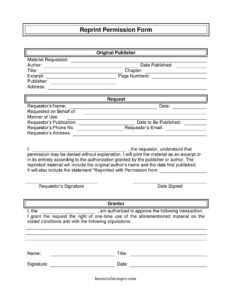
Reprint Permission Form
Use our free Reprint Permission Form template to request and grant rights to reprint published material — free PDF and DOCX download, no signup required.
PDF
DOCX
4 downloads
0
likes
Download Files
- DOCX
A Reprint Permission Form is a written request used to ask a publisher or author for the right to reproduce previously published material, and to record their formal authorization. People most often use it to legally republish an excerpt, chapter, or article in a new publication while crediting the original source. You can download this template free in PDF and DOCX formats, with no signup required.
What Is a Reprint Permission Form?
A Reprint Permission Form is a document that connects a requestor — someone who wants to reuse published content — with a grantor, typically the original publisher or author who controls the rights. It identifies the exact material being requested, describes how it will be used, and captures the grantor’s decision and any conditions attached to that approval. The form serves as a paper trail showing that reproduction was authorized rather than copied without permission. It is commonly used by authors, editors, educators, publishers, and content creators who need to include someone else’s work in a book, journal, course pack, anthology, newsletter, or website while respecting copyright and giving proper credit.
When Do You Need a Reprint Permission Form?
This form is useful any time you intend to reproduce material that you did not create and do not control the rights to. Common scenarios include:
- Including a chapter or excerpt from a published book in a new anthology or compilation.
- Reprinting a journal article, essay, or poem in a course reader or educational packet.
- Quoting a substantial passage in your own book and needing the original publisher’s sign-off.
- Republishing a previously printed piece on a website, blog, or in a corporate newsletter.
- Reproducing a figure, table, or illustration from another publication in your work.
- Documenting one-time use rights for a magazine, brochure, or marketing collateral.
Even when material seems freely available, copyright generally remains with the rights holder, so a documented permission protects you from disputes later.
What a Reprint Permission Form Should Have
A complete form clearly identifies both the source material and the intended new use. It should name the original publisher, the author, the work’s title, and the date published, along with the specific chapter, excerpt, or page numbers being requested. It should describe the manner of use and where the material will appear. Finally, it needs an acknowledgment from the requestor agreeing to the conditions, a signature line, and a grantor section where the publisher or author records their approval, any stipulations, and their own signature and date.
How to Fill Out a Reprint Permission Form
- Enter the Original Publisher and the Material Requested at the top to identify the source.
- List the Author, Date Published, and Title of the original work.
- Specify the exact portion: the Chapter, Excerpt, and Page Numbers you wish to reproduce.
- Record the rights-holding Publisher and their Address so the request reaches the right office.
- Write out your Request, then add the Requestor’s Name and the Date.
- Note who the request is Requested on Behalf of if you are acting for an organization.
- Describe the Manner of Use, your Requestor’s Publication, and the Date to Be Published.
- Provide your Phone No., Email, and Address for contact.
- Review the acknowledgment that permission may be denied, that you will print the material as authorized, and that you will credit the author and include the “Reprinted with Permission” statement, then sign and date the Requestor’s Signature line.
- The grantor completes the bottom: confirming authorization, granting one-time use, listing any stipulations, and adding their Name, Title, Signature, and Date.
Understanding the Grantor Section and Conditions
The grantor portion is what transforms a request into an actual permission. By signing, the publisher or author confirms they are authorized to approve the transaction and grants the right of one-time use of the material. Pay close attention to the stipulations line: a grantor may limit the format, restrict distribution numbers, require specific credit wording, or attach a fee. The form’s standard credit clause — “Reprinted with Permission from ____” — is important because most rights holders require an exact attribution. Always honor the credit format the grantor specifies, including the author’s name and original publication date, exactly as approved.
One-Time Use Versus Broader Licenses
This template grants one-time use, meaning the permission covers a single, defined reproduction rather than ongoing or unlimited rights. If you later want to reuse the same material in a second edition, a different publication, or a new format, you will generally need to request permission again. For repeated or commercial reuse, rights holders may direct you to a formal licensing agreement instead. Keeping the scope clear on the form helps both parties avoid misunderstandings about what was actually authorized.
Common Mistakes to Avoid
- Leaving the page numbers or excerpt details vague, which makes it unclear exactly what was approved.
- Forgetting to describe the manner of use and where the material will be published.
- Omitting the required credit line or using a different attribution than the grantor specified.
- Assuming silence equals approval — permission must be granted in writing and signed.
- Reusing one-time permission for additional editions, formats, or platforms without re-requesting.
- Failing to keep a signed copy of the completed form for your records.
Frequently Asked Questions
What is a Reprint Permission Form used for? It is used to formally request and document permission to reproduce published material, such as a book chapter, article, or excerpt, in a new publication. It records the source details, the intended use, and the rights holder’s written approval. This protects the requestor from accusations of unauthorized copying.
Do I really need written permission to reprint published work? In most cases, yes — copyright generally protects published material, and reproducing it without authorization can lead to disputes. A signed form provides clear evidence that the rights holder approved the specific use. When in doubt, request permission rather than assume the material is free to reuse.
Does a Reprint Permission Form need to be notarized? Notarization is typically not required for a reprint permission. What matters most is that both the requestor and an authorized grantor sign and date the form, and that the conditions are stated clearly. Requirements can vary, so check whether your publisher or institution has additional formalities.
Can the publisher deny my request? Yes. The form’s acknowledgment states that permission may be denied without explanation, and the rights holder is under no obligation to grant reuse. They may also approve the request with stipulations such as fees, format limits, or specific credit wording. Always review and follow any conditions the grantor adds.
Is this Reprint Permission Form legally binding? Once both parties sign and any stipulations are agreed upon, the form documents a granted permission and the conditions attached to it. Its enforceability depends on the terms and applicable law, so for high-value or complex licensing you may want a professional review. The template is a useful starting framework for most routine reprint requests.
How much does this template cost? Nothing — this Reprint Permission Form is completely free to download in both PDF and DOCX formats, with no signup or account required. You can edit the DOCX version to add fields or adjust the stipulations to fit your situation.
This Reprint Permission Form template is provided as a general example for informational purposes only and does not constitute legal advice. Copyright and permission requirements vary by jurisdiction and by rights holder. For specific situations or significant licensing matters, consult a qualified attorney or rights professional.
Related Forms
- Parental Image Use Permission Form
- Request For Bank Statement
- Estimate Of Auto Repairs
- Supplies Requisition Form
- FOIA Request
- Shareholder Ballot
Browse more in Request and Authorization.