
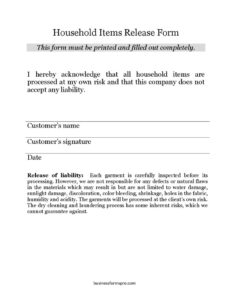
Household Items Release Form
Download a free Household Items Release Form template to document customer acknowledgment of processing risk and release liability — free PDF and DOCX download.
PDF
DOCX
1 downloads
0
likes
Download Files
- DOCX
A Household Items Release Form is a short document a service business asks a customer to sign before it cleans, launders, or processes their belongings, confirming the customer accepts the inherent risks involved. The most common reason businesses use it is to limit liability for unavoidable issues like color bleeding, shrinkage, or hidden fabric defects that can surface during dry cleaning or laundering. You can download this Household Items Release Form free in both PDF and DOCX formats, with no signup required.
What Is a Household Items Release Form?
A Household Items Release Form is a written acknowledgment and release of liability used primarily by dry cleaners, laundromats, garment-care services, and similar businesses that handle a customer’s personal items. The form is presented to the customer at drop-off and signed before any processing begins. It documents two things: that the customer understands their household items are processed at their own risk, and that the company is not accepting liability for certain defects or natural flaws in the materials. Because cleaning and laundering carry unavoidable risks even when items are inspected carefully, the form gives the business a clear record that the customer was informed and agreed before service.
When Do You Need a Household Items Release Form?
This release is useful any time you accept a customer’s belongings for cleaning or treatment and want a documented acknowledgment of risk. Common situations include:
- A dry cleaner accepting garments that may be prone to shrinkage, discoloration, or color bleeding during processing.
- A laundry or wash-and-fold service taking in items with no care label or with ambiguous fabric content.
- Processing delicate or older fabrics that already show wear, weakness, or prior water and sunlight damage.
- Cleaning specialty household textiles such as drapes, linens, or upholstery covers that carry inherent treatment risks.
- Accepting items a customer specifically requests be cleaned despite a warning that the result cannot be guaranteed.
- Onboarding a new customer who is dropping off multiple items and you want a signed acknowledgment on file.
What a Household Items Release Form Should Have
A complete release form is short but should leave no ambiguity about who agreed to what and when. The key elements are: a clear title identifying it as a household items release; an acknowledgment statement that items are processed at the customer’s own risk; a release-of-liability clause listing the kinds of defects and natural flaws the company will not be responsible for, such as water damage, sunlight damage, discoloration, color bleeding, shrinkage, holes, humidity, and acidity; the customer’s printed name; the customer’s signature; and the date of signing. The signature and date are what turn the form from a notice into a signed acknowledgment, so they should always be completed before processing begins.
How to Fill Out a Household Items Release Form
Filling out this form is quick, but every field matters. Walk through it in order:
- Print the form. The template notes that the form must be printed and filled out completely, so begin with a clean printed copy for the customer.
- Review the acknowledgment statement. Read the line confirming that all household items are processed at the customer’s own risk and that the company does not accept liability.
- Read the release of liability paragraph. Make sure the customer understands the listed risks — water damage, sunlight damage, discoloration, color bleeding, shrinkage, holes in the fabric, humidity, and acidity — and that the dry cleaning or laundering process has inherent risks.
- Enter the customer’s name. Print the full name clearly so the signer is identifiable.
- Have the customer sign. The customer signs in the signature field to confirm they accept the terms.
- Add the date. Record the date the form is signed, which establishes when the acknowledgment was made.
Understanding the Release of Liability
The heart of this form is its release-of-liability language. It explains that each garment is carefully inspected before processing, but that the company cannot be held responsible for defects or natural flaws already present in the materials. These flaws may not be visible at intake and can only emerge once an item is exposed to cleaning solvents, heat, or moisture. By signing, the customer accepts that issues such as color bleeding or shrinkage may occur despite proper handling. This protects the business from claims over outcomes it genuinely cannot control, while still making clear that items are inspected with reasonable care. It is not a blanket waiver for negligence — it specifically addresses inherent material and process risks.
Tips for Using the Form in Your Business
To get the most value from the form, present it consistently. Have every customer sign at drop-off rather than after the fact, when a signature carries little protective weight. Keep completed forms organized by date or ticket number so you can locate the matching acknowledgment if a dispute arises. Point out visibly fragile or questionable items at intake and note any concerns verbally, since a signed form works best alongside good communication. Store signed copies securely for a reasonable period, and consider keeping a digital scan as backup. Train staff to explain the form in plain language rather than rushing customers through it.
Common Mistakes to Avoid
- Letting the customer sign without actually reading the release paragraph, which undermines the acknowledgment.
- Beginning processing before the form is signed and dated.
- Leaving the date field blank, so there is no record of when the customer agreed.
- Failing to print the customer’s name legibly, making it hard to identify the signer later.
- Treating the form as a substitute for careful inspection — items should still be checked at intake.
- Discarding signed forms too soon, leaving you without documentation if a question comes up.
Frequently Asked Questions
What is a Household Items Release Form used for? It is used by cleaning and laundering businesses to document that a customer understands and accepts the inherent risks of processing their belongings. By signing, the customer acknowledges that items are handled at their own risk and releases the company from liability for certain unavoidable defects. It protects the business while keeping the customer informed.
How do I fill out the form? Print the form, have the customer read the acknowledgment and release-of-liability sections, then complete the customer’s name, signature, and date fields. The form should always be signed before any item is processed. The whole process usually takes only a minute or two.
Does this form need to be notarized or witnessed? No. A Household Items Release Form is a simple acknowledgment between a business and its customer and typically does not require notarization or a witness. The customer’s signature and the date are generally enough to document agreement, though local requirements can vary.
Is the release of liability legally binding? A signed release can serve as evidence that the customer was informed of and accepted the risks, but how courts treat such releases varies by jurisdiction and circumstance. Releases generally do not excuse negligence or misconduct. Consult a qualified professional if you need certainty about enforceability in your area.
Does signing mean the company is never responsible for damage? No. The release specifically covers inherent material flaws and process risks such as color bleeding, shrinkage, and discoloration. It is not intended to waive responsibility for damage caused by carelessness or improper handling by staff.
How much does this template cost? Nothing — it is completely free to download from Business Forms Pro in both PDF and DOCX formats, with no signup required. You can print it as-is or edit the DOCX to add your business name and logo. Reuse it for as many customers as you need.
This template is provided as a general example for informational purposes only and does not constitute legal advice. Liability releases and their enforceability vary by jurisdiction, so consult a qualified attorney to ensure your form meets the requirements of your location and business.
Related Forms
- FOIA Request
- Request To Terminate Unauthorized Service
- Request A Raise
- Product Replacement Request
- Limited Power of Attorney
- Specialty Item Form
Browse more in Request and Authorization.