
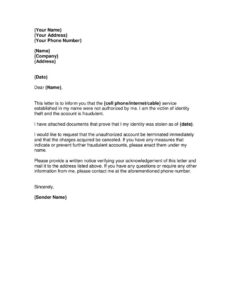
Request To Terminate Unauthorized Service
Use this free Request to Terminate Unauthorized Service letter template to dispute fraudulent accounts from identity theft — free PDF and DOCX download.
PDF
DOCX
0
likes
Download Files
- DOCX
A Request to Terminate Unauthorized Service is a formal letter you send to a service provider to dispute and cancel an account opened in your name without your permission. People most often use it after discovering they are victims of identity theft and find a fraudulent cell phone, internet, or cable account on their record. You can download this letter free in both PDF and DOCX formats — no signup required.
What Is a Request to Terminate Unauthorized Service?
A Request to Terminate Unauthorized Service is a written notice from a consumer to a company informing them that a service account was established fraudulently and demanding that it be closed. It is typically issued by an individual who has discovered that someone used their personal information to open utility, telecom, or media services. The letter documents the dispute in writing, requests immediate termination of the account, asks for the cancellation of any charges, and requests written acknowledgement from the provider. Because it creates a dated paper trail, it serves as evidence that you reported the fraud promptly — which can be important when contesting charges, repairing your credit, or working with law enforcement and credit bureaus.
When Do You Need a Request to Terminate Unauthorized Service?
This letter is useful any time a service account appears in your name that you never authorized. Common situations include:
- You receive a bill or collection notice for a cell phone plan you never signed up for.
- An internet or broadband account shows up on your credit report at an address that is not yours.
- You discover a fraudulent cable or streaming service tied to your Social Security number or personal details.
- A provider contacts you about overdue payments on an account you don’t recognize.
- You have filed an identity theft report and need to notify each affected company in writing.
- You want to request that the provider add fraud protections to prevent future accounts from being opened in your name.
What a Request to Terminate Unauthorized Service Should Have
To be effective, the letter needs a few core elements. It should clearly identify you and your contact information, name the company and the specific service in dispute, and state plainly that the account was not authorized and is the result of identity theft. It should specify the date your identity was stolen, reference any supporting documents you are attaching, and make three clear requests: terminate the account, cancel the fraudulent charges, and provide written acknowledgement. A polite but firm tone, an offer to provide additional information, and your signature round out a complete, professional dispute letter.
How to Fill Out a Request to Terminate Unauthorized Service
- Enter {Your Name}, {Your Address}, and {Your Phone Number} at the top so the provider can verify your identity and reach you.
- Add the recipient details: {Name} of the contact or department, the {Company}, and its {Address}.
- Insert the {Date} you are sending the letter — this establishes when you reported the fraud.
- Open with the salutation, addressing the recipient by {Name}.
- Specify the service type in the {cell phone/internet/cable} field so it is clear which fraudulent account you mean.
- State that you are a victim of identity theft and fill in the {date} your identity was stolen, then note the documents you have attached as proof.
- Confirm your requests: immediate termination, cancellation of charges, and any available fraud-prevention measures.
- Ask for written acknowledgement mailed to your address, then sign as {Sender Name}.
Documents to Attach and How to Send It
Strengthen your letter by enclosing copies — never originals — of supporting evidence. This often includes a copy of your identity theft report, a police report number, a completed FTC IdentityTheft.gov affidavit, and a copy of a government-issued ID. Many people also attach a recent credit report highlighting the fraudulent account. Send the letter by certified mail with a return receipt so you have proof of delivery and a record of the date the company received it. Keep a copy of everything you send for your own files, and note the names and dates of any phone conversations you have with the provider as a backup to the written record.
What to Do After You Send the Letter
Sending the termination request is one step in a larger recovery process. Follow up if you do not receive the written acknowledgement you requested within a reasonable window. Place a fraud alert or credit freeze with the major credit bureaus, dispute the fraudulent account directly with each bureau, and monitor your accounts for additional unauthorized activity. Retain all correspondence in one folder so that if the disputed charges resurface or are sent to collections, you can quickly demonstrate that you reported the fraud and requested termination on a specific date.
Common Mistakes to Avoid
- Leaving the service type or account details vague, which can slow the provider’s investigation.
- Forgetting to date the letter or to state the date the identity theft occurred.
- Sending originals of your ID or reports instead of copies.
- Mailing by regular post with no delivery tracking, leaving you unable to prove the company received it.
- Failing to request written acknowledgement, so you have no confirmation the dispute was logged.
- Not keeping a personal copy of the signed letter and its attachments.
Frequently Asked Questions
What is a Request to Terminate Unauthorized Service letter? It is a formal written notice telling a service provider that an account in your name was opened fraudulently and asking them to close it. It documents that you reported the identity theft and requested cancellation of the related charges. The letter also creates a dated record you can rely on later.
How do I fill out the form? Enter your name, address, and phone number, then the company’s name and address. Identify the fraudulent service, state the date your identity was stolen, list your attached proof, and make your requests before signing. The template guides you field by field.
Does this letter need to be notarized? Notarization is generally not required for a consumer dispute letter like this one. Some people choose to have an accompanying identity theft affidavit notarized, but the termination request itself usually relies on your signature and supporting documents. Check whether your provider has specific requirements.
Is the letter legally binding on the company? The letter is a formal request rather than a contract, but it can carry legal weight as evidence that you disputed the account and reported fraud. Many consumer protection rules require providers to investigate disputes you raise in writing. Keeping proof of delivery helps protect your rights.
How much does this template cost? Nothing — you can download the Request to Terminate Unauthorized Service template for free in PDF and DOCX formats. There is no signup or account required. You only fill in the bracketed fields with your own information.
What should I do if the company ignores my letter? Follow up in writing and by phone, escalate to the company’s fraud department, and file complaints with the relevant consumer protection agency and credit bureaus. Keep copies of every communication. A documented paper trail strengthens your case if charges proceed to collections.
This template is a general example provided for informational purposes only and is not legal, financial, or credit-repair advice. Identity theft procedures and consumer protection requirements vary by jurisdiction. Consult a qualified professional for guidance on your specific situation.
Related Forms
- Day Off Request Form
- Revocation of Power of Attorney
- Certified Copy of Resolution
- Reprint Permission Form
- Drug and Alcohol Testing Company
- FOIA Request Appeal
Browse more in Request and Authorization.