
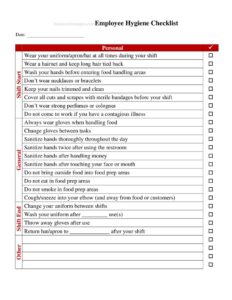
Employee Hygiene Checklist
Download a free Employee Hygiene Checklist template in PDF and DOCX to track handwashing, uniforms, and food safety standards with no signup required.
PDF
DOCX
2 downloads
0
likes
Download Files
- DOCX
An Employee Hygiene Checklist is a daily inspection tool restaurants use to confirm that food handlers meet personal cleanliness and food safety standards before and during their shifts. It is most commonly used by managers during pre-shift line checks to catch issues like dirty uniforms, untreated cuts, or missed handwashing before they put guests at risk. You can download this Employee Hygiene Checklist free in both PDF and DOCX formats — no signup, no payment, just print and use.
What Is an Employee Hygiene Checklist?
An Employee Hygiene Checklist is a structured form that a shift supervisor, kitchen manager, or person-in-charge completes to verify each employee’s personal hygiene against a set list of food safety criteria. It documents observations such as clean hands and fingernails, proper uniform and hair restraints, absence of illness symptoms, and adherence to glove and handwashing rules. In a restaurant setting, the form serves as both a coaching tool and a compliance record, showing that the operation actively monitors hygiene. Many establishments keep completed checklists on file to demonstrate due diligence during health inspections and to reinforce a culture of cleanliness among kitchen and front-of-house staff.
When Do You Need an Employee Hygiene Checklist?
This checklist is useful any time food is handled, prepared, or served. Common scenarios include:
- Pre-shift line checks — a manager runs through hygiene items as each cook and server clocks in for the day.
- New employee onboarding — verifying that a recently hired food handler understands and follows hygiene expectations during their first weeks.
- Health inspection preparation — building a paper trail that shows regulators your team monitors hygiene consistently.
- After an illness report — confirming that an employee who reported symptoms is cleared and follows return-to-work hygiene protocols.
- High-volume service periods — holiday rushes, catering events, or banquets where extra staff and pace increase contamination risk.
- Routine audits — corporate or franchise compliance teams using a standardized form across multiple locations.
What an Employee Hygiene Checklist Should Have
A complete and useful checklist covers the core areas a health inspector or food safety standard would examine. Strong checklists include the date and shift, the employee’s name and station, and the name of the person performing the inspection. The body should list specific, observable hygiene criteria rather than vague statements — for example, “hands washed at sink for 20 seconds” instead of “good hygiene.” Each item needs a clear pass/fail or yes/no marker, plus a comments column for noting corrective action. A signature line for both the inspector and, where appropriate, the employee, closes the loop and confirms the review took place.
How to Fill Out an Employee Hygiene Checklist
Work through the form station by station, observing each employee directly rather than relying on memory:
- Enter the header details: record the date, shift (morning, evening, etc.), location or department, and the name of the manager or person-in-charge conducting the check.
- List the employee: write each food handler’s name and assigned station so the record is traceable.
- Check hand hygiene: confirm hands and forearms are washed, nails are short and clean, and no nail polish or artificial nails are worn where prohibited.
- Inspect uniform and appearance: verify a clean apron or uniform, proper hair restraint, and minimal jewelry.
- Assess health status: note any visible signs of illness, open wounds, or symptoms that require sending the employee home.
- Verify glove and bandage use: ensure cuts are covered with a clean bandage and single-use gloves where required.
- Record results: mark each item pass or fail, add comments and corrective actions, then sign and date the form.
Tying the Checklist to Food Safety Standards
Personal hygiene is one of the most common factors in foodborne illness outbreaks, which is why most food safety frameworks place it near the top of their priorities. A hygiene checklist translates broad rules — like “employees must wash hands at appropriate times” — into concrete daily actions your team can be held to. When you align each line item with the practices your local health code or HACCP plan emphasizes, the checklist becomes more than paperwork; it becomes a teaching tool. Reviewing failed items with staff on the spot reinforces correct behavior far better than a once-a-year training session, and the documented trend over weeks helps you spot recurring problems with specific shifts or individuals.
Keeping and Using Completed Checklists
A checklist only protects you if you keep it. Store completed forms in a binder or scan them into a shared folder organized by date so they are easy to retrieve during an inspection or internal audit. Review the records periodically to look for patterns — if handwashing fails cluster around the busiest shift, you may need an extra sink reminder or a quick refresher. Treat repeated failures as a coaching and accountability matter, escalating from a verbal reminder to documented retraining when needed. The DOCX version makes it simple to add your restaurant’s logo, adjust the criteria to match your menu and equipment, and tailor the language to your team.
Common Mistakes to Avoid
- Filling it out from memory: completing the form at the end of the night instead of observing employees in real time defeats its purpose.
- Using vague criteria: items like “looks clean” are subjective; specific, observable standards produce consistent results.
- Skipping the comments column: a failed item without a noted corrective action leaves no record that the problem was addressed.
- Ignoring illness symptoms: letting a visibly sick employee handle food creates serious liability and health risks.
- Never reviewing the records: checklists that pile up unexamined miss the trends they were designed to catch.
- Treating it as a one-time task: hygiene must be verified every shift, not just during inspection week.
Frequently Asked Questions
What is an Employee Hygiene Checklist used for? It is used to verify that food handlers meet personal cleanliness standards — clean hands, proper uniforms, no illness symptoms, and correct glove use — before and during a shift. Restaurants use it to prevent contamination and to document their food safety efforts.
Who should fill out the checklist? Typically the manager, kitchen supervisor, or designated person-in-charge completes it by observing each employee. In some operations, employees may self-check certain items, but a second-party verification is more reliable for compliance purposes.
How often should hygiene checks be done? Best practice is to perform a hygiene check at the start of every shift and to spot-check during long or high-volume periods. Daily checks create the consistent record that inspectors and food safety programs expect.
Does this checklist need to be signed? A signature from the inspecting manager strengthens the record by showing who performed the review and when. Having the employee initial as well can reinforce accountability, though it is not always required.
Is this checklist legally required? Specific recordkeeping requirements vary by jurisdiction and by the food safety framework your operation follows. While a hygiene checklist is widely recommended and helpful during inspections, you should confirm what your local health department requires.
Is this template really free to download? Yes. You can download the Employee Hygiene Checklist for free in PDF and DOCX formats with no signup. The editable DOCX lets you customize the criteria, add your logo, and adapt it to your restaurant’s needs.
This template is a general example provided for informational purposes only and is not legal, health, or regulatory advice. Food safety and recordkeeping requirements vary by jurisdiction and by the standards governing your operation. Consult your local health department or a qualified food safety professional to ensure your practices meet applicable requirements.
Related Forms
- Pantry Inventory Log
- Seat Yourself Sign
- Takeout Menu
- Brunch Menu
- Bathrooms For Customers Sign
- Food Waste Log
Browse more in Restaurant.