
Transmittal Letter
Use this free Transmittal Letter template to professionally accompany enclosed brochures, samples, or documents you send to prospects — free download in PDF/DOCX.
PDF
DOCX
1 downloads
0
likes
Download Files
- DOCX
A transmittal letter is a short cover letter that accompanies documents, brochures, or sales materials you send to a recipient, explaining what is enclosed and why it matters to them. The most common reason people use one is to add a personal, professional touch when mailing sales literature to a prospect so the package doesn’t arrive as a stack of paper with no context. This template is free to download in PDF and DOCX, with no signup required.
What Is a Transmittal Letter?
A transmittal letter — sometimes called a cover letter or letter of transmittal — is a brief document that introduces and explains the materials enclosed with it. In a sales context, it is typically written by a salesperson, account manager, or business owner and sent to a prospective customer along with brochures, product information, or samples. The letter tells the recipient what they are receiving, highlights the most relevant parts, and prompts a next step such as filling out a mail-in card or requesting more detail. It transforms a plain envelope of literature into a guided, personalized introduction that reflects well on your company.
When Do You Need a Transmittal Letter?
This form fits any moment you send physical or attached materials and want to frame them clearly. Common scenarios include:
- Mailing product brochures to a prospect who requested information or expressed interest at a trade show.
- Following up after a sales call by sending detailed literature with a note that points to the sections you discussed.
- Introducing a new product line to existing customers along with updated catalogs and pricing.
- Responding to an inbound inquiry where a prospect asked about your services and you want to direct their attention to the most relevant offerings.
- Sending samples or material specs and asking the recipient to share their own materials so you can tailor a quote.
- Highlighting a limited-time offer such as a shipping discount or favorable delivery time on featured products.
In each case, the letter does the work of a salesperson who can’t be in the room — it tells the reader exactly where to look and what to do next.
What a Transmittal Letter Should Have
A complete sales transmittal letter is short but purposeful. It should clearly identify what is enclosed, point to the most relevant pages or sections, name a specific benefit (such as a discount or fast delivery), and include a clear call to action. It also needs the recipient’s name and address, a courteous opening, and your signature so the reader knows exactly who to reply to. Keeping it to a single page is best — the letter introduces the materials, it doesn’t replace them.
How to Fill Out a Transmittal Letter
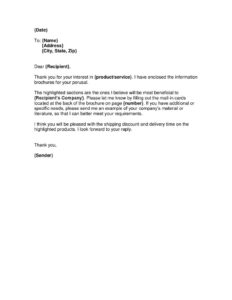
- Date: Enter the date you are sending the package in the {Date} field at the top.
- Recipient name and address: Fill in {Name}, {Address}, and {City, State, Zip} with the prospect’s full mailing details so the letter reads as a personal, addressed communication.
- Salutation: In the {Recipient} field, write the contact’s name (for example, “Dear Ms. Carter”).
- Product or service: Replace {product/service} with the specific offering they expressed interest in.
- Recipient’s company: Insert the prospect’s organization name in {Recipient’s Company} when explaining which highlighted sections benefit them.
- Page number: In the {number} field, list the brochure page where the mail-in cards are located so they can respond easily.
- Sign off: Add your name in the {Sender} field and sign above it before mailing.
Review the letter to confirm every placeholder is replaced and the highlighted sections you reference actually correspond to what you’ve marked in the enclosed brochure.
Tips for a Persuasive Sales Transmittal Letter
The strength of this letter is its personalization. Generic cover notes get skimmed; a letter that names the recipient’s company and points to specific pages gets read. Take a highlighter to the physical brochure and reference those exact sections in the text so the reader knows your recommendation is deliberate, not automated. Lead with a benefit they care about — in this template, the shipping discount and delivery time on the highlighted products gives the reader a concrete reason to act. Finally, make the response effortless by pointing to the mail-in cards and inviting them to send their own material so you can tailor your offer.
Transmittal Letter vs. Sales Letter
It helps to know what this document is not. A pure sales letter tries to sell entirely on its own, building a full pitch from headline to close. A transmittal letter is lighter: it accompanies materials that carry the detailed pitch. Its job is to orient the reader, highlight the relevant pages, and prompt the next step. Because the brochure does the heavy lifting, the letter stays brief and conversational. Use a transmittal letter whenever you are physically or digitally sending literature; use a standalone sales letter when the letter itself must do all the persuading.
Common Mistakes to Avoid
- Leaving placeholders unfilled: Sending a letter that still says {product/service} or {Recipient’s Company} instantly signals carelessness.
- Forgetting to actually highlight the brochure: Referencing “the highlighted sections” when nothing is highlighted confuses the reader.
- Giving the wrong page number for the mail-in cards, which kills your call to action.
- Making it too long: A transmittal letter should be one page — save the detail for the enclosed materials.
- Omitting a clear next step, leaving the reader unsure what you want them to do.
- Skipping your signature or contact details, so the prospect has no easy way to reply.
Frequently Asked Questions
What is a transmittal letter used for? A transmittal letter accompanies enclosed documents or sales materials and explains what they are and why they matter to the recipient. In sales, it personalizes a brochure mailing, points to the most relevant sections, and prompts a response such as returning a mail-in card.
How do I fill out this transmittal letter template? Replace each placeholder — the date, the recipient’s name and address, the product or service, the company name, the brochure page number, and your name — with your real details. Then highlight the matching sections in the enclosed brochure and sign the letter before sending.
Does a transmittal letter need to be signed? Yes, a handwritten or typed signature in the sender field is recommended because it adds a personal, professional touch and tells the reader exactly who to reply to. It does not require notarization or witnesses.
How long should a transmittal letter be? Keep it to a single page. The letter introduces and frames the enclosed materials rather than replacing them, so a few short paragraphs that highlight key sections and a clear call to action are enough.
Can I use this template for emails as well as printed mail? Yes. Although the wording references enclosed brochures and mail-in cards, you can adapt it for email by attaching the brochure as a PDF and replacing the mail-in card line with a link or reply request.
Is this transmittal letter template free? Yes, it is completely free to download in both PDF and DOCX formats with no signup required. You can edit the DOCX version to match your branding, products, and offers.
This transmittal letter template is provided as a general example for informational purposes only and does not constitute legal, financial, or professional sales advice. Business practices and any applicable disclosure requirements vary by jurisdiction and industry; consult a qualified professional for guidance specific to your situation.
Need to work out sales tax? Use our free Sales Tax Calculator to add or remove sales tax from any amount in seconds.
Official resource: for the rules that apply to your situation, see the U.S. Small Business Administration.
Related Forms
- Order Authorization Form
- Request To Return Merchandise
- Gift Certificate Log
- Cancel Back Order letter
- Acceptance Of Defective Goods letter
- Price Quotes List
Browse more in Sales.