
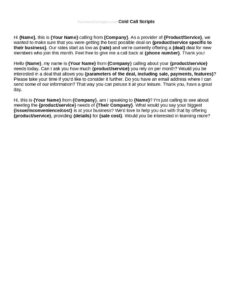
Cold Call Scripts
Download free Cold Call Scripts templates to open conversations, handle objections, and book more meetings — free template in PDF and DOCX.
DOCX
1 downloads
0
likes
Download Files
- DOCX
A cold call script is a written guide that helps salespeople and outreach teams structure a phone conversation with a prospect they have not spoken to before. The most common reason people use one is to stay confident and consistent on calls so they open strong, handle objections, and move toward a clear next step. You can download this Cold Call Scripts template free in both PDF and DOCX formats, with no signup required.
What Is a Cold Call Script?
A cold call script is a planned framework for a sales or prospecting phone call to someone who has had no prior contact with your company. It is typically created by sales reps, business development teams, recruiters, fundraisers, or small business owners who rely on outbound calling to generate leads. The script documents the opening line, the reason for the call, qualifying questions, a short value statement, common objections with responses, and a closing ask. Rather than reading word-for-word like a robot, a good cold call script acts as a roadmap that keeps the conversation focused while leaving room for natural dialogue and active listening.
When Do You Need a Cold Call Scripts Template?
Cold call scripts are useful any time you are reaching out to prospects who do not yet know you. Common situations include:
- Launching a new outbound campaign and needing a consistent message across the whole sales team.
- Onboarding new sales reps who need a reliable starting point before they develop their own style.
- Booking discovery meetings or demos where the only goal of the call is to secure the next appointment.
- Following up on trade show or event leads who expressed mild interest but never converted.
- Re-engaging cold or dormant accounts that went quiet after an earlier conversation.
- Testing different value propositions by running several script variations and comparing which one books more meetings.
Types of Cold Call Scripts
Not every call has the same goal, so most teams keep more than one version on hand. An appointment-setting script aims only to book a follow-up meeting. A qualification script focuses on quickly learning whether a prospect is a good fit before investing more time. A gatekeeper script helps you navigate past receptionists and assistants to reach a decision-maker. A voicemail script gives you a tight, repeatable message for when no one picks up. Keeping these variations in one document lets reps choose the right approach for each situation.
What a Cold Call Script Should Have
A complete cold call script generally includes a few core building blocks: a short, personable opening that states who you are; a clear reason for the call tied to a relevant pain point or benefit; one or two qualifying questions to confirm fit and keep the prospect talking; a concise value statement that explains why this matters to them; an objection-handling section with responses to the most common pushbacks; and a specific call to action, such as proposing a 15-minute meeting. Many scripts also leave space for notes, the prospect’s name and company, and the outcome of the call so reps can log results afterward.
How to Fill Out a Cold Call Script
Use this template as a fill-in-the-blank framework. Work through it section by section:
- Add your introduction. Write your name, your company, and a one-line greeting. Keep it warm and natural — for example, “Hi [Prospect Name], this is [Your Name] from [Company].”
- State your reason for calling. In one or two sentences, connect the call to a problem your prospect likely faces or a result they want.
- Insert a permission or hook line. Ask for a moment of their time or pose a relevant question that earns the right to continue.
- List your qualifying questions. Write two or three open-ended questions that reveal need, budget, timing, or authority.
- Write your value statement. Summarize the benefit you deliver in plain language, ideally with a quick proof point or example.
- Build the objection-handling section. List the top three or four objections you hear and a calm, honest response under each.
- Define your call to action. Spell out the exact next step you will ask for and offer two specific time options.
- Leave room for notes. Add fields for the prospect’s name, company, date, outcome, and follow-up date.
Tips for Using Your Script Effectively
The best script is one you eventually outgrow. Read it aloud several times until the language feels like your own, then rely on it as a guide rather than a teleprompter. Smile while you dial — it genuinely changes your tone. Pause after questions to let the prospect answer fully, and resist the urge to rush to your pitch. Track which openings and objection responses lead to booked meetings, and revise the script every few weeks based on real results. Over time, your team’s collective experience should shape a sharper, higher-converting version.
Cold Call Script vs. Sales Pitch
A cold call script and a full sales pitch are related but serve different purposes. A cold call script is short and focused on starting a conversation with a stranger, usually with the modest goal of qualifying interest or booking a meeting. A sales pitch is a longer, more detailed presentation typically delivered once a prospect has already agreed to a conversation or demo. Trying to cram an entire pitch into a cold call is one of the fastest ways to lose a prospect. Use the script to earn the meeting, and save the deeper presentation for when you have their attention.
Common Mistakes to Avoid
- Reading word-for-word in a flat monotone, which makes you sound scripted and disengaged.
- Talking too much and never pausing to let the prospect respond or ask questions.
- Leading with a hard sell instead of building a brief connection and stating a relevant reason for the call.
- Ignoring objections or arguing with them rather than acknowledging and addressing the concern.
- Forgetting a clear call to action, so the call ends without a defined next step.
- Never updating the script based on what is actually working on real calls.
Frequently Asked Questions
What is a cold call script used for? It is used to guide a salesperson through a phone call with a prospect who has not heard from them before. The script keeps the conversation structured, helps the rep stay confident, and increases the chance of booking a meeting or qualifying the lead. It is especially valuable for new reps and for keeping messaging consistent across a team.
How do I fill out the cold call script template? Start by adding your name, company, and a short greeting, then write your reason for calling and a permission line. Fill in your qualifying questions, a brief value statement, responses to common objections, and a specific call to action. Leave space at the bottom to log the prospect’s details and the outcome of each call.
Should I read the script exactly as written? No — treat it as a roadmap, not a teleprompter. Practice it until the language feels natural, then adapt your wording to each conversation while keeping the structure and key points intact. Sounding human and listening actively matters far more than reciting every line.
How long should a cold call script be? Keep it short. The opening and reason for calling should take only 15 to 20 seconds, and the whole call often runs just a few minutes. The goal of most cold calls is to earn the next step, not to deliver a full sales presentation.
Is this cold call script template really free? Yes. You can download it free from Business Forms Pro in both PDF and DOCX formats with no signup required. Edit the DOCX version freely to match your product, industry, and tone.
How do I make my cold calls more effective? Personalize the opening with the prospect’s name and a relevant detail, ask open-ended questions, and pause to listen. Track which lines and objection responses lead to booked meetings, then refine your script regularly. Consistent practice and follow-up usually matter more than the exact wording.
This Cold Call Scripts template is a general example provided for informational purposes only and does not constitute legal, financial, or professional sales advice. Telemarketing and outbound calling rules vary by jurisdiction — including do-not-call and consent requirements — so consult a qualified professional to ensure your outreach complies with applicable regulations.
Related Forms
- Company Error Scripts
- Appointment Reminder Scripts
- Business Outgoing Message Scripts
- Company Confirmation Scripts
Browse more in Script.