
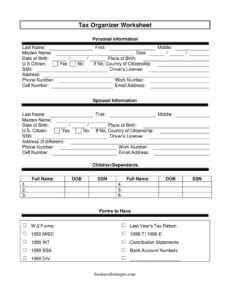
Tax Organization Worksheet (two pages)
Gather every receipt, form, and deduction in one place with our free Tax Organization Worksheet template — free PDF and DOCX download, no signup.
PDF
DOCX
5 downloads
0
likes
Download Files
- DOCX
A Tax Organization Worksheet is a two-page intake document that helps you collect your personal details, income forms, and deductible expenses in one place before filing your taxes. People most often use it to prepare for an appointment with a tax preparer or to organize their own return, and it’s free to download here in PDF and DOCX with no signup required.
What Is a Tax Organization Worksheet?
A Tax Organization Worksheet is a structured checklist and data-entry form that taxpayers fill out at the start of tax season. It captures everything a preparer needs — identity and dependent information, the source documents you should have on hand (like W-2s and 1099s), and a summary of potential deductions such as charitable gifts, education costs, and homeownership expenses. Individuals, families, and small accounting firms use it to avoid back-and-forth emails and missed write-offs. Rather than replacing your official tax forms, the worksheet organizes the underlying facts so the actual return can be completed accurately and efficiently.
When Do You Need a Tax Organization Worksheet?
This worksheet is useful any time you want to walk into tax season prepared rather than scrambling. Common situations include:
- Before a tax-preparer appointment — bring a completed worksheet so your accountant has everything up front.
- Filing jointly as a married couple — the spousal section keeps both sets of details and documents together.
- Claiming dependents or childcare — record children’s names, dates of birth, and the provider’s tax ID for the childcare credit.
- Running a side business or being self-employed — track Schedule SE income, business expenses, and net profit or loss.
- Owning or renting out property — capture mortgage interest, property tax, maintenance, and rental income in one spot.
- Paying for education or making large donations — document 1098-T/1098-E details and charitable gifts over $250 that require receipts.
What a Tax Organization Worksheet Should Have
A complete worksheet covers four broad areas: identity, documents, income, and deductions. The identity section gathers names, Social Security numbers, dates of birth, citizenship, and contact information for the taxpayer, spouse, and dependents. The documents section is a checklist of source forms to collect — W-2s, 1099s, 1098s, and last year’s return. The income and deduction sections itemize self-employment results, childcare and education expenses, charitable donations, moving costs, and homeowner or rental property figures. Clear labels, yes/no prompts for citizenship, and dedicated lines for amounts and tax IDs make the form valid and easy for a preparer to read.
How to Fill Out a Tax Organization Worksheet
- Personal information: Enter your last, first, middle, and maiden name, the date, date and place of birth, and answer the U.S. citizen yes/no question (list your country of citizenship if no).
- Identifiers and contact: Add your SSN, driver’s license number, address, and your phone, work, cell, and email.
- Spousal information: Repeat the same fields for your spouse, noting a separate address only if it differs.
- Children/dependents: List each dependent’s full name and date of birth.
- Forms to have: Check off the documents you’ve gathered — W-2 forms, last year’s return, 1099-MISC, 1098, 1099-INT, contribution statements, 1099-SSA, and bank account numbers.
- Childcare expenses: Record the provider’s name, tax ID or SSN, and address.
- Self-employment: Note Schedule SE, business name and address, deductible materials, and your net income or net loss.
- Education and donations: Enter 1098-T/1098-E details, school, bills, loans, and materials, plus charitable donations (flag any over $250 with recipients and receipts).
- Moving and property: Add old address, job location, new address, miles driven, mortgage interest, property tax, IRA contributions, and rental or homeowner maintenance and renovation figures.
Organizing Your Source Documents
The “forms to have” checklist is the heart of this worksheet because the figures you report must trace back to official documents. Keep physical or digital copies of every W-2 and 1099 you check off, and store them with the completed worksheet so nothing is lost between gathering and filing. For donations over $250, the IRS generally requires a written acknowledgment from the charity, so attach those receipts to the worksheet. For self-employment, education, and rental property, having backup — invoices, statements, and mileage logs — means you can substantiate every number if questions arise later.
Worksheet vs. Filed Return
It is worth remembering that this worksheet is a preparation tool, not the tax return itself. The information you collect here flows into official IRS forms such as Form 1040 and its schedules. Filling out the worksheet carefully does not file your taxes — it simply ensures that when you or your preparer complete the actual return, every deduction and income source is accounted for and supported. Treat it as your single, organized snapshot of the tax year.
Common Mistakes to Avoid
- Skipping the spousal fields on a joint return, which leaves the preparer chasing missing details.
- Reporting deduction amounts without receipts, especially charitable donations over $250.
- Forgetting dependents’ dates of birth or SSNs, which are needed to claim credits.
- Mixing personal and self-employment expenses instead of separating business materials and net income.
- Estimating mileage or rental figures rather than using actual logs and statements.
- Leaving the citizenship yes/no boxes blank or omitting a non-citizen’s country of citizenship.
Frequently Asked Questions
What is a Tax Organization Worksheet used for? It is used to gather all the personal information, source documents, income, and deductions needed to prepare a tax return. People typically complete it before meeting a preparer or filing themselves so nothing is overlooked. It keeps everything in one organized place for the entire tax year.
Is the Tax Organization Worksheet the same as a tax return? No. The worksheet is a preparation and intake tool, while the tax return is the official document filed with the IRS. The figures you collect on the worksheet are later transferred onto forms like the 1040 and its schedules.
How do I fill out the self-employment section? Enter your business name and address, note that you may need Schedule SE, list tax-deductible materials, and record your net income or net loss for the year. Keep invoices and receipts as backup for every figure you report.
Do charitable donations need receipts on this worksheet? Yes, especially for donations over $250, which generally require a written acknowledgment from the recipient organization. Record the recipient and amount, and attach the receipts so they are ready when you file.
Does this worksheet need to be notarized or witnessed? No. A Tax Organization Worksheet is an internal preparation document, so it does not require notarization, witnesses, or signatures from a third party. You simply complete it accurately and keep it with your supporting documents.
Is this Tax Organization Worksheet really free? Yes. You can download it free in PDF and DOCX formats with no signup or payment required. Use it for your own taxes or distribute it to clients as an intake form.
This template is a general example provided for informational purposes only and is not legal, financial, or tax advice. Tax rules and filing requirements vary by jurisdiction and change over time — consult a qualified tax professional or accountant for guidance specific to your situation.
Need to work out sales tax? Use our free Sales Tax Calculator to add or remove sales tax from any amount in seconds.
Official resource: for the rules that apply to your situation, see the IRS.
Related Forms
Browse more in Tax Schedules.