
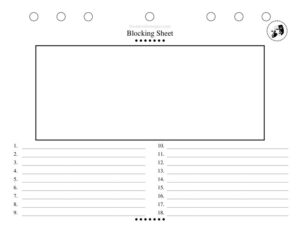
Blocking Sheet
Track every actor's movement and stage position with our free Blocking Sheet template, available as a free download in PDF and DOCX formats.
PDF
DOCX
4 downloads
0
likes
Download Files
- DOCX
A blocking sheet is the document a director or stage manager uses to record exactly where actors stand, move, and gesture during a scene. It’s the single most reliable way to capture the choreography of a production so it can be repeated identically night after night, and you can download it free here in both PDF and DOCX formats with no signup required.
What Is a Blocking Sheet?
A blocking sheet is a theater production document that maps and describes the physical movement of performers on stage — known in the craft as “blocking.” It is typically created by the stage manager (or assistant stage manager) under the director’s instruction during rehearsals, and lives alongside the script in the prompt book. Each sheet documents a specific scene or page of dialogue, noting entrances, exits, crosses, levels, and key gestures. Its purpose is to preserve the staging so the show can be rehearsed, understudied, and remounted consistently. When the director is absent or an actor is replaced, the blocking sheet is the authoritative record of who goes where and when.
When Do You Need a Blocking Sheet?
Blocking sheets are essential any time movement on stage needs to be remembered, taught, or reproduced. Common situations include:
- During first blocking rehearsals — to capture the director’s staging decisions in real time before they’re forgotten.
- Training understudies and swings — so a replacement can learn precise positions without slowing the whole company.
- Remounting a production — when reviving a show months or years later, the sheets let you rebuild the staging faithfully.
- Touring or transferring to a new venue — adapting blocking to a different stage size while keeping the core movement intact.
- Calling the show — the stage manager references blocking to anticipate cues for lights, sound, and scenery changes.
- Student and community theater — where rehearsal time is short and a clear written record keeps everyone aligned between sessions.
What a Blocking Sheet Should Have
A complete blocking sheet ties stage movement to the script and to a clear picture of the playing space. The most useful sheets include the production and scene identification, the script page or line references being staged, a small stage diagram or grid using standard stage areas (upstage, downstage, stage left, stage right, center), and a written description of each movement keyed to a cue or line. Many sheets also note the characters involved, the actors playing them, props handled during the action, and any timing or count information. The goal is that someone who wasn’t in the room could read the sheet and reproduce the staging accurately.
How to Fill Out a Blocking Sheet
- Label the production and scene. Write the show title, act, scene, and the date or rehearsal in which the blocking was set so revisions can be tracked.
- Note the script reference. Record the page numbers and starting line so each movement is anchored to the dialogue it accompanies.
- Draw the stage diagram. Sketch the set pieces, furniture, and entrances on the provided grid, marking standard stage areas to orient anyone reading later.
- Mark starting positions. Use a letter or symbol for each character and place them on the diagram where they begin the scene.
- Describe each move. In sequence, write what the actor does — “JANE crosses DSL to the chair on line ‘Sit down'” — pairing the cue line with the action.
- Add props and business. Note any objects picked up, set down, or used, plus gestures and stage business that matter to the staging.
- Record exits and final positions. Close out the scene so the next sheet picks up cleanly. Date any updates as the director adjusts the staging.
Understanding Stage Directions and Notation
Blocking sheets rely on a shared shorthand so notes stay fast to write and easy to read. Positions are described from the actor’s point of view facing the audience: stage left is the actor’s left, stage right is their right, upstage is away from the audience, and downstage is toward it. These combine into abbreviations like DSR (downstage right) or USC (upstage center). Movements are often written with arrows on the diagram and a matching line of text below. Many stage managers number each character and use that number consistently on every sheet, so a single glance at the grid reveals the full picture. Keep your notation legible and consistent — penciled so it can be erased and revised — because blocking almost always changes between the first staging rehearsal and opening night.
Tips for Keeping Blocking Sheets Useful
Work in pencil during rehearsal and date every change, because a director will refine staging repeatedly. Photograph or scan finished sheets and store them with the prompt book so the production has a backup. If you’re calling the show, color-code technical cues separately from movement notes to avoid confusion under pressure. Standardize your character symbols across the entire script so anyone — an understudy, a returning cast member, or a remount director — can read any page without relearning your system. Finally, review your sheets against the actual run during tech week and correct anything that drifted; the sheet is only valuable if it matches what happens on stage.
Common Mistakes to Avoid
- Writing in pen — blocking changes constantly, and ink makes revisions messy and hard to follow.
- Forgetting the cue line — a movement without its trigger line leaves you guessing about timing.
- Inconsistent stage terms — mixing the actor’s and audience’s perspective creates dangerous confusion.
- Skipping the diagram — text alone rarely conveys spatial relationships as clearly as a quick sketch.
- Not dating revisions — when staging evolves, undated notes make it impossible to know which version is current.
- Vague descriptions — “moves over” tells a substitute nothing; specify direction, destination, and distance.
Frequently Asked Questions
What is a blocking sheet used for? A blocking sheet records the precise movement, positions, and stage business of performers during a scene. It lets a production reproduce that staging consistently across rehearsals and performances, and it serves as the reference for understudies, remounts, and the stage manager calling the show.
Who fills out the blocking sheet? Usually the stage manager or assistant stage manager completes it during rehearsals, writing down the staging as the director sets it. In smaller or student productions the director may keep their own sheets, and actors sometimes track their personal blocking in their scripts as well.
What do the stage abbreviations mean? Directions are given from the actor’s perspective facing the audience: stage left and stage right are the actor’s left and right, upstage is away from the audience, and downstage is toward it. Common combinations include DSR, USL, and center stage, which keep notes short and unambiguous.
Should I fill out the form in pen or pencil? Pencil is strongly recommended. Blocking is refined throughout the rehearsal process, and writing in pencil lets you erase and update positions cleanly without rewriting the whole sheet each time staging changes.
Is a blocking sheet a legal document? No. A blocking sheet is an internal production and rehearsal tool, not a contract or legal record. It exists purely to organize and preserve the artistic staging of a show for everyone working on the production.
How much does this blocking sheet template cost? It is completely free to download from Business Forms Pro in both PDF and DOCX formats, with no signup or payment required. You can print copies for your prompt book or edit the DOCX version to match your show’s specific scenes and notation style.
This blocking sheet template is provided as a general example for informational purposes only and is not professional production, legal, or contractual advice. Theatrical practices and notation conventions vary by company and region — adapt the form to your production’s needs and consult experienced theater professionals where appropriate.
Related Forms
- Props List
- Performance Sign-In Sheet
- Production Meeting Notes
- Production Schedule
- Scene Breakdown Action
- Actor Breakdown
Browse more in Theater.