
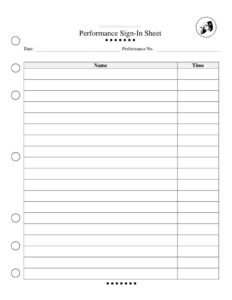
Performance Sign-In Sheet
Track cast and crew attendance for every show with our free Performance Sign-In Sheet template, available as a free download in PDF and DOCX.
PDF
DOCX
1 downloads
0
likes
Download Files
- DOCX
A Performance Sign-In Sheet is a simple attendance log that cast and crew members complete before each show, rehearsal, or call time so a stage manager knows exactly who has arrived. The most common reason theater companies use one is to confirm that every required person is present and accounted for before the house opens. It’s free to download here in both PDF and DOCX formats, with no signup required.
What Is a Performance Sign-In Sheet?
A Performance Sign-In Sheet is a single-page tracking document, usually posted at the stage door or on the callboard, where each member of a production signs and times their arrival for a specific performance or call. It is typically maintained by the stage manager or assistant stage manager and becomes part of the show’s daily report. The sheet documents who was present, when they checked in, and whether anyone was late, absent, or covered by an understudy. In professional, community, and educational theater alike, it provides a clear, time-stamped record that keeps the company organized and the curtain on schedule.
When Do You Need a Performance Sign-In Sheet?
This form is useful any time a group of performers and technicians must gather at a set time for a coordinated event. Common situations include:
- Confirming the full cast and crew have arrived before the half-hour call for an evening performance.
- Tracking attendance across a multi-week rehearsal process for a play, musical, or dance recital.
- Verifying that musicians, stagehands, and front-of-house staff are present for a concert or live event.
- Recording who attended a tech rehearsal, dress rehearsal, or put-in for an understudy.
- Providing documentation to producers or schools when attendance affects pay, grades, or eligibility.
- Keeping a paper trail for touring productions where personnel rotate between venues.
What a Performance Sign-In Sheet Should Have
A complete sign-in sheet captures enough detail to be useful as a record while staying quick to fill out. The essential elements are the production name and the specific date and performance (for example, “Saturday Matinee” or “Evening Show”), the call time, and a row for each person to write their name, role or department, arrival time, and initials or signature. Many sheets add columns for notes—late arrivals, absences, or substitutions—and a line for the stage manager to sign off once everyone is accounted for. Clear labeling of the show, venue, and date prevents sheets from being confused between performances in a busy run.
How to Fill Out a Performance Sign-In Sheet
Because this is a flexible, blank-row template, you can adapt it to any size company. Follow these steps:
- At the top, enter the production title, the venue or theater name, and the date of the performance or rehearsal.
- Specify the performance or call (matinee, evening show, dress rehearsal) and the official call time so latecomers are easy to identify.
- Have each person write their full name in the name column as they arrive.
- Record their role, character, or department—actor, stage crew, wardrobe, orchestra, or front of house.
- Note the time of arrival next to each name; many companies require this be filled in by the individual, not by someone signing in on their behalf.
- Collect an initial or signature to confirm each person signed themselves in.
- Use the notes column for absences, understudy substitutions, or anyone running late.
- The stage manager reviews the sheet at the call deadline, signs or dates it, and files it with the day’s report.
Tips for Running an Effective Sign-In Process
A sign-in sheet only works if the company actually uses it consistently. Post the sheet in the same visible location every day—usually the callboard near the stage door—so it becomes part of everyone’s arrival routine. Require people to sign themselves in rather than allowing a colleague to mark them present, which preserves the integrity of the record. Set the call time clearly and have the stage manager check the board at that exact moment so any missing personnel can be contacted before it affects the schedule. Keep completed sheets in a binder or folder by date; over a run, they create a reliable history you can reference if there is ever a dispute about attendance or a need to review who was on hand during a particular show.
How It Differs From a Daily Rehearsal Report
People sometimes confuse the sign-in sheet with the stage manager’s daily report, but they serve different purposes. The sign-in sheet is strictly an attendance and arrival-time log completed by the company members themselves. The daily report is a broader summary written by the stage manager covering rehearsal notes, technical issues, schedule changes, and incidents. The two work together: the sign-in sheet feeds attendance data into the report, and together they form a complete record of the production day. Keeping them as separate documents keeps each one clean and easy to scan.
Common Mistakes to Avoid
- Leaving off the date or performance label, which makes it impossible to tell sheets apart during a long run.
- Letting one person sign in for the whole group, which defeats the purpose of an arrival record.
- Forgetting to record the actual time of arrival, so late cast members can’t be identified.
- Not noting understudy or swing substitutions, leaving gaps in who actually performed.
- Failing to have the stage manager review and close out the sheet at the call deadline.
- Discarding old sheets instead of filing them, losing valuable attendance history.
Frequently Asked Questions
What is a Performance Sign-In Sheet used for? It is used to track which cast and crew members have arrived for a specific performance, rehearsal, or call time. The stage manager uses it to confirm everyone is present before the show begins and to document any late arrivals, absences, or substitutions. It serves as the official attendance record for that production day.
Who is responsible for the sign-in sheet? Typically the stage manager or assistant stage manager posts the sheet, maintains it, and reviews it at the call deadline. However, each company member is responsible for signing themselves in and recording their own arrival time. The stage manager then files the completed sheet with the daily records.
How do I fill out the sign-in sheet? Add the production title, venue, date, and call time at the top, then have each person write their name, role or department, arrival time, and initials as they arrive. Use the notes column for any latecomers or substitutions. The stage manager signs off once everyone is accounted for.
Is a sign-in sheet legally binding? A sign-in sheet is primarily an organizational and record-keeping tool rather than a legal contract. That said, in professional settings it may support attendance, payroll, or contractual obligations, so it should be filled out accurately. Check your company’s policies or union agreement for any specific requirements.
Can I use this for rehearsals as well as performances? Yes. The template works equally well for rehearsals, tech and dress rehearsals, put-ins, and live performances. Simply label the date and the specific call so the record reflects the right event.
How much does this template cost? Nothing—it is completely free to download here in both PDF and DOCX formats, with no signup required. You can print the PDF as-is or open the DOCX to customize the columns, add your company logo, or adjust the call-time fields to match your production’s needs.
This template is provided as a general example for informational purposes only and does not constitute legal, employment, or professional advice. Attendance and record-keeping requirements vary by organization, venue, and any applicable union agreements—consult the appropriate professional or your company’s management for guidance specific to your situation.
Related Forms
- Preliminary Script Analysis
- Stage Choreography Numbers Black
- Intermission Checklist
- Scene Breakdown Action
- Audition Checklist
- Understudy Tracker
Browse more in Theater.