
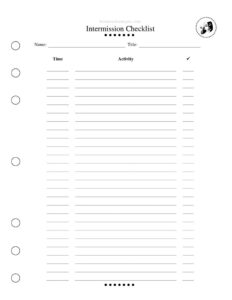
Intermission Checklist
Free theater intermission checklist template in PDF & DOCX so the crew resets the stage, props, and house during the break. Run a smooth show — download free.
PDF
DOCX
2 downloads
0
likes
Download Files
- DOCX
An intermission checklist is a stage and house crew’s task list for the break between acts — everything that has to be reset, checked, and readied so the second half goes off without a hitch. In live theater, the few minutes of intermission are a flurry of work, and a checklist makes sure nothing is forgotten. Download this free template in PDF or DOCX. No signup required.
What Is an Intermission Checklist?
An intermission checklist is a written list of the tasks the backstage and front-of-house crew must complete during the interval of a performance. To the audience, intermission is a chance to stretch and grab a drink; backstage, it’s a tightly choreographed reset. Props must be returned to their starting positions, set pieces moved or struck, costumes and quick-change areas prepared, lighting and sound cues reset, and the stage checked for safety — all in the short window before the second act. A checklist turns this potentially chaotic scramble into a calm, repeatable routine, so the same things get done in the same way every performance and nothing is left to chance or memory under pressure.
When Do You Need an Intermission Checklist?
- Running a play, musical, or live show with one or more intermissions.
- Coordinating a stage crew so every reset task is covered during the break.
- Ensuring props, set, and costumes are ready for the top of the next act.
- Maintaining safety by checking the stage and backstage areas before resuming.
- Standardizing the routine across performances and across different crew members.
- Training new crew so they learn the intermission routine quickly and reliably.
What the Checklist Should Cover
A thorough intermission checklist spans the whole production. Backstage, it covers resetting props to their act-two starting positions, moving or striking set pieces, and preparing quick-change and costume areas. On the technical side, it includes resetting lighting and sound cues and checking equipment. For safety, it covers clearing the stage of hazards, securing anything that moved, and checking sightlines and the deck. Front-of-house tasks — readying the house for the audience’s return and any concessions reset — can be included too. Organizing the list by area or by crew role ensures every responsibility has an owner.
How to Use the Intermission Checklist
- List the prop resets — every prop returned to its act-two starting position.
- Note set changes — pieces to move, strike, or set for the next act.
- Include costume and quick-change preparations.
- Add lighting and sound resets and equipment checks.
- Cover safety checks — clear the deck, secure moved pieces, check sightlines.
- Assign each task to a crew role and check items off as they’re completed during the break.
Running a Smooth Intermission
The secret to a calm intermission is that everyone knows their tasks before the lights even come up. Assign each item on the checklist to a specific crew member or role so there’s no confusion in the moment, and run the list in a sensible order — safety-critical resets first, finishing touches last. Keep a copy at the stage manager’s station and at key backstage positions so the crew can confirm their tasks at a glance. Time your run-throughs: knowing how long the full reset takes lets you set the intermission length confidently and avoid holding the audience. After a few performances, refine the list based on what actually trips the crew up, and use it to onboard new members quickly. A good checklist doesn’t just prevent the missed prop or unreset cue that can derail a second act — it lets the crew work calmly and the show resume exactly as rehearsed, performance after performance.
Common Mistakes to Avoid
- Relying on memory during the rush instead of a written list.
- Not assigning tasks to specific crew members, so items fall through the cracks.
- Forgetting to reset a key prop or cue needed at the top of act two.
- Skipping the safety check of the stage and backstage areas.
- Underestimating how long the reset takes and rushing the audience back.
- Never updating the checklist to fix the tasks that repeatedly cause problems.
Adapting the Checklist to Your Production
No two shows reset the same way, so the most useful intermission checklist is one tailored to your particular production. Build the first version during technical rehearsals, when you can watch exactly what has to move, reset, and be prepared between acts, and write down every task as it actually happens rather than how you imagine it. Then divide the list by crew role — props, set, wardrobe, lighting, and sound — so each person knows their own column at a glance and nothing depends on someone remembering an item under pressure. Order the tasks sensibly within the short window: handle anything safety-critical or time-consuming first, leave quick finishing touches for last, and note any task that must be done in a specific sequence. Time a few full run-throughs so you know how long the reset genuinely takes; that figure lets the stage manager set an honest intermission length and avoid either rushing the crew or holding the audience. After the first performances, revise the list to fix whatever repeatedly causes a scramble — a prop that’s always hard to find, a cue that’s easy to forget — because a checklist that reflects real experience is far more reliable than an idealized one. Keep current copies at the stage manager’s station and key backstage positions, and use the same list to train new or covering crew so the routine stays consistent no matter who’s working. A living, well-owned checklist is what lets the second act begin exactly as rehearsed, night after night.
Frequently Asked Questions
What is an intermission checklist? It’s the crew’s task list for the break between acts — the prop resets, set changes, costume prep, technical cue resets, and safety checks that ready the stage for the next act.
Who uses an intermission checklist? The stage management and backstage crew, with tasks often divided among props, set, wardrobe, and technical roles. Front-of-house staff may have their own items too.
Why use a checklist for intermission? Because the break is short and busy, and a missed reset can derail the second act. A checklist makes the routine consistent, safe, and repeatable every performance.
What should be on it? Prop resets, set changes, costume and quick-change prep, lighting and sound resets, and safety checks of the stage. Organizing by area or crew role ensures every task has an owner. The template above is set up this way.
How do I run a smooth intermission? Assign every task in advance, run the list in a sensible order with safety first, keep copies at key positions, and time your run-throughs so the intermission length is realistic.
How much does this template cost? Nothing — it’s free to download in PDF and DOCX, with no signup required.
Related Forms
- Stage Choreography Numbers
- Props Scene List
- Instrument Schedule
- Blank Schedule Ongoing
- Blocking Sheet
- Callback Sheet
Browse more in Theater.