
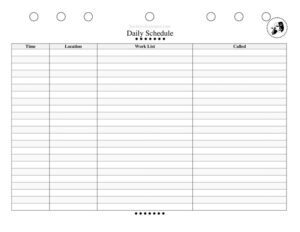
Daily Schedule
Download a free Daily Schedule template for theater productions to organize call times, locations, and work lists — free PDF and DOCX download, no signup.
PDF
DOCX
6 downloads
0
likes
Download Files
- DOCX
A Daily Schedule is the day-by-day planning sheet that tells a theater company exactly what is happening, where, when, and who is needed. Stage managers and production teams use it most often to keep rehearsals, technical sessions, and performances running on time without confusion. You can download this Daily Schedule free in both PDF and DOCX formats — no signup required.
What Is a Daily Schedule?
A Daily Schedule is a working document, usually issued by the stage manager or production office, that maps out a single day of activity for a theater production. It lists the times of each event, the location where it happens, the work to be accomplished, and the personnel called to attend. Unlike a long-range production calendar that covers weeks or months, the Daily Schedule zooms in on one day so cast and crew know precisely how to plan their hours. It is the practical translation of the rehearsal plan into hour-by-hour instructions, keeping actors, designers, technicians, and stage management aligned around a shared, clear set of expectations for the day ahead.
When Do You Need a Daily Schedule?
A Daily Schedule is essential whenever multiple people must coordinate their time around a single production. Common situations include:
- Rehearsal days — scheduling scene work, blocking, and music or dance calls so only the needed performers are asked to arrive.
- Technical rehearsals — coordinating lighting, sound, and set transitions where many departments work in the same space at staggered times.
- Performance days — listing the half-hour call, warm-ups, house opening, and curtain so everyone is ready on cue.
- Load-in and strike — organizing crew calls for moving sets, hanging lights, or clearing the theater after closing.
- Costume fittings and design meetings — booking specific people into specific rooms without disrupting the main rehearsal.
- Touring or multi-venue runs — communicating different locations and travel times across a single busy day.
What a Daily Schedule Should Have
An effective Daily Schedule is short, scannable, and unambiguous. At minimum it should clearly show the date and production name at the top, a column of times listed in chronological order, the location for each block of work, a description of what will be accomplished, and the names or groups of people called. The best schedules also note any breaks, meal periods, and contact information for the stage manager. Clarity matters more than detail: anyone glancing at the sheet should instantly know whether and when they are needed, where to go, and what to prepare.
How to Fill Out a Daily Schedule
- Add the heading. Write the production title and the calendar date at the top so the sheet cannot be confused with another day.
- Enter the Time. In the Time field, list each block in order — for example, 6:00 PM, 7:30 PM, 9:00 PM. Use a consistent format and include start and end times for each segment when possible.
- Fill in the Location. For every time block, specify the Location: “Main Stage,” “Rehearsal Room B,” “Costume Shop,” or a touring venue address.
- Complete the Work List. In the Work List field, describe the activity — “Act 1 blocking,” “Lighting focus,” “Dance call,” or “Half-hour and warm-up.” Be specific enough that people know what to prepare.
- Fill the Called column. Under Called, name the individuals, roles, or departments expected — “Full cast,” “Ensemble only,” “Lighting and sound crew,” or specific actor names.
- Distribute it. Post the finished schedule on the call board and send copies to everyone listed before the day begins.
Tips for Building a Schedule People Actually Follow
The Daily Schedule only works if it is realistic and respected. Build in transition time between activities — actors and crew need minutes to move between rooms, reset the stage, or change costumes. Always protect meal breaks and note them clearly, because skipping them frustrates the company and may violate union or contract rules. Where possible, group an actor’s calls together so they are not asked to wait idle for hours between scenes. Color-coding or bolding the Called column helps each person spot their own name quickly. Finally, version-control your schedule: if you reissue an updated sheet, label it with a time stamp so no one is working from yesterday’s plan.
How It Differs from a Production Calendar
People sometimes confuse the Daily Schedule with the overall production calendar, but they serve different purposes. The production calendar is the big picture — it shows the whole rehearsal period, technical week, previews, and the opening across many days. The Daily Schedule breaks just one of those days into precise, hour-by-hour instructions with locations and called personnel. Think of the calendar as the map and the Daily Schedule as the turn-by-turn directions for today. Most productions keep both: the calendar sets long-term expectations and deadlines, while the daily sheet handles the moment-to-moment logistics that change as rehearsals progress.
Common Mistakes to Avoid
- Vague work descriptions — “rehearsal” tells no one what to prepare; “Act 2 music review, Scenes 4–6” does.
- Forgetting the date — an undated schedule causes people to show up on the wrong day.
- Calling people who aren’t needed — over-calling wastes time, money, and goodwill.
- Omitting breaks — failing to schedule meals leads to fatigue and possible contract violations.
- Unrealistic timing — packing blocks back-to-back with no transition time guarantees the day runs late.
- Not redistributing updates — changing a time but leaving the old sheet posted creates chaos.
Frequently Asked Questions
What is a Daily Schedule in theater? It is a one-day planning sheet that lists the times, locations, work to be done, and people called for a production. Stage managers create it to keep cast and crew coordinated and on time. It turns the broad production calendar into specific, actionable instructions for a single day.
Who fills out the Daily Schedule? The stage manager or production office typically prepares and distributes it, often in consultation with the director and department heads. It is then posted on the call board and shared with everyone listed. Designers and crew chiefs may contribute the timing needs for their own work.
What does “Called” mean on the schedule? The Called column lists exactly who must attend each time block — specific actors, the full cast, the ensemble, or particular crew departments. It tells each person whether they are needed at that moment so they don’t waste time waiting around. Being precise in this field is one of the most important parts of a useful schedule.
How is this different from a call sheet? The terms overlap heavily; in many theaters the daily schedule and the call sheet are essentially the same document. A call sheet often emphasizes individual arrival times, while a daily schedule lays out the full sequence of the day. This template covers both purposes with its Time, Location, Work List, and Called fields.
Is this Daily Schedule free to download? Yes. You can download this Daily Schedule template completely free in PDF and DOCX formats, with no account or signup required. Edit the DOCX version to match your production’s needs and reprint as your schedule changes.
Can I reuse the same schedule every day? Generally no — each day of a production usually has different scenes, locations, and personnel needs, so the schedule should be rebuilt for each day. You can, however, save your formatted template as a reusable starting point and simply update the date and entries. This keeps your layout consistent while reflecting the day’s actual plan.
This Daily Schedule template is a general example provided for informational purposes only and is not legal, contractual, or labor-law advice. Scheduling rules, union agreements, and break requirements vary by organization and jurisdiction — consult your producer, union representative, or a qualified professional to ensure compliance.
Related Forms
- Conflict Calendar
- Script Assignment Tracker
- Actor Breakdown
- Production Schedule
- Costume Changes
- Scene Breakdown Actors
Browse more in Theater.