
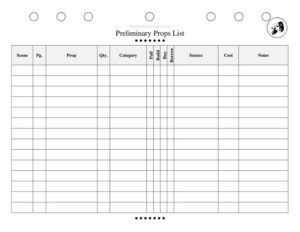
Preliminary Props List
Download a free Preliminary Props List template in PDF and DOCX to track every prop in your production, organize by scene, and assign responsibilities.
PDF
DOCX
2 downloads
0
likes
Download Files
- DOCX
A Preliminary Props List is an early-stage inventory that a production team uses to capture every physical object an actor handles or that appears on stage before rehearsals and budgeting are finalized. Most people create one during pre-production to give the director, stage manager, and props master a shared starting point. You can download this Preliminary Props List free in both PDF and DOCX formats — no signup required.
What Is a Preliminary Props List?
A Preliminary Props List is a working document that records all the props identified during the initial reading and analysis of a script. It is typically compiled by the props master or stage manager, often with input from the director and set designer. Unlike a final props list, the preliminary version is intentionally rough — it represents a first pass meant to be expanded, corrected, and refined as the production develops. It documents what each prop is, where and when it appears, who is responsible for it, and whether it needs to be bought, built, borrowed, or pulled from existing stock. This early list drives the budget, sourcing schedule, and rehearsal planning.
When Do You Need a Preliminary Props List?
This list becomes essential at the very front end of a production, well before opening night. Common situations include:
- After the first script read-through — when the team marks every object referenced in the dialogue or stage directions.
- During pre-production budgeting — to estimate how much money is needed for purchases, builds, and rentals.
- When assigning crew responsibilities — so each prop has a named person accountable for acquiring and maintaining it.
- For community theater, school plays, and student films — where volunteers need a clear, simple checklist to divide work.
- When borrowing or renting items — to track which props come from outside sources and must be returned.
- In the lead-up to technical rehearsals — to ensure no required object is forgotten before the show goes on stage.
What a Preliminary Props List Should Have
A useful list balances detail with flexibility, since it will change. The core elements include the production or play title, the name of the person compiling the list, and the date. For each prop, you want a clear description, the scene or act in which it appears, the character or actor who uses it, the quantity needed, the source (buy, build, borrow, or pull from stock), an estimated cost, and a status or notes column. Leaving room for revisions matters most — because this is a preliminary document, columns for follow-up, assigned crew, and changes are what make it genuinely useful as the show evolves.
How to Fill Out a Preliminary Props List
- Enter the production details. Write the title of the play or film, the director’s name, and the date you are creating the list so versions can be tracked.
- Add the compiler’s name. Note who is responsible for maintaining the document — usually the props master or stage manager.
- List each prop by scene. Work through the script in order, recording every object as it appears. Number each entry for easy reference.
- Describe the prop clearly. Write a specific description (e.g., “antique brass candlestick”) rather than a vague label.
- Note the scene and character. Record where the prop appears and which character or actor uses it.
- Add quantity and source. Indicate how many are needed and whether each will be bought, built, borrowed, or pulled from existing stock.
- Estimate cost and assign responsibility. Add a rough price and the crew member tasked with obtaining it.
- Use the notes column for status. Mark items as “to confirm,” “ordered,” or “need replacement” as the production progresses.
Organizing Props by Scene and Type
Most experienced props teams sort the list two ways: by scene order and by category. Scene order ensures nothing is missed as you move through the script and helps the running crew during performances. Categorizing by type — hand props (objects actors carry), set props (furniture and large pieces), and consumables (food, breakaway items, or anything used up each show) — helps with budgeting and sourcing. Consumables in particular deserve early attention because they must be replenished for every performance, which affects both cost and the rehearsal schedule. Building these distinctions into your preliminary list from the start saves significant rework later.
From Preliminary to Final List
Treat this document as a living draft. As the director blocks scenes, props are added, cut, or substituted, and the preliminary list gradually becomes the final props list and the running list used backstage. Keep dated versions so you can see what changed and why. Many teams color-code or add a status column to show which items are confirmed, in progress, or still undecided. Communicate updates clearly to the stage manager and running crew, because the people setting and resetting props during performances rely on an accurate, current list to avoid missing or misplaced items on stage.
Common Mistakes to Avoid
- Skipping props mentioned only in dialogue. If a character refers to a letter or a glass of wine, that object may need to appear — read for implied props, not just stage directions.
- Forgetting consumables. Food, drinks, and breakaway items get used every show and must be budgeted per performance, not just once.
- Leaving out quantities. “Sword” is not enough if a fight scene needs three matching swords.
- No assigned responsibility. A prop with no named owner often gets forgotten until tech week.
- Treating the list as final too early. Lock it down before blocking is complete and you’ll be constantly reworking it.
- Not dating versions. Without dates, the crew can’t tell which copy is current.
Frequently Asked Questions
What is a Preliminary Props List used for? It is the first inventory of every prop a production needs, compiled early in pre-production. The team uses it to plan the budget, divide sourcing tasks, and ensure nothing is overlooked before rehearsals begin. It is meant to be revised as the show develops.
How do I fill out a Preliminary Props List? Start by adding the production title, your name, and the date, then read the script scene by scene and record each prop with a description, the scene and character, the quantity, the source, an estimated cost, and notes. Work in script order so you don’t miss anything, and update the status column as items are confirmed.
Who is responsible for the props list? The props master usually creates and maintains the list, often in close collaboration with the stage manager and director. On smaller productions, a single crew member or volunteer may handle both roles. Whoever owns the document should keep it current and shared with the team.
What is the difference between a preliminary and a final props list? The preliminary list is an early draft compiled from the script before blocking and budgeting are settled, so it changes frequently. The final list reflects confirmed decisions and becomes the basis for the backstage running list used during performances. The preliminary version evolves into the final one.
Is this Preliminary Props List template free? Yes. You can download it free in both PDF and DOCX formats with no signup required. The DOCX version is fully editable so you can add scenes, columns, or production-specific details.
Should I include set pieces and furniture on this list? Many productions include large set props and furniture, while others track them on a separate set list. It often helps to note them in a clearly labeled category so the props and set teams stay coordinated. Decide early how you’ll split responsibility and stay consistent.
This template is provided as a general example for informational purposes only and is not professional production, legal, or financial advice. Production needs and conventions vary by company and venue — adapt this list to your specific show and consult your director, stage manager, or producer as needed.
Related Forms
- Costume Measurement Form
- Comp Ticket Request Form
- Production Meeting Notes
- Stage Choreography Numbers
- Storage Contents Tracker
- Entrance Exit Tracker
Browse more in Theater.