
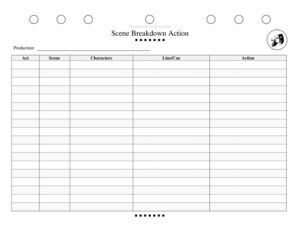
Scene Breakdown Action
Organize blocking, cues, and stage action with a free Scene Breakdown Action sheet template — download in PDF or DOCX, no signup required.
PDF
DOCX
7 downloads
0
likes
Download Files
- DOCX
A Scene Breakdown Action sheet is a production document that maps out exactly what happens on stage during each scene of a play or musical, tying specific actions and movements to lines and cues. Directors and stage managers use it most often to track blocking, entrances, exits, and physical business so every rehearsal stays consistent. It is free to download here in both PDF and DOCX formats, with no signup required.
What Is a Scene Breakdown Action Sheet?
A Scene Breakdown Action sheet is a planning and reference tool that breaks a production down scene by scene and records the action that unfolds within each one. It is typically created by the director or stage manager and shared with assistant directors, actors, and crew. Rather than capturing dialogue, it documents what people do: who enters, where they move, what props they handle, and which technical cues accompany each beat. By aligning each piece of action with a specific line or cue, the sheet becomes a shared script of movement that keeps rehearsals organized and ensures the staging looks the same from one performance to the next.
When Do You Need a Scene Breakdown Action Sheet?
This document is useful any time a production needs a clear, repeatable record of physical staging. Common situations include:
- Blocking rehearsals — when the director sets movement for the first time and needs to record it before actors forget it.
- Stage management prep — building a master breakdown so the stage manager can call cues and track entrances and exits accurately.
- Understudy and swing training — giving a replacement performer a precise map of every action tied to its line or cue.
- Remounting a show — reviving a previous production and needing the original staging documented for a new cast.
- Tech rehearsals — coordinating action with lighting, sound, and scene changes so cues fire at the right moment.
- Fight or intimacy choreography — logging carefully staged sequences that must be performed identically every time for safety.
What a Scene Breakdown Action Sheet Should Have
A complete breakdown ties every entry to a recognizable moment in the script. Strong sheets include a clear production identifier, the act and scene reference so the page can be filed correctly, the characters involved in each beat, the precise line or cue that triggers the action, and a concise description of the action itself. The most valuable sheets describe action in active, unambiguous language — “crosses downstage left to the table” rather than “moves”— so anyone reading it can reproduce the staging without guessing. Consistency in how stage directions are written across all pages makes the full breakdown far easier to use.
How to Fill Out a Scene Breakdown Action Sheet
- Production: Enter the title of the show at the top so the sheet can be matched to the correct script and filed with the right production materials.
- Act: Record the act number this page covers. Use a separate sheet or clearly labeled section for each act to keep the breakdown organized.
- Scene: Note the scene number or name within the act so the action lines up with the correct portion of the script.
- Characters: List the characters present or involved in the action being described. Use consistent character names that match the script and cast list.
- Line/Cue: Write the specific line of dialogue, page number, or technical cue that triggers the action. This anchor lets the stage manager and actors find the exact moment quickly.
- Action: Describe what happens — the movement, prop handling, entrance, exit, or piece of business. Use clear stage directions and standard terminology (upstage, downstage, stage left, stage right) so the entry is unambiguous.
Work through the scene chronologically, adding a new row each time the action changes, and review the completed sheet against a run-through to confirm nothing was missed.
Tips for Writing Clear Action Entries
The usefulness of a breakdown depends almost entirely on how clearly the action is described. Use the stage geography consistently and from the actor’s point of view facing the audience. Begin each entry with a strong verb — crosses, enters, exits, kneels, lifts, hands — and name the destination or object so there is no doubt about the intent. When several characters move at once, list them in the order they act or group simultaneous moves together. Where an action depends on a technical cue, note that link directly in the Line/Cue column so the stage manager can coordinate calling. Keep abbreviations standard (DSL for downstage left, X for cross) and include a small key if your team is large or new to the shorthand.
How It Differs From a Prompt Book and a Cue Sheet
A Scene Breakdown Action sheet, a prompt book, and a cue sheet overlap but serve different purposes. The prompt book is the master script with everything marked directly on the pages, including blocking, cues, and notes. A cue sheet focuses narrowly on technical triggers — lighting, sound, fly, and automation cues — for the operators running them. The action breakdown sits between the two: it isolates the human stage action by scene in a clean table, making it easier to study, teach, and revise than scanning a dense annotated script. Many productions use all three together, with the breakdown feeding into the prompt book.
Common Mistakes to Avoid
- Vague verbs: Writing “moves” or “goes over” instead of a precise direction leaves the staging open to interpretation.
- Inconsistent character names: Switching between a character’s name, nickname, and actor’s name across rows causes confusion.
- Missing the line or cue anchor: Action with no trigger point is hard to time and even harder to teach to a replacement performer.
- Mixing up stage directions: Confusing stage left and right, or audience left and right, leads to actors crossing the wrong way.
- Not updating after changes: Failing to revise the sheet when the director re-blocks a moment makes the document unreliable.
- Cramming too much per row: Combining several distinct actions into one entry makes the sequence hard to follow during a fast scene.
Frequently Asked Questions
What is a Scene Breakdown Action sheet used for? It is used to document the physical action — blocking, entrances, exits, and business — that occurs in each scene of a production. Directors and stage managers rely on it to keep staging consistent across rehearsals and performances, and to train understudies quickly.
Who fills out the Scene Breakdown Action sheet? Usually the stage manager, assistant director, or director completes it during or just after blocking rehearsals. In smaller productions a single person may maintain it, while larger shows often assign the task to the stage management team.
How do I describe action so it’s easy to follow? Use a strong active verb, name the destination or object, and reference stage geography consistently (upstage, downstage, stage left, stage right) from the performer’s point of view. Tie each action to the line or cue that triggers it so the timing is clear.
Is this the same as a prompt book? No. A prompt book is the full annotated script containing all markings, while this breakdown isolates the stage action in a scene-by-scene table. Many productions use both, with the action sheet feeding into the prompt book.
Can I edit this template for my own production? Yes. The DOCX version is fully editable, so you can add columns for props, costume changes, or technical notes, or adjust the layout to match how your company works. The PDF is ideal for printing a clean copy for the binder.
How much does this template cost? It is completely free to download in both PDF and DOCX formats, with no signup or account required. You can use it for school, community, and professional theater projects at no charge.
This template is provided as a general example for informational purposes only and is not professional, legal, or production-safety advice. Staging practices, safety requirements, and union or venue rules vary — consult your director, stage management team, and any applicable governing organizations for guidance specific to your production.
Related Forms
- Bio Form
- Stage Choreography Numbers Black
- Contact Sheet Cast
- Weekly Rehearsal Schedule
- Performance Report
- Post-Show Checklist
Browse more in Theater.