
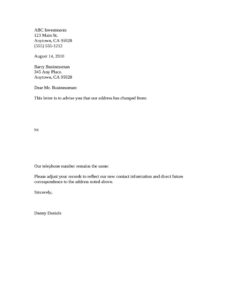
Address Change notification letter
Download a free Address Change notification letter template in PDF and DOCX to inform clients, vendors, and contacts of your new business address.
DOCX
1 downloads
0
likes
Download Files
- DOCX
An Address Change notification letter is a short business letter used to formally inform clients, vendors, banks, and other contacts that your company or office has moved to a new location. The most common reason people use it is to make sure invoices, statements, and correspondence reach the right place after a relocation. You can download this template free in both PDF and DOCX formats, with no signup required.
What Is an Address Change Notification Letter?
An Address Change notification letter is a written notice—usually printed on letterhead or sent by email—that announces a sender’s updated mailing address and asks the recipient to update their records accordingly. It is typically issued by a business, professional office, or organization, though individuals use a similar format too. The letter documents both the old address and the new address, confirms whether the phone number and other contact details have stayed the same, and provides an effective date or context for the change. Its purpose is practical: to prevent lost mail, misdirected payments, and missed communications during and after a move. Because it creates a clear written record, it also helps resolve disputes about whether a contact was properly notified.
When Do You Need an Address Change Notification Letter?
This letter is useful any time a business or professional relocates and needs to keep its relationships running smoothly. Common situations include:
- Your company moves to a new office, suite, or building and you need to notify ongoing clients.
- You want to inform suppliers and vendors so future invoices and shipments go to the correct location.
- You need to update banks, insurers, or financial partners like the “ABC Investments” example so statements and notices arrive properly.
- You are changing your registered mailing address with regulatory bodies, professional associations, or licensing boards.
- You want to alert subscription services, utilities, or membership organizations before mail starts piling up at the old address.
- You need a paper trail proving you gave formal notice of your new contact details to a specific party.
What an Address Change Notification Letter Should Have
A complete and effective notification letter is brief but leaves no room for confusion. It should include the sender’s business name and current letterhead details, the date the letter is written, and the recipient’s name and address. The body must clearly state both the old address and the new address so the recipient can match the change to existing records. If the phone number, fax, or email remain unchanged, say so explicitly to avoid accidental edits. A polite request asking the recipient to update their files and redirect future correspondence completes the message. Finally, a courteous closing and a signature from a named representative give the letter authority and a clear point of contact.
How to Fill Out an Address Change Notification Letter
- Sender block: At the top, enter your company name, current address, city, state, ZIP, and phone—mirroring the “ABC Investments, 123 Main St., Anytown, CA 95928, (555) 555-1212” layout.
- Date: Add the date you are sending the letter (e.g., August 14, 2010), which establishes when notice was given.
- Recipient name and address: Enter the contact’s name and mailing address, as with “Barry Businessman, 345 Any Place, Anytown, CA 95928.”
- Salutation: Open with a courteous greeting such as “Dear Mr. Businessman:”
- Old address: Fill in the “changed from” line with your previous full address.
- New address: Fill in the “to” line with your complete new address.
- Unchanged details: Confirm what stays the same—”Our telephone number remains the same.”
- Request and closing: Ask the reader to update their records, then sign off with “Sincerely,” and your name, like “Danny Daniels.”
Tips for Sending the Letter Effectively
Timing and delivery matter as much as wording. Send the letter shortly before or right at the time of your move so contacts have a window to update their systems. For important recipients—banks, key vendors, or government offices—consider sending the notice by certified mail or with delivery confirmation so you have proof it was received. Keep a copy of every letter you send, along with the date, in case a payment or document later goes missing. If you have many contacts, you can reuse the same template and simply swap the recipient block, which makes a mass notification quick and consistent. Where possible, set up mail forwarding through your postal service as a safety net to catch anyone you may have missed.
Letter vs. Email or Online Form
A formal printed letter carries more weight than a quick email and is sometimes required by financial institutions, regulators, or contracts that specify written notice. An email is faster and fine for casual contacts, but it can be overlooked or filtered into spam. Many large organizations also offer an online address-update form, which is convenient but may not generate a record you control. Using this letter template gives you a clean, professional document you can print, email as an attachment, or keep on file—covering both formal requirements and your own recordkeeping.
Common Mistakes to Avoid
- Listing only the new address and forgetting the old one, which makes it hard for the recipient to find the right record to change.
- Mistyping the suite number, ZIP code, or street name in the new address—double-check every character.
- Forgetting to confirm which details stay the same, leading a recipient to wrongly delete your unchanged phone number.
- Sending the letter too late, after mail and payments have already gone to the old address.
- Not keeping a copy or proof of delivery for important recipients.
- Using a vague signature with no named representative, so the recipient has no one to contact with questions.
Frequently Asked Questions
What is an Address Change notification letter used for? It is used to formally tell clients, vendors, banks, and other contacts that your mailing address has changed. The letter documents the old and new addresses and asks the recipient to update their records so future mail and payments arrive correctly.
How do I fill out the template? Replace the sample details with your own: your company name and current contact block, the date, the recipient’s name and address, your old address on the “from” line, your new address on the “to” line, and your signature. Confirm any details that stay the same, such as your phone number, before sending.
Does an address change letter need to be notarized or witnessed? In most cases, no. It is an informational business notice rather than a legal instrument, so a signature is usually enough. However, certain regulatory or financial filings may have their own format requirements, so check the recipient’s specific instructions.
Is this letter legally binding? The letter itself is a notice, not a contract, but it can serve as evidence that you gave proper written notification of your new address. If a contract requires written notice of changes, keeping a dated copy helps demonstrate you met that obligation.
How much does this template cost? Nothing—it is completely free to download from Business Forms Pro in both PDF and DOCX formats, with no signup or account required. You can edit the DOCX version in your word processor and reuse it for multiple recipients.
Should I send it by regular mail or email? Either works, but for important contacts like banks and government offices, mailing a signed copy—ideally with delivery confirmation—creates a stronger record. Email is faster and fine for routine contacts, and you can attach the PDF version for a professional appearance.
This template is provided as a general example for informational purposes only and is not legal, financial, or tax advice. Notice requirements and acceptable formats vary by jurisdiction and by the recipient’s own rules—consult a qualified professional if you have specific concerns.
Related Forms
Browse more in Contact.