
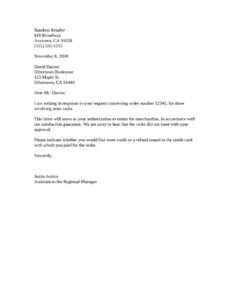
Authorization To Return Merchandise
Download a free Authorization to Return Merchandise letter template in PDF and DOCX to approve customer returns, refunds, or store credit quickly.
DOCX
4 downloads
0
likes
Download Files
- DOCX
An Authorization to Return Merchandise is a short business letter a seller sends to confirm that a customer is approved to send goods back, usually in connection with a satisfaction guarantee or return policy. Companies most often use it to formally greenlight a return and ask whether the buyer wants a refund or store credit. You can download this template free in both PDF and DOCX, with no signup required.
What Is an Authorization to Return Merchandise?
An Authorization to Return Merchandise is a written reply from a vendor, retailer, or supplier granting a customer permission to send purchased items back. It is typically issued by a sales representative, account manager, or customer service team in response to a return request. The letter documents that the seller has reviewed the order, agreed the goods may be returned under company policy, and is prepared to process a refund or credit. In many businesses it also functions as a paper trail tied to a specific order number, helping the warehouse, accounting, and the customer stay aligned on what was approved and why. It is courteous, brief, and professional in tone.
When Do You Need an Authorization to Return Merchandise?
This letter fits any moment when a customer asks to send something back and you want a clear, written approval. Common situations include:
- A wholesale buyer reports that products — like the three revolving store racks in this example — did not meet expectations under your satisfaction guarantee.
- A retail customer requests a return within your stated return window and needs written confirmation before shipping items back.
- An item arrived damaged, defective, or different from what was ordered, and you want to authorize its return.
- A business-to-business order was over-shipped or incorrect, and the receiving company asks to return the surplus.
- You are issuing a return merchandise authorization (RMA) for tracking and want a friendly cover letter to accompany it.
- A customer needs documentation to choose between a refund to their original payment method or store credit.
Types of Return Situations
Returns generally fall into a few buckets: buyer’s remorse or dissatisfaction (covered by a goodwill or satisfaction guarantee), defective or damaged goods (often handled under warranty), and seller error such as wrong or duplicate shipments. The same authorization letter format works for all three — you simply adjust the reason and the resolution offered.
What an Authorization to Return Merchandise Should Have
A complete letter is concise but covers the essentials so there is no confusion later. It should include the seller’s company name and contact details, the date, and the recipient’s name and address. It must reference the specific order number and describe the merchandise being returned. The body should clearly state that the letter serves as authorization to return the goods and cite the policy or guarantee that applies. It should acknowledge the customer’s concern courteously, then ask the customer to choose their preferred resolution — typically a refund to the original payment method or store credit. Finally, it needs a polite closing and the signature, name, and title of the person authorizing the return.
How to Fill Out an Authorization to Return Merchandise
- Add your company header. Enter your business name, street address, city, state, ZIP, and phone — for example, Random Retailer, 818 Broadway, Anytown, CA 95928, (555) 555-1212.
- Insert the date. Use the date you are sending the letter so the timeline of the return is clear.
- Address the recipient. Fill in the customer’s name and company along with their full mailing address, such as David Davies, Othertown Bookstore, 123 Maple St., Othertown, CA.
- Open with a greeting. Use a courteous salutation like “Dear Mr. Davies:”.
- Reference the order. State the order number (e.g., 12345) and describe the items, such as “three revolving store racks.”
- Grant authorization. Confirm the letter authorizes the return, noting the relevant policy or satisfaction guarantee.
- Acknowledge the concern. Express regret that the merchandise did not meet approval.
- Request the resolution choice. Ask whether the customer prefers store credit or a refund to the card used for payment.
- Sign off. Close with “Sincerely,” then the authorizer’s name and title, such as Justin Justice, Assistant to the Regional Manager.
Tips for Handling the Return After You Send the Letter
Sending the authorization is only the first step. Pair the letter with a return merchandise authorization (RMA) number if your system uses one, so the warehouse can match incoming goods to the approval. Tell the customer where to ship the items, who pays return freight, and any condition or packaging requirements. Set a clear expectation for how long the refund or credit will take once the goods are received and inspected. Keeping a copy of the signed letter on file protects both parties if a dispute arises later, and it gives your accounting team the documentation they need to issue the credit.
How It Differs from a Standard RMA Form
A formal RMA form is often a structured document with fields for serial numbers, reason codes, and warehouse routing. This authorization letter is the human-friendly counterpart: it confirms approval in plain language and keeps the customer relationship warm. Many businesses use both — the letter to communicate, the RMA number to track. For smaller orders or wholesale accounts, this letter alone may be all the documentation you need.
Common Mistakes to Avoid
- Omitting the order number. Without it, your warehouse and accounting teams cannot match the return to the original sale.
- Failing to describe the merchandise. Vague references invite the wrong items being shipped back.
- Not stating the resolution options. Leaving out whether you offer a refund, store credit, or both leads to follow-up emails and delays.
- Skipping the policy reference. Citing your satisfaction guarantee or return window sets clear expectations and protects you.
- Forgetting the signature and title. An unsigned letter looks unofficial and may not be honored internally.
- Using a cold tone. A curt letter can damage a customer relationship; keep it courteous even when declining future returns.
Frequently Asked Questions
What is an Authorization to Return Merchandise? It is a letter from a seller confirming that a customer is approved to return purchased goods, usually under a return policy or satisfaction guarantee. It references the order, describes the items, and explains how the refund or credit will be handled.
How do I fill out the return authorization letter? Add your company header and date, address the customer, reference the order number and merchandise, state that the letter authorizes the return, and ask the customer to choose a refund or store credit. Finish with a polite closing, signature, name, and title.
Is an Authorization to Return Merchandise legally binding? The letter documents an agreement to accept a return, but it is generally a business communication rather than a formal contract. Your underlying sales terms, return policy, and any consumer-protection laws govern the actual obligations between the parties.
Does this letter need to be notarized or witnessed? No. A return authorization is routine business correspondence and does not require notarization or witnesses. A signature from an authorized representative is sufficient.
Should I offer a refund or store credit? That depends on your company policy. This template lets you offer either or both and asks the customer to indicate their preference, which keeps the process transparent and reduces back-and-forth.
How much does this template cost? Nothing — it is completely free to download from Business Forms Pro in PDF and DOCX formats, with no signup or account required. You can edit it to match your company’s branding and return policy.
This template is a general example provided for informational purposes only and is not legal, financial, or tax advice. Return obligations and consumer-protection requirements vary by jurisdiction and by your own sales terms. Consult a qualified professional to ensure your return practices comply with applicable laws.
Need to work out sales tax? Use our free Sales Tax Calculator to add or remove sales tax from any amount in seconds.
Official resource: for the rules that apply to your situation, see the U.S. Small Business Administration.
Related Forms
- Commission Summary
- Amortization Schedule
- Transmittal Letter
- Gift Certificate Log
- Daily Sales Log
- Price Quote Request Form
Browse more in Sales.