
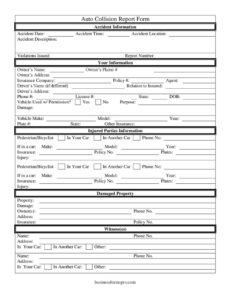
Auto Collision Report Form
Document a car accident accurately with our free Auto Collision Report Form template, capturing drivers, vehicles, injuries, and witnesses — free download in PDF and DOCX.
PDF
DOC
2 downloads
0
likes
Download Files
- DOC
An Auto Collision Report Form is a structured document used to record the full details of a vehicle accident — when and where it happened, who was involved, what was damaged, and who witnessed it. People most often use it immediately after a crash to capture facts before memories fade and to support an insurance claim. You can download this form free in both PDF and DOCX formats, with no signup required.
What Is an Auto Collision Report Form?
An Auto Collision Report Form is a single-document worksheet that gathers every key fact about a motor vehicle accident in one place. It is typically completed by a driver, vehicle owner, or insured party at or near the scene, and may also be used by fleet managers, rideshare operators, or company drivers to report incidents to their employer or insurer. The form documents the accident circumstances, the people and vehicles involved, any injuries, damaged property, and witness contact information. Unlike an official police report, this is your own organized record — but it captures the same categories of information, making it easier to file claims, answer adjuster questions, and reconstruct what happened weeks or months later.
When Do You Need an Auto Collision Report Form?
- Right after a fender-bender or major crash, when you need to record the other driver’s details, plate number, and insurance before anyone leaves.
- When filing a claim with your insurance company and the adjuster asks for a written account of the accident.
- For company or fleet vehicles, where employers require drivers to submit a standardized incident report.
- When a pedestrian, cyclist, or passenger is injured and you must document who was hurt and how.
- When property other than a vehicle — a fence, mailbox, parked car, or storefront — is damaged and the owner needs to be identified.
- If a citation or violation was issued and you want to keep a clear record alongside the official report number.
What an Auto Collision Report Form Should Have
A complete report leaves no important detail to memory. It should capture the accident’s date, time, exact location, and a factual description of how it unfolded, along with any violations issued and the official report number if police responded. It needs full owner and driver identification, insurance policy details, and vehicle descriptions. Strong forms also separate injured parties by where they were — pedestrian, in your car, or in another car — and provide space for damaged property, its owner, and independent witnesses. The more thoroughly each section is filled in, the more useful the document becomes.
How to Fill Out an Auto Collision Report Form
- Under Accident Information, enter the accident date, time, and location, then write a clear, factual description of what happened. Note any violations issued and the police report number.
- In Your Information, record the owner’s name, phone, and address, then the insurance company, policy number, and agent.
- If the driver differs from the owner, complete the driver’s name, relation to insured, address, phone, license number, state, and date of birth.
- Indicate whether the vehicle was used with permission (Yes/No), the purpose of the trip, and a description of the damage.
- Describe the vehicle: make, model, year, plate number, state, and any other insurance carried.
- Under Injured Parties, note each person and whether they were a pedestrian/bicyclist, in your car, or in another car, with phone numbers and — if in a car — that vehicle’s make, model, year, insurance, policy number, plates, and the injury and damage.
- Record damaged property, its owner(s), phone, address, insurance, and policy number.
- List each witness with name, phone, address, and where they were located.
Tips for an Accurate, Useful Report
Fill out the form while the scene is still fresh — ideally before you leave. Write the accident description in plain, neutral language: state the facts (“vehicle stopped at red light, struck from behind”) rather than assigning blame or speculating about fault. Photograph everything you describe in the form so your written notes match visual evidence. Double-check plate numbers, policy numbers, and license numbers character by character, since a single transposed digit can stall a claim. If a police officer responded, ask for the official report number and the responding agency so you can request the full report later. Keep your completed form and any photos together in one place.
How It Differs From a Police Report
This form is your personal record, not an official government document. A police report is prepared by responding officers and may include their assessment of fault, diagrams, and citations; it carries legal weight that your own notes do not. However, your Auto Collision Report Form is often more immediate and detailed about contact information and insurance, and it’s something you control entirely. Use both together: your form to capture everything on the spot, and the official report number field to link to the authorities’ version. Insurers typically welcome a clear policyholder account that complements the official record.
Common Mistakes to Avoid
- Leaving the other driver’s insurance company and policy number blank — without them, your claim can be delayed significantly.
- Confusing the vehicle owner with the driver; complete the separate driver section whenever they differ.
- Writing opinions or admissions of fault in the description instead of objective facts.
- Forgetting to record witnesses’ contact details before they leave the scene.
- Omitting injured passengers or pedestrians, or failing to note which vehicle they were in.
- Recording an approximate time or location instead of the precise details an adjuster needs.
Frequently Asked Questions
What is an Auto Collision Report Form used for? It is used to document the complete details of a car accident in one organized place — the date, time, location, vehicles, drivers, injuries, damaged property, and witnesses. People most commonly use it to support an insurance claim and to preserve facts before they’re forgotten. It can also satisfy an employer’s incident-reporting requirement for fleet or company vehicles.
Is this the same as a police accident report? No. This is your own record that you complete, while a police report is an official document prepared by responding officers. The two work well together: this form captures contact and insurance details immediately, and you can note the official report number to link to the authorities’ version. For serious accidents, you should still report to police where required by local law.
Does an Auto Collision Report Form need to be notarized? Generally no. It is a factual record rather than a sworn legal instrument, so notarization is not typically required. Always sign and date it, and follow any specific instructions from your insurer or employer about how reports should be submitted.
How soon after the accident should I complete it? As soon as it is safe to do so — ideally at the scene while details, plate numbers, and witnesses are still available. The longer you wait, the more likely you are to forget important facts. If you can’t finish at the scene, complete it the same day.
What if the driver wasn’t the vehicle’s owner? The form includes a separate driver section for exactly this situation. Fill in the driver’s name, their relation to the insured, address, phone, license number, state, and date of birth, and indicate whether the vehicle was used with permission. This helps the insurer determine coverage.
How much does this form cost? Nothing — this Auto Collision Report Form template is completely free to download from Business Forms Pro in both PDF and DOCX formats, with no signup or account required. You can print it to keep in your glove box or fill it out digitally after an incident.
This template is a general example provided for informational purposes only and does not constitute legal, insurance, or financial advice. Reporting requirements and obligations after an accident vary by state and jurisdiction. Consult your insurance provider and a qualified professional, and follow all applicable laws regarding reporting accidents to authorities.
Related Forms
- Blank Survey Template
- Letter to Legislator Giving Support
- Customizable Now Hiring Sign
- PICK Chart
- Gantt Chart Eight Weeks
- Weekly Schedule By Name
Browse more in Miscellaneous.