
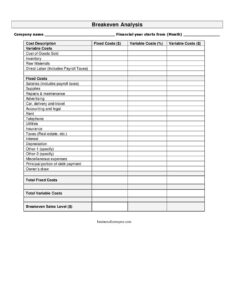
Break Even Analysis
Use this free Break Even Analysis template to calculate the sales level your business needs to cover costs — free PDF and DOCX download, no signup.
PDF
DOCX
0
likes
Download Files
- DOCX
A Break Even Analysis is a financial worksheet that calculates the exact sales level at which your total revenue equals your total costs — the point where your business stops losing money and starts making a profit. People most often use it to figure out how much they need to sell to cover fixed and variable costs before launching a product, opening a location, or setting prices. You can download this template free in PDF and DOCX, with no signup required.
What Is a Break Even Analysis?
A Break Even Analysis is a planning tool used by business owners, founders, finance teams, and lenders to determine the minimum sales volume needed to cover all expenses. It separates costs into fixed costs (expenses that stay the same regardless of how much you sell, like rent and insurance) and variable costs (expenses that rise and fall with sales volume, like raw materials and direct labor). By comparing these against revenue, it pinpoints the break-even sales level. This template documents company details, a detailed cost breakdown across categories like cost of goods sold, salaries, advertising, and utilities, and the resulting totals — giving you a clear, organized picture of what it really takes to keep the doors open.
When Do You Need a Break Even Analysis?
This worksheet is useful any time you need to understand the relationship between costs, pricing, and sales volume. Common situations include:
- Starting a new business — to estimate how many units or how much revenue you must generate to become self-sustaining.
- Launching a new product or service — to confirm the pricing covers both production costs and overhead.
- Applying for a loan or pitching investors — lenders and backers want to see you understand your cost structure and path to profitability.
- Setting or revising prices — to see how a price change affects the volume you need to sell.
- Evaluating a major expense — such as new equipment, a lease, or an additional hire that raises fixed costs.
- Annual budgeting — to set realistic sales targets for the upcoming financial year.
What a Break Even Analysis Should Have
A complete analysis identifies every recurring cost and sorts it correctly. The essential elements are the company name and the month your financial year starts from, a clear cost description for each line, and a full separation of fixed costs from variable costs. It should capture cost of goods sold, inventory, raw materials, direct labor, salaries, supplies, repairs and maintenance, advertising, vehicle and travel expenses, accounting and legal fees, rent, telephone, utilities, insurance, taxes, interest, depreciation, the principal portion of debt payments, and the owner’s draw. Finally, it must total fixed and variable costs and present the calculated break-even sales level so the result is immediately visible.
How to Fill Out a Break Even Analysis
- Enter your company name and the month your financial year starts from at the top to anchor the period covered.
- For each row, write a clear cost description and decide whether the amount belongs in the fixed costs or variable costs column.
- Record variable costs that move with sales: cost of goods sold, inventory, raw materials, direct labor (include payroll taxes), and supplies.
- Enter fixed operating costs: salaries (with payroll taxes), repairs and maintenance, advertising, car, delivery and travel, and accounting and legal fees.
- Add facility and overhead lines: rent, telephone, utilities, insurance, taxes (real estate, etc.), interest, and depreciation.
- Capture remaining items in other and miscellaneous expenses, then add the principal portion of debt payment and owner’s draw.
- Sum the columns into total fixed costs and total variable costs, then compute the break-even sales level using your contribution margin.
Understanding the Break-Even Calculation
The core formula is straightforward: divide total fixed costs by your contribution margin ratio. The contribution margin is the portion of each sales dollar left after variable costs are subtracted — so if variable costs are 40% of sales, your contribution margin is 60%, or 0.60. Dividing total fixed costs by 0.60 gives the revenue you must earn to break even. For example, with $60,000 in total fixed costs and a 0.60 margin, the break-even sales level is $100,000. Every dollar of sales above that point contributes to profit, while every dollar below it deepens a loss. Getting the fixed-versus-variable split right is what makes this number trustworthy.
Tips for an Accurate Analysis
Be honest and conservative with your estimates — it is better to overstate costs slightly than to be caught short. Remember that some line items, such as labor or utilities, can be partly fixed and partly variable; split them as accurately as you can. Treat the owner’s draw and the principal portion of debt payment deliberately, since they affect cash flow even though they may not appear on a standard income statement. Revisit the worksheet whenever a major cost or your pricing changes, and run more than one scenario — optimistic, realistic, and worst-case — so you understand how sensitive your break-even point is to assumptions.
Common Mistakes to Avoid
- Miscategorizing costs — putting a variable cost in the fixed column (or vice versa) distorts the contribution margin and the final result.
- Forgetting payroll taxes — direct labor and salaries should include payroll taxes, not just wages.
- Omitting hidden costs — leaving out depreciation, interest, or insurance makes break-even look lower than it really is.
- Ignoring owner’s draw and debt principal — these consume cash even though they may sit outside operating profit.
- Using a single optimistic scenario — failing to test conservative assumptions leaves you exposed if sales come in soft.
- Never updating the analysis — costs and prices change, so a stale worksheet quickly becomes misleading.
Frequently Asked Questions
What is a break even analysis used for? It calculates the sales level at which total revenue covers all fixed and variable costs, so profit begins. Business owners use it to set prices, plan launches, evaluate big expenses, and support loan or investor applications.
How do I calculate my break-even point? Total your fixed and variable costs, then determine your contribution margin (sales minus variable costs as a percentage of sales). Divide total fixed costs by that margin to find the break-even sales level shown on this template.
What’s the difference between fixed and variable costs? Fixed costs stay roughly the same no matter how much you sell — examples include rent, insurance, and salaries. Variable costs rise and fall with sales volume, such as raw materials, inventory, and cost of goods sold.
Should I include owner’s draw and depreciation? Yes — this template lists both because they affect your true financial picture. Owner’s draw and the principal portion of debt consume cash, while depreciation reflects the cost of using up assets, so including them gives a more realistic break-even target.
Is this break even analysis template free? Yes, it is completely free to download in both PDF and DOCX formats, with no signup or payment required. You can fill it in by hand on the PDF or edit the DOCX version on your computer.
How often should I update my break even analysis? Review it at least once a year during budgeting, and recalculate whenever a significant cost changes, you adjust prices, or you take on new fixed expenses like a lease or additional staff. Frequent updates keep your sales targets realistic.
This Break Even Analysis template is a general example provided for informational purposes only and is not financial, accounting, or tax advice. Accounting practices and reporting requirements vary by jurisdiction and business type — consult a qualified accountant or financial professional before relying on these figures for important decisions.
Official resource: for the rules that apply to your situation, see the Consumer Financial Protection Bureau.
Related Forms
- Business Checking Record
- Stock Portfolio
- Dependent Care Claim Form
- Accounts Receivable Aging
- Hair Cash Envelope
- Large-Print Bill Tracker
Browse more in Money.