
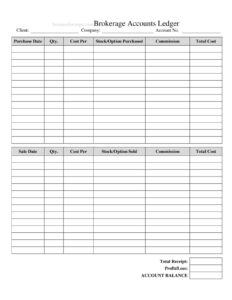
Brokerage Accounts Ledger
Track investment holdings, trades, and balances with this free Brokerage Accounts Ledger template, available as a free download in PDF and DOCX.
PDF
DOCX
4 downloads
0
likes
Download Files
- DOCX
A Brokerage Accounts Ledger is a record-keeping document used to track every investment account, transaction, and balance in one organized place. People most often use it to keep a clear running history of trades, deposits, dividends, and account values across multiple brokerages. It is free to download here in both PDF and DOCX formats, with no signup required.
What Is a Brokerage Accounts Ledger?
A Brokerage Accounts Ledger is a structured log that documents the activity and standing of one or more investment accounts held at brokerage firms. Individual investors, families managing shared portfolios, financial advisors, bookkeepers, and small business owners use it to consolidate scattered statements into a single reference. It typically records account identifiers, security purchases and sales, contributions and withdrawals, dividends and interest, fees, and the resulting balances over time. Rather than replacing official brokerage statements, the ledger summarizes and cross-checks them so you always know where your money is. It serves as both a planning tool and a paper trail, making it easier to monitor performance, reconcile records, and prepare for tax season.
When Do You Need a Brokerage Accounts Ledger?
This ledger is useful any time investment activity needs to be tracked deliberately rather than guessed at. Common situations include:
- Managing multiple accounts — when you hold taxable, retirement, and joint accounts across several brokerages and want one consolidated view.
- Tracking trades through the year — logging each buy and sell so cost basis and gains are easy to find at tax time.
- Recording dividends and interest — keeping a running tally of income generated by your holdings.
- Monitoring contributions and withdrawals — documenting how much you have added or removed and when.
- Reconciling against statements — comparing your own figures to official brokerage statements to catch errors or unauthorized activity.
- Estate and family planning — giving a spouse, executor, or trusted relative a clear map of where assets are held.
What a Brokerage Accounts Ledger Should Have
A complete ledger captures enough detail to identify each account and explain every change in value. The most important elements are:
- Account details — brokerage name, account number or nickname, and account type (individual, joint, IRA, etc.).
- Date of each entry — so the timeline of activity is clear and sortable.
- Transaction type — buy, sell, deposit, withdrawal, dividend, interest, or fee.
- Security and quantity — the ticker or fund name and number of shares or units involved.
- Price and amount — per-share price and total dollar value of the transaction.
- Running balance — the updated cash or account value after the entry.
- Notes — context such as reinvested dividends, transfers, or corrections.
How to Fill Out a Brokerage Accounts Ledger
Work through the ledger one entry at a time so your records stay accurate and easy to audit:
- List your accounts. At the top or in a header section, record each brokerage name, account number or nickname, and account type.
- Enter the date. For every transaction, write the trade or settlement date so entries appear in chronological order.
- Choose the transaction type. Mark whether the line is a purchase, sale, deposit, withdrawal, dividend, interest, or fee.
- Identify the security. Note the ticker symbol or fund name and the quantity of shares or units.
- Record the price and total. Enter the per-unit price and the total dollar amount, including any commission.
- Update the running balance. Adjust the cash or account value to reflect the entry.
- Add notes. Capture anything that explains the entry, such as a dividend reinvestment or an account transfer.
- Reconcile periodically. Compare totals to your official statement at month-end and correct discrepancies.
Tips for Keeping Accurate Records
The value of a ledger comes from consistency. Update it on a regular schedule — weekly or right after each trade — rather than trying to reconstruct months of activity at once. Keep your supporting documents, such as trade confirmations and brokerage statements, filed alongside the ledger so you can verify any figure. Use the same naming conventions for tickers and account nicknames throughout, which prevents confusion when you sort or total entries. If you maintain the DOCX version, consider creating a separate table or page for each account so balances never get mixed together. For tax purposes, flag entries that affect cost basis or generate taxable income so they are simple to locate later.
Ledger vs. Brokerage Statement
A brokerage statement is the official record produced by your financial institution; your ledger is a personal summary you control. The statement is authoritative, but it arrives on the brokerage’s schedule, may span dozens of pages, and rarely combines multiple firms into one view. Your ledger fills those gaps by letting you record activity in real time, consolidate accounts across providers, and annotate entries with your own notes. When the two disagree, the statement generally wins — your ledger exists to help you catch and investigate those differences, not to override them.
Common Mistakes to Avoid
- Updating sporadically — long gaps make it hard to remember details and lead to missed entries.
- Forgetting fees and commissions — leaving these out distorts your true cost basis and returns.
- Mixing accounts together — combining balances from different accounts makes reconciliation nearly impossible.
- Omitting dividend reinvestments — these change your share count and basis even when no cash moves.
- Not reconciling with statements — without comparison, errors and unauthorized activity can go unnoticed.
- Storing it insecurely — account numbers and holdings are sensitive, so protect the file accordingly.
Frequently Asked Questions
What is a Brokerage Accounts Ledger used for? It is used to track investment account activity — trades, deposits, withdrawals, dividends, fees, and balances — in one organized place. Investors rely on it to monitor performance, reconcile against official statements, and prepare records for tax season. It complements, rather than replaces, the statements your brokerage provides.
How do I fill out a Brokerage Accounts Ledger? Start by listing each account with its brokerage name, number, and type, then log every transaction by date, type, security, quantity, price, and total. Update the running balance after each entry and add notes for context. Reconcile your totals against your brokerage statement on a regular schedule.
Is a Brokerage Accounts Ledger an official record? No. The official record is the statement produced by your brokerage. Your ledger is a personal tracking tool you maintain yourself, and if the two ever conflict, the brokerage statement is the authoritative source.
Does this ledger replace my tax documents? It does not. Forms such as the 1099 from your brokerage remain the documents used for filing taxes. A well-kept ledger does make tax preparation easier by helping you locate cost basis, capital gains, and income throughout the year.
Can I track multiple brokerage accounts in one ledger? Yes, and many people do. Just keep each account clearly separated — a dedicated table, section, or page per account — so balances and reconciliations never get blended together.
How much does this template cost? Nothing. The Brokerage Accounts Ledger is available as a free download in both PDF and DOCX formats, with no signup required, so you can print it or edit it in your word processor right away.
This template is a general example provided for informational purposes only and is not financial, investment, or tax advice. Record-keeping and tax requirements vary by jurisdiction and situation, so consult a qualified financial advisor or tax professional regarding your specific circumstances.
Official resource: for the rules that apply to your situation, see the Consumer Financial Protection Bureau.
Related Forms
- Account Statement
- Household Cash Envelope
- Loan Deferral Request
- Payment Calculator per $10000
- Cash Receipts
- Christmas Cash Envelope
Browse more in Money.