
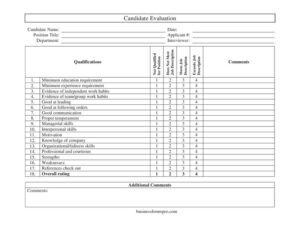
Candidate Evaluation
Download a free Candidate Evaluation form template in PDF and DOCX to score interviews fairly, document qualifications, and compare applicants consistently.
PDF
DOC
0
likes
Download Files
- DOC
A Candidate Evaluation form is a structured scoring sheet that interviewers use to rate a job applicant against the requirements of a specific role. It is the single most reliable way to turn a subjective interview into a documented, comparable record — and you can download it here for free in PDF and DOCX, with no signup required.
What Is a Candidate Evaluation Form?
A Candidate Evaluation form is a hiring document that records how well a person performed in an interview and how closely they match the job description. It is typically completed by the interviewer, hiring manager, or a member of a selection panel immediately after meeting the applicant. The form captures basic identifying details, a rating of qualifications, scores across competencies such as communication and motivation, and free-text notes on strengths and weaknesses. Its purpose is to standardize decision-making so candidates are judged on the same criteria, to create a paper trail for HR and compliance, and to make it easier to compare several applicants for the same position objectively rather than relying on memory.
When Do You Need a Candidate Evaluation Form?
- After interviewing applicants for an open position title, so each interviewer records consistent feedback.
- When a hiring panel needs to compare multiple candidates side by side using the same scoring categories.
- For roles that require specific minimum education or experience, where you must document whether each applicant meets the threshold.
- When HR or legal needs a record showing that hiring decisions were based on job-related criteria.
- During structured or behavioral interviews, where ratings on leadership, teamwork, and temperament guide the final shortlist.
- When debriefing as a team and you want a single overall rating and summary to anchor the discussion.
What a Candidate Evaluation Form Should Have
A complete evaluation form pairs identifying information with a clear rating framework. It should identify the candidate, the role, and the evaluator, then provide a consistent scale for qualifications — for example, Not Qualified, Does Not Meet Job Description, Meets Job Description, and Exceeds Job Description. Beyond that headline judgment, it should include rating lines for the specific competencies the role demands: work habits, communication, motivation, interpersonal and managerial skills. Finally, it needs space for narrative comments, documented strengths and weaknesses, confirmation that references checked out, and a single overall rating that summarizes the recommendation. The strongest forms keep every field tied to the job description so that the score reflects fit, not personal preference.
How to Fill Out a Candidate Evaluation Form
- Enter the Candidate Name, the Date of the interview, the Position Title, the Applicant #, and the Department at the top so the record can be filed and matched.
- Write your name in the Interviewer field so feedback is attributable.
- Under Qualifications, select the appropriate level: Not Qualified for Position, Does Not Meet Job Description, Meets Job Description, or Exceeds Job Description.
- Confirm whether the candidate satisfies the minimum education requirement and minimum experience requirement.
- Rate observed traits: independent work habits, team/group work habits, ability to lead and to follow orders, communication, temperament, managerial and interpersonal skills, motivation, knowledge of the company, organizational/tidiness skills, and whether they were professional and courteous.
- Summarize the candidate’s Strengths and Weaknesses, and note whether references check out.
- Record the Overall rating and add any Additional Comments before signing and submitting to HR.
Building a Fair and Consistent Scoring Process
The value of a Candidate Evaluation form comes from using it the same way every time. Decide in advance what each rating level means so that Meets Job Description signals the same standard to every interviewer. Ratings like communication, temperament, and motivation are inherently judgment-based, so anchor them to specific examples from the interview rather than a gut feeling — note what the candidate actually said or did. Complete the form promptly while the conversation is fresh, ideally before discussing the candidate with colleagues, to avoid groupthink. When several people interview the same applicant, collect each evaluation independently and then compare them; large gaps in scores are a useful prompt to revisit the evidence together.
Keeping Evaluations Job-Related and Defensible
Hiring records can later be reviewed, so keep every comment focused on the requirements of the role. Tie your notes on strengths, weaknesses, and competencies to the job description and observable behavior, not to personal characteristics unrelated to the work. Avoid language that references age, race, religion, national origin, gender, disability, or other protected categories — comments should describe whether the person can do the job. Store completed forms securely with the rest of the applicant’s file and apply a consistent retention period. A clean, criteria-based evaluation protects both the organization and the candidate, and it makes the eventual decision far easier to explain.
Common Mistakes to Avoid
- Leaving the Applicant #, Position Title, or Department blank, which makes it hard to match the form to the right candidate later.
- Marking an overall rating without supporting comments, so the score can’t be explained.
- Letting one strong impression inflate every category (the halo effect) instead of rating each competency on its own.
- Recording subjective or personal observations unrelated to the job description.
- Filling out the form days later from memory, after the details have faded.
- Skipping the references check out field or the minimum education and experience checks before recommending a hire.
Frequently Asked Questions
What is a Candidate Evaluation form used for? It is used to score and document how an applicant performed in an interview and how well they match the job description. The form standardizes feedback across interviewers, creates a record for HR, and helps a hiring team compare multiple candidates fairly using the same criteria.
Who should complete this form? Anyone who interviews or assesses the candidate — typically the hiring manager, an HR representative, or members of an interview panel. When several people meet the same applicant, each should complete a separate form independently, then the team compares results before making a decision.
How do the qualification ratings work? The form offers four levels: Not Qualified, Does Not Meet Job Description, Meets Job Description, and Exceeds Job Description. Choose the level that reflects how the candidate measures against the role’s stated requirements, and use the comments and competency ratings to support that judgment with specific evidence.
Is a Candidate Evaluation form legally required? No law requires this specific form, but maintaining structured, job-related evaluations is a recognized best practice that supports fair hiring and helps demonstrate that decisions were based on qualifications. Many organizations keep them as part of the applicant file for consistency and accountability.
How long should we keep completed evaluations? Retention periods vary by jurisdiction and by employer policy, and recordkeeping rules for hiring documents differ by location. Store completed forms securely with the applicant’s file and follow your organization’s records-retention schedule and local requirements.
Is this Candidate Evaluation template free to download? Yes. You can download this template free in both PDF and DOCX formats with no signup required. The DOCX version is fully editable, so you can adjust the rating categories and competencies to fit the specific position and your hiring process.
This Candidate Evaluation template is a general example provided for informational purposes only and does not constitute legal, HR, or employment advice. Hiring and recordkeeping requirements vary by jurisdiction and may change over time. Consult a qualified HR or legal professional to ensure your evaluation practices comply with applicable laws.
Official resource: for the rules that apply to your situation, see the U.S. Department of Labor.
Related Forms
- Employee Of The Month Nomination Form
- Employee Exit Interview
- Employee Fired For Cause
- Employee Name Change Notification
- Employee Termination Notice
- Employee Benefits Sheet
Browse more in Employment.