
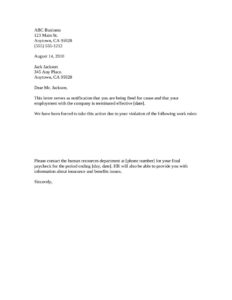
Employee Fired For Cause
Download a free Employee Fired For Cause termination letter template to document a cause-based dismissal clearly — free PDF and DOCX download, no signup.
DOCX
1 downloads
0
likes
Download Files
- DOCX
An Employee Fired For Cause letter is a formal written notice that an employer gives a worker whose employment is being terminated because of specific misconduct or policy violations. Most companies use it to create a clear, dated record of why a dismissal occurred and what the employee should do next. You can download this template free in PDF and DOCX with no signup required.
What Is an Employee Fired For Cause Letter?
An Employee Fired For Cause letter is a document issued by an employer — usually a manager or the human resources department — to notify an employee that their employment is ending due to a specific reason such as a violation of company work rules. Unlike a layoff or a no-fault separation, a for-cause termination cites a justifiable basis, such as misconduct, repeated rule violations, or breach of policy. The letter documents the effective termination date, the rules that were violated, and practical next steps like collecting a final paycheck and obtaining benefits information. It serves both as official notice to the employee and as a record the company can keep in the personnel file.
When Do You Need an Employee Fired For Cause Letter?
Employers turn to this letter whenever a termination is tied to a documented reason rather than a business slowdown. Common situations include:
- An employee has repeatedly violated written workplace rules despite prior warnings.
- A serious single incident — such as theft, falsifying records, or workplace safety violations — warrants immediate dismissal.
- An employee has breached a code of conduct, attendance policy, or confidentiality agreement.
- Documented performance or behavior issues have continued after a formal improvement plan.
- The company needs a written record connecting the termination to specific cause for the personnel file.
- HR wants to provide the employee with clear instructions about final pay, insurance, and benefits in one document.
What an Employee Fired For Cause Letter Should Have
A complete for-cause termination letter is short, factual, and free of emotional language. Key elements include the company’s name and contact details, the date of the letter, and the employee’s name and address. The body should clearly state that employment is being terminated for cause and identify the effective termination date. It should list the specific work rules or policies that were violated so the reason is documented and unambiguous. Finally, it should give the employee actionable next steps: how to contact HR, when and how to receive the final paycheck, and where to get information about insurance and benefits. A signature line from the appropriate company representative completes the document.
How to Fill Out an Employee Fired For Cause Letter
- Enter your company name and full address at the top — for example, ABC Business, 123 Main St., Anytown, CA 95928 — along with a phone number.
- Add the date the letter is issued, such as August 14, 2010.
- Fill in the employee’s name and mailing address, for example Jack Jackson, 345 Any Place, Anytown, CA, followed by a proper salutation like “Dear Mr. Jackson.”
- In the opening sentence, confirm that the employee is being fired for cause and insert the effective termination date in the bracketed [date] field.
- List the specific work rules or policies the employee violated. Be factual and reference the actual rule numbers or policy names where possible.
- Provide the HR department’s phone number in the [phone number] field so the employee can arrange to collect the final paycheck.
- Insert the pay period ending [day, date] so the employee knows which earnings the final check covers.
- Close with “Sincerely,” and have the authorized representative sign and print their name and title.
For-Cause vs. Other Types of Termination
It helps to understand how a for-cause termination differs from related separations. A for-cause termination ends employment because of the employee’s conduct or rule violations and typically cites a specific reason. A layoff or reduction in force ends employment for business reasons unrelated to performance. A without-cause termination in at-will employment ends the relationship without a stated reason. A resignation is initiated by the employee. Because a for-cause letter explicitly attributes the dismissal to misconduct, the language should be accurate and supportable. Vague or exaggerated claims can create disputes, so stick to documented facts that match your internal records and prior warnings.
Documentation and Final Pay Tips
Before issuing the letter, gather supporting documentation — written warnings, incident reports, signed acknowledgments of company policy, and any performance records. This backup is important if the termination is later questioned. Many jurisdictions have specific rules about when a final paycheck must be delivered, what it must include, and how unused leave is handled, so confirm your local requirements before stating a payment date. Keep a copy of the signed letter in the employee’s personnel file, and deliver the original in person or by a trackable method. Coordinate with HR so the employee receives accurate information about continuing insurance coverage and any benefits they may be entitled to after separation.
Common Mistakes to Avoid
- Leaving the [date], [phone number], or pay-period fields blank, which leaves the employee unsure of key facts.
- Listing vague reasons like “poor attitude” instead of specific, documented rule violations.
- Including emotional, accusatory, or speculative language rather than factual statements.
- Failing to verify local rules on final-paycheck timing and content before promising a payment date.
- Forgetting to mention how the employee can obtain insurance and benefits information.
- Not keeping a signed copy of the letter and its supporting documentation in the personnel file.
Frequently Asked Questions
What does “fired for cause” mean? Being fired for cause means an employee’s job is terminated because of a specific reason tied to their conduct, such as violating company work rules, misconduct, or breach of policy. It is different from a layoff, which is based on business needs, or a no-reason termination. The letter documents the cause so the basis for the decision is clear and on record.
How do I fill out the Employee Fired For Cause letter? Start by adding your company information, the date, and the employee’s name and address. Then state the effective termination date, list the specific work rules that were violated, and include the HR phone number and the final pay period date. Finish with an authorized signature.
Does this letter need to be notarized or witnessed? A termination letter typically does not require notarization or a witness to be valid. It is an internal employment document, not a notarized legal instrument. That said, it is good practice to have it signed by an authorized representative and to keep a dated copy in the personnel file.
Is an Employee Fired For Cause letter legally binding? The letter itself documents a decision rather than creating a contract, but it can carry legal weight as evidence of the reason and timing of termination. Because employment laws vary widely, accuracy matters and the stated reasons should be supportable. Consult a qualified professional if you are unsure how local law applies to your situation.
How much does this template cost? The template is completely free to download from Business Forms Pro in both PDF and DOCX formats. There is no signup, subscription, or payment required. You can edit the DOCX version to add your company’s details and specific work-rule violations.
When does the employee receive their final paycheck? The letter directs the employee to contact HR to arrange the final paycheck for a specified pay period. Many states set deadlines for when final wages must be paid after a termination, so verify your local requirements and fill in the correct pay-period date before issuing the letter.
This template is a general example provided for informational purposes only and is not legal, financial, or tax advice. Employment and final-pay requirements vary by jurisdiction, and individual circumstances differ. Consult a qualified attorney or HR professional before terminating an employee or relying on this document.
Official resource: for the rules that apply to your situation, see the U.S. Department of Labor.
Related Forms
- Job Application Comparison Chart
- Employee Incident Report Form
- Education Verification
- Employee Termination Notice
- Notice of Probation
- Manual Timecard Semi-Monthly Mini
Browse more in Employment.