
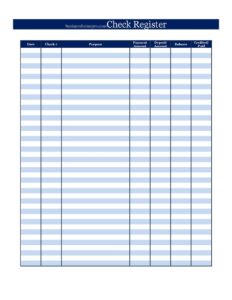
Check Register Blue
Download the Check Register Blue template free to track checks, deposits, and your running balance—free download in PDF and DOCX, no signup.
PDF
DOCX
0
likes
Download Files
- DOCX
A Check Register Blue is a simple ledger for recording every check you write, every deposit you make, and the running balance of your account. People most often use it to reconcile their checkbook against bank statements and avoid overdrafts. It’s free to download here in both PDF and DOCX formats, with no signup required.
What Is a Check Register Blue?
A Check Register Blue is a printable record-keeping sheet used to track the flow of money in and out of a checking account. Individuals, families, small business owners, and bookkeepers use it to log each transaction by date, note its purpose, and calculate an updated balance after every entry. Unlike a bank statement that arrives weeks later, a check register gives you a real-time, day-to-day picture of your available funds. The “blue” simply refers to the clean, color-coded layout of this version. It documents checks paid, deposits received, and whether each line has cleared the bank, making month-end reconciliation faster and far more accurate.
When Do You Need a Check Register Blue?
This register is useful any time you want a manual, reliable record alongside (or instead of) digital banking apps. Common situations include:
- Tracking handwritten checks for rent, utilities, contractors, or vendors so you always know what’s been issued.
- Reconciling your checkbook against your monthly bank statement to catch errors or unauthorized charges.
- Recording paycheck deposits, transfers, and cash deposits to maintain an accurate running balance.
- Managing a small business or club account where multiple people write checks and you need a shared paper trail.
- Preparing for tax season by keeping organized records of payments and the purpose of each.
- Teaching a teenager or new account holder how to balance a checkbook the traditional way.
What a Check Register Blue Should Have
A complete check register captures every detail needed to reconstruct your account activity and verify it against the bank. The essential elements are a column for the transaction date, a check number (or a note for non-check items like deposits and fees), a clear description of the purpose, separate columns for payment amounts and deposit amounts, a running balance that updates with each line, and a way to mark whether the item has cleared. Together these fields let you see at a glance what you owe, what’s pending, and what your actual spendable balance is on any given day.
How to Fill Out a Check Register Blue
- Date: Enter the date the check was written or the deposit was made. Keep entries in chronological order for easy reconciliation.
- Check #: Write the number of the check you issued. For deposits, transfers, ATM withdrawals, or bank fees, note a short code like “DEP,” “TRF,” or “FEE” instead.
- Purpose: Describe the transaction—who you paid and why, such as “Electric bill” or “Payroll deposit.” This makes future lookups and tax prep much simpler.
- Payment Amount: For money leaving the account, record the amount of the check or withdrawal here.
- Deposit Amount: For money coming into the account, record the deposit or credit amount in this column.
- Balance: Subtract a payment or add a deposit to the previous balance, and write the new running total. Update this after every single line.
- Credited/Paid: Place a checkmark once the transaction appears as cleared on your bank statement, so you can quickly spot outstanding items.
How to Reconcile With Your Bank Statement
The real power of a check register shows up at reconciliation time. When your statement arrives, compare each entry on the statement to a line in your register and place a mark in the Credited/Paid column for every item that matches. Any register entry without a mark is “outstanding”—a check that hasn’t cashed yet or a deposit still in transit. To reconcile, start with the ending balance on your statement, add deposits not yet shown, and subtract outstanding checks. The result should equal your register’s running balance. If the two don’t agree, double-check your arithmetic, look for transposed digits (writing $54 instead of $45 is common), and confirm you recorded bank fees and interest.
Tips for Keeping an Accurate Register
Record transactions immediately—ideally the moment you write a check or swipe a debit card—so nothing slips through unrecorded. Use consistent abbreviations in the Purpose column so your records read cleanly. If you share the account, agree on who logs which transactions to prevent duplicate or missing entries. Carry the running balance forward to a new sheet when one fills up, and keep completed registers filed by month or year. Many people keep both this paper register and their banking app, using the app to catch anything they forgot to write down by hand.
Common Mistakes to Avoid
- Forgetting to record debit card purchases, ATM withdrawals, or automatic payments, which causes the balance to drift higher than reality.
- Skipping bank fees, monthly service charges, or interest, which throws off reconciliation.
- Math errors when updating the running balance—always double-check additions and subtractions.
- Recording the wrong amount or transposing digits, then carrying that error forward through every later line.
- Leaving the Purpose column blank, making it impossible to identify a transaction months later.
- Failing to mark items in the Credited/Paid column, so you lose track of which checks are still outstanding.
Frequently Asked Questions
What is a check register used for? A check register is used to manually track every check, deposit, withdrawal, and fee affecting a checking account. It maintains a running balance so you always know how much money is actually available, and it makes reconciling against your bank statement quick and accurate.
How do I calculate the running balance? Start with your current balance, then for each new line subtract any payment amount or add any deposit amount. Write the result in the Balance column after every transaction so the figure always reflects your true available funds.
What does the Credited/Paid column mean? That column is where you mark a transaction once it has cleared and appears on your bank statement. Any entry left unmarked is still outstanding, which helps you identify checks that haven’t cashed yet during reconciliation.
Is a check register legally required? No, keeping a check register is not legally required, but it is a strongly recommended financial habit. It helps you avoid overdraft fees, catch bank errors, detect fraud early, and keep organized records for budgeting or taxes.
Can I use this register for a business account? Yes. The same Date, Check #, Purpose, Payment, Deposit, Balance, and Credited/Paid columns work well for small business or organizational accounts. For complex bookkeeping or tax reporting, you may eventually want dedicated accounting software, but this register is a solid starting point.
How much does the Check Register Blue template cost? It is completely free to download here in both PDF and DOCX formats, with no signup or account required. Print as many copies as you need, or edit the DOCX version to fit your account and preferences.
This Check Register Blue template is provided as a general example for informational purposes only and does not constitute financial, accounting, or tax advice. Banking practices and record-keeping requirements vary, so consult a qualified financial professional or your bank for guidance specific to your situation.
Official resource: for the rules that apply to your situation, see the Consumer Financial Protection Bureau.
Related Forms
- Monthly Bookkeeping Record
- Payment Calculator per $10000
- Zero-Based Budget
- Personal Care Envelope
- Insurance Coverage Record
- Debt Payment Organizer
Browse more in Money.