
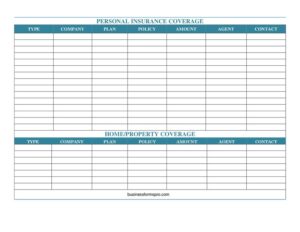
Insurance Coverage Record
Track every policy in one place with this free Insurance Coverage Record template — organize coverage, premiums, and contacts. Free download in PDF and DOCX.
PDF
DOCX
0
likes
Download Files
- DOCX
An Insurance Coverage Record is a simple worksheet that lists every insurance policy you or your household carries — including the insurer, policy number, coverage amounts, premiums, and contact details — in one organized place. People most often use it so they can find critical policy information fast during an emergency, a claim, or estate planning. It’s free to download here in both PDF and DOCX formats, with no signup required.
What Is an Insurance Coverage Record?
An Insurance Coverage Record is a personal or business reference document that consolidates the details of all your active insurance policies into a single, easy-to-scan summary. It is typically created and maintained by an individual, a family, or a small-business owner rather than issued by an insurer. The record documents what types of coverage you hold, who provides them, how much each policy pays, what you pay in premiums, and how to reach your agent or company. Its purpose is practical: instead of digging through filing cabinets or email inboxes when something happens, you have one trusted page that answers “What am I covered for, and who do I call?” It is a tracking tool, not a contract or proof of insurance.
When Do You Need an Insurance Coverage Record?
This record is useful any time you need a clear overview of your protection. Common situations include:
- Filing a claim after an accident, theft, fire, or storm, when you need your policy number and insurer phone number immediately.
- Annual policy reviews, where you compare premiums and coverage limits to decide whether to shop around or adjust deductibles.
- Estate and emergency planning, so a spouse, executor, or trusted family member can locate life, health, and property policies quickly.
- Buying a home or vehicle, when a lender asks for proof of coverage and you need to confirm what policies are in force.
- Running a small business, to track general liability, property, workers’ compensation, and professional policies in one summary.
- Bundling or switching insurers, where having every policy side by side reveals gaps, overlaps, or lapsed coverage.
What an Insurance Coverage Record Should Have
A complete Insurance Coverage Record captures enough detail to act on without pulling the full policy. The essentials are the policy holder’s name, the type of insurance (auto, home, life, health, disability, umbrella, business, etc.), the insurance company name, the policy or account number, and the named agent or broker. It should also list coverage amounts or limits, the deductible, the premium and how often it’s paid, the policy effective and expiration or renewal dates, and reliable contact information including a claims phone number. A notes column for beneficiaries, riders, or where the original documents are stored rounds out a genuinely useful record.
How to Fill Out an Insurance Coverage Record
- Enter the policy holder. Write the name of the person or business that owns the policy at the top of each entry.
- Identify the type of insurance. Label each row clearly — auto, homeowners, renters, life, health, disability, or business liability.
- Record the insurance company. Add the insurer’s full name so you don’t confuse similar policies.
- Add the policy number. Copy it exactly from your declarations page; this is the first thing a claims rep asks for.
- List the agent or broker. Include the contact name, phone number, and email for the person who services the policy.
- Note coverage limits and deductible. Enter the maximum the policy pays and what you owe out of pocket per claim.
- Fill in the premium and frequency. Write the amount and whether it’s paid monthly, quarterly, semi-annually, or annually.
- Add effective and renewal dates. Record when coverage started and when it expires or renews so nothing lapses.
- Use the notes field. Note beneficiaries, riders, payment method, or where the full policy is filed.
How to Organize and Store Your Record
A coverage record only helps if you can find it when you need it. Keep one copy in a secure but accessible spot at home — a fireproof box or a labeled binder — and consider sharing a copy with a trusted family member, executor, or business partner. If you use the DOCX version, you can keep it as a living document, updating cells whenever a policy renews. Many people store a password-protected digital copy in cloud storage so they can reach it from a phone after an accident. Avoid recording full Social Security numbers or banking login details on the sheet; reference policy numbers and contact lines instead, and keep sensitive identifiers in a separate secured location.
Keeping the Record Current
Insurance changes constantly — premiums shift at renewal, you add a teen driver, you pay off a mortgage, or you switch carriers for a better rate. Set a recurring reminder to review the record at least once a year, ideally alongside your renewal notices. Each time a policy changes, update the limits, premium, and dates immediately rather than relying on memory. When a policy is canceled or replaced, either remove the row or mark it inactive with the cancellation date so you retain a clear history. A current record turns a stressful claim into a quick phone call.
Common Mistakes to Avoid
- Listing the wrong policy number by transposing digits — always copy from the declarations page and double-check.
- Forgetting renewal dates, which leads to surprise lapses in coverage at the worst time.
- Omitting the deductible, so you can’t estimate your true out-of-pocket cost when a claim hits.
- Recording sensitive data like full account or Social Security numbers on an unsecured sheet.
- Letting the record go stale after a renewal, move, or carrier change so the details no longer match reality.
- Storing the only copy in one place — keep a backup that a trusted person can reach in an emergency.
Frequently Asked Questions
What is an Insurance Coverage Record used for? It is a personal tracking sheet that summarizes all your insurance policies — insurer, policy number, coverage, premium, and contacts — in one place. People use it to file claims faster, review coverage at renewal, and help family members locate policies in an emergency. It is a reference tool, not proof of insurance.
How do I fill out an Insurance Coverage Record? Create one row for each policy and enter the policy holder, type of insurance, insurer, policy number, agent contact, coverage limits, deductible, premium, and renewal date. Copy details directly from your declarations pages so the numbers are accurate. Add notes for beneficiaries or where the full documents are stored.
Is an Insurance Coverage Record legally binding? No. The record itself does not create or change any coverage — only your actual policies and their declarations pages are binding. Think of it as an organized summary you maintain for convenience. If there is ever a discrepancy, the official policy documents from your insurer govern.
Does it need to be notarized or witnessed? No notarization or witnesses are required, because it is an informal personal reference rather than a legal contract. You can simply fill it in and store it securely. If you keep it with estate-planning documents, your attorney can advise how to reference it.
What information should I avoid putting on it? Avoid recording full Social Security numbers, complete bank account numbers, or login passwords directly on the sheet, especially if it is shared or stored in the cloud. Use policy numbers and contact lines instead, and keep highly sensitive identifiers in a separate, secured location.
How much does this template cost? Nothing. You can download the Insurance Coverage Record for free here in both PDF and DOCX formats, with no signup or account required. Use the editable DOCX to maintain a living document you update at each renewal.
This template is a general example provided for informational purposes only and is not legal, financial, tax, or insurance advice. Coverage terms, claims procedures, and recordkeeping requirements vary by insurer and jurisdiction. For guidance on your specific policies and circumstances, consult a licensed insurance professional or qualified advisor.
Official resource: for the rules that apply to your situation, see the Consumer Financial Protection Bureau.
Related Forms
- Lump Sum Payment Planning Form
- Payment Calculator per $100
- Large-Print Bill Tracker
- Household Cash Envelope
- Bill Organizer
- Debt Payment Organizer
Browse more in Money.