
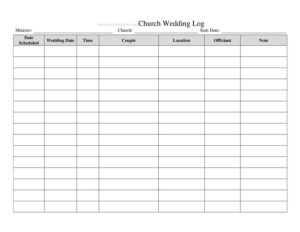
Church Wedding Log
Track every marriage ceremony at your parish with a free Church Wedding Log template, available as a free download in PDF and DOCX formats.
PDF
DOCX
7 downloads
0
likes
Download Files
- DOCX
A Church Wedding Log is a record-keeping document that parishes, congregations, and ministries use to chronicle every marriage ceremony performed within the church. The most common reason people reach for one is to maintain an accurate, ongoing register of weddings for sacramental records, certificate issuance, and historical reference. It is free to download here in both PDF and DOCX formats, with no signup required.
What Is a Church Wedding Log?
A Church Wedding Log is an organized register, usually kept by a church secretary, parish administrator, or officiating minister, that documents the essential details of each wedding the congregation hosts or solemnizes. It records who was married, when and where, who officiated, and who served as witnesses. Unlike a single marriage certificate issued to one couple, the log is a cumulative book or spreadsheet covering many ceremonies over time. Churches rely on it to answer later requests for proof of marriage, to cross-check civil filings, and to preserve the spiritual and communal history of the congregation. It supports both administrative accuracy and the long tradition of keeping faithful sacramental records.
When Do You Need a Church Wedding Log?
Almost any church that performs weddings benefits from keeping a consistent log. Common situations include:
- Recording each ceremony as it happens, so no wedding goes undocumented in the parish records.
- Responding to certificate requests when a former member needs proof of marriage years later for legal, insurance, or genealogical purposes.
- Reconciling with civil records to confirm the officiant filed the marriage license with the county or registry on time.
- Tracking annual ministry activity for board reports, denominational reporting, or year-end summaries of pastoral services.
- Preserving congregational history so future leadership and family members can trace marriages within the church community.
- Coordinating scheduling and follow-up, such as anniversary acknowledgments or pastoral care for newly married couples.
What a Church Wedding Log Should Have
A complete log captures enough detail to identify each marriage unambiguously and to confirm it was properly solemnized. Essential elements include the full names of both spouses, the date and location of the ceremony, the name and title of the officiating minister, the names of witnesses, and the marriage license or registration number. Many churches also include a reference number for each entry, the type or rite of ceremony, and a notes field for special circumstances. Space for a signature or initials from the officiant adds an extra layer of verification. The strongest logs use a uniform layout so every entry can be read and compared at a glance over months and years.
How to Fill Out a Church Wedding Log
Because this is a log of multiple ceremonies, you complete one row or entry per wedding. Work through it consistently:
- Assign an entry or record number to each ceremony so it can be referenced and located quickly later.
- Enter the wedding date exactly as it occurred, using a clear and consistent date format throughout the log.
- Record both spouses’ full legal names, including middle names or maiden names, to avoid any later identification confusion.
- Note the ceremony location, such as the sanctuary, chapel, or off-site venue where the marriage was solemnized.
- List the officiant’s name and title, for example the pastor, priest, deacon, or visiting minister who performed the rite.
- Add the names of the witnesses who signed the marriage license or attended in that official role.
- Write down the marriage license number and the issuing county or jurisdiction where applicable.
- Confirm filing status by noting whether the signed license was returned to the civil authority.
- Use the notes column for special details such as the rite used, convalidations, or pastoral observations.
Keeping Sacramental Records Accurate and Secure
A wedding log is often considered part of a church’s permanent sacramental records, so accuracy and preservation matter. Make entries promptly after each ceremony while details are fresh, and write legibly or type entries if you use the DOCX version. Store the physical log in a secure, fire-resistant location, and keep a backup copy of any digital version. Because the log may contain personal information, limit access to authorized staff and clergy. Some denominations have their own record-keeping guidelines or central registries, so coordinate the log with any required denominational reporting. A well-maintained log protects both the couple and the congregation if questions about a marriage ever arise.
Church Wedding Log vs. Marriage Certificate
It helps to understand how the log differs from related documents. A marriage certificate is the official proof of a single marriage, typically issued by a civil authority and sometimes by the church as a keepsake. A marriage license is the government authorization that allows the wedding to take place. The Church Wedding Log, by contrast, is an internal cumulative register that lists many ceremonies in one place. It does not replace the civil certificate or license, but it complements them by giving the church its own reliable history and an easy way to verify that each ceremony was recorded and properly filed.
Common Mistakes to Avoid
- Delaying entries until weeks after the ceremony, when details and license numbers are harder to recall accurately.
- Recording nicknames instead of full legal names, which complicates future certificate requests.
- Skipping the license number or the filing confirmation, leaving no link between the church record and the civil record.
- Inconsistent date formats across entries, which makes the log harder to search and verify.
- Keeping only one copy with no backup, risking total loss of records in a fire or flood.
- Leaving the witnesses or officiant fields blank, which weakens the log’s value as a verification tool.
Frequently Asked Questions
What is a Church Wedding Log used for? It is used to keep an ongoing register of every marriage ceremony a church performs. Parishes rely on it to issue or verify records later, to confirm that licenses were filed, and to preserve the congregation’s history. It serves administrative, pastoral, and historical purposes.
How do I fill out a Church Wedding Log? Complete one entry per ceremony, recording the date, both spouses’ full names, the ceremony location, the officiant, the witnesses, and the marriage license number. Add an entry number and use the notes field for any special circumstances. Make entries promptly so details stay accurate.
Is a Church Wedding Log a legal document? The log itself is primarily an internal church record rather than a government document, and it does not replace the official marriage certificate or license. However, it can support proof of a ceremony and is often treated as part of a church’s permanent records. Legal recognition requirements vary by jurisdiction.
Who is responsible for keeping the log? Typically a church secretary, parish administrator, registrar, or the officiating clergy maintains the log. Many churches assign one person to ensure entries are consistent and stored securely. The key is having a clear, single point of responsibility.
Does the log need to be notarized or witnessed? The log generally does not require notarization, since it is a cumulative internal register. The marriage license that accompanies each ceremony is the document that usually requires witnesses and official filing. Check your local and denominational requirements for specifics.
How much does this template cost? Nothing — this Church Wedding Log template is completely free to download in both PDF and DOCX formats, with no signup required. You can print it as a physical register or edit the DOCX version to match your church’s record-keeping style.
This template is provided as a general example for informational purposes only and does not constitute legal, financial, or religious record-keeping advice. Requirements for documenting and filing marriages vary by jurisdiction and denomination. Consult a qualified professional or your denominational authority to ensure your records meet applicable requirements.
Related Forms
- Psalm 23 Holy Card (2 per page)
- Prayer Journal
- St Francis Funeral Card (2 per page)
- Prayer List
- Baptism Holy Card (2 per page)
- Offering Count Sheet
Browse more in Church.