
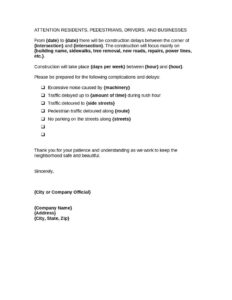
Construction Delay Letter
Download a free Construction Delay Letter template to notify residents, drivers, and businesses about work dates, locations, and delays — free download in PDF/DOCX.
DOCX
0
likes
Download Files
- DOCX
A Construction Delay Letter is a public notice that alerts residents, pedestrians, drivers, and nearby businesses about upcoming roadwork or building activity that will disrupt normal traffic and access. People most often use it to give the community advance warning about construction dates, locations, and expected complications. You can download this template for free in PDF and DOCX with no signup required.
What Is a Construction Delay Letter?
A Construction Delay Letter is a written announcement issued by a city department, contractor, property developer, or utility company to inform the surrounding area about planned construction and the disruptions it may cause. It documents the start and end dates, the affected location, the type of work being done, the daily schedule, and the specific delays people should expect. Rather than waiting for surprised drivers and frustrated neighbors, the letter sets clear expectations and frames the project as a community improvement. It is typically posted on doors, mailed to nearby addresses, displayed on signage, or distributed to local businesses so everyone affected has time to plan alternate routes, adjust deliveries, or prepare for noise.
When Do You Need a Construction Delay Letter?
This notice is useful any time work will interfere with the normal flow of a street, sidewalk, or neighborhood. Common scenarios include:
- A city is repaving roads or repairing a damaged stretch of pavement between two intersections.
- A utility company must dig up a section of street to replace water mains, gas lines, or power lines.
- A developer is constructing a new building and trucks, equipment, and crews will occupy part of the road or sidewalk.
- Sidewalk replacement or accessibility upgrades will force pedestrians to detour for several weeks.
- Tree removal or landscaping work near the curb will temporarily close lanes or block driveways.
- A business district is undergoing streetscape improvements that affect parking and foot traffic for nearby shops.
Types of Construction That Warrant Notice
The template’s flexible “focus” field lets you tailor the letter to almost any project. Roadwork and repaving generate dust, noise, and lane closures. Sidewalk and tree removal work primarily affects pedestrians and adjacent property owners. Utility projects — power lines, water mains, and underground cabling — often require digging that blocks driveways and parking. New road or new building construction tends to last longer and may involve heavy machinery, staging areas, and ongoing detours. Identifying the type of work clearly in the letter helps recipients understand exactly how the project will touch their daily routine.
What a Construction Delay Letter Should Have
A complete notice answers the basic who, what, when, and where so no one is caught off guard. It should include the construction start and end dates, a precise description of the affected area (such as the stretch between two named intersections), the type of work being performed, the days and hours crews will be active, and a clear list of expected complications like lane closures, noise, dust, or limited parking. Finally, it should close with a courteous thank-you and the contact details of the issuing official or company so recipients know who to reach with questions or concerns.
How to Fill Out a Construction Delay Letter
- Open with the attention line directed at residents, pedestrians, drivers, and businesses so everyone affected knows the notice applies to them.
- Enter the project’s start date and end date in the “From {date} to {date}” field to establish the full timeline.
- Name the two boundary points in the intersection fields — for example, “between the corner of Main St. and 5th Ave.” — so the affected zone is unmistakable.
- Describe the work in the focus field: building construction, sidewalks, tree removal, new roads, repairs, power lines, or whatever applies.
- Specify the days per week and the daily hours (start and end time) so people know when activity will occur.
- List the expected complications and delays — lane closures, detours, noise, dust, parking restrictions, or limited driveway access.
- Close with the polite thank-you line, then add the City or Company Official name, Company Name, Address, and City, State, Zip as the signature block.
Tips for Distributing the Notice
Timing and reach matter as much as the wording. Distribute the letter at least one to two weeks before construction begins so recipients can adjust their plans. Hand-deliver or mail copies to homes and businesses directly bordering the work zone, and consider posting weatherproof copies on visible signage at each affected intersection. If your jurisdiction requires permits for road closures, confirm those are approved before promising specific dates, since delays in permitting can push the timeline. Including a phone number or email in the signature block gives concerned neighbors a direct line, which reduces complaints and builds goodwill throughout the project.
How It Differs From a Permit or Work Order
A Construction Delay Letter is purely informational — it tells the public what is happening, when, and where. It is not a permit, which grants legal authorization to perform the work, nor is it a work order, which directs a crew internally. The letter assumes the necessary approvals are already in place and focuses entirely on community communication. Keep the language plain and free of technical jargon so every reader, regardless of background, understands the impact.
Common Mistakes to Avoid
- Leaving the affected area vague — always name both intersections so the boundaries are clear.
- Forgetting to list specific complications, which leaves people unsure how the work will actually affect them.
- Omitting the daily hours, so neighbors don’t know when to expect noise or equipment.
- Failing to include contact information for the issuing official or company.
- Distributing the notice too late for people to make alternate arrangements.
- Promising firm end dates before permits or weather contingencies are confirmed.
Frequently Asked Questions
What is a Construction Delay Letter used for? It is used to formally notify residents, drivers, pedestrians, and businesses about upcoming construction that will disrupt traffic or access. The letter communicates the dates, location, type of work, schedule, and expected complications so the community can prepare in advance.
Who should send a Construction Delay Letter? It is typically sent by the party responsible for the work — a city or municipal department, a general contractor, a property developer, or a utility company. The signature block should name the specific official or company so recipients know who is accountable.
Is a Construction Delay Letter legally binding? No, it is an informational notice rather than a contract or permit, so it does not create legal obligations on its own. However, some jurisdictions require public notification before certain road or utility work, so check your local rules to ensure the letter satisfies any notice requirements.
How far in advance should I send it? Send it at least one to two weeks before construction begins so people have time to plan alternate routes, reschedule deliveries, or adjust parking. For longer or larger projects, even earlier notice is appreciated.
How do I fill out the template? Enter the start and end dates, the two boundary intersections, a description of the work, the days and hours crews will be active, and the expected complications. Then complete the signature block with the official’s name, company, and full address.
How much does this template cost? It is completely free to download here in both PDF and DOCX formats, with no signup required. You can edit the DOCX version to match your project details and branding.
This Construction Delay Letter template is provided as a general example for informational purposes only and does not constitute legal advice. Public notice requirements, permit rules, and posting regulations vary by jurisdiction — consult your local authority or a qualified professional to ensure your notice complies with applicable requirements.
Related Forms
- Offer to a Potential Client
- Cease and Desist Copyright
- New Product Announcement
- Late Reply to a Customer
- Pandemic Employee Letter
- Landlord Unauthorized Guest Warning
Browse more in Business Letters.