
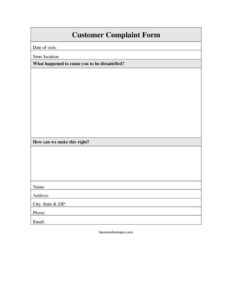
Customer Complaint Form
Download a free Customer Complaint Form template to capture, document, and resolve customer issues fast — free download in PDF and DOCX, no signup.
PDF
DOCX
0
likes
Download Files
- DOCX
A Customer Complaint Form is a simple document a business uses to capture a customer’s dissatisfaction in writing — what happened, where, and how they’d like it resolved. People most often reach for one when a shopper or client has a problem they want addressed and the business wants a consistent, trackable way to record it. You can download this Customer Complaint Form free in PDF and DOCX, with no signup required.
What Is a Customer Complaint Form?
A Customer Complaint Form is a structured intake document that lets a customer describe a negative experience and request a specific remedy. It’s typically issued by a store, restaurant, service provider, or support team and completed either by the customer directly or by a staff member taking down the details. The form documents the date and place of the incident, a description of what went wrong, the customer’s preferred resolution, and their contact information. Beyond simply recording the issue, it creates a paper trail that helps managers respond consistently, spot recurring problems, and follow up. Because it standardizes how feedback is gathered, it turns scattered verbal gripes into actionable, comparable records the business can actually use.
When Do You Need a Customer Complaint Form?
Almost any business that deals with the public benefits from having a complaint form ready at the counter, on the website, or in a service area. Common situations include:
- Retail dissatisfaction — a shopper received a damaged, defective, or wrong product and wants a refund or replacement.
- Poor service experience — a customer felt ignored, rushed, or treated rudely during a store visit and wants to be heard.
- Food or hospitality issues — a diner reports a cold meal, a billing error, or a cleanliness concern at a specific location.
- Billing and pricing disputes — a client was overcharged or charged for something they didn’t authorize.
- Long wait times or unmet promises — a service wasn’t delivered on time or didn’t match what was advertised.
- Quality-control tracking — management wants written feedback from multiple store locations to identify patterns and coach staff.
What a Customer Complaint Form Should Have
A complete complaint form balances enough detail to act on the issue with enough simplicity that a frustrated customer will actually fill it out. The essential elements are a clear date of the visit and the store location so the incident can be pinpointed, a free-text area describing what happened, and a separate field asking how the business can make it right. Just as important are full contact details — name, address, phone, and email — so someone can follow up. A good form keeps the language neutral and non-defensive, gives the customer room to explain in their own words, and signals that the business takes the matter seriously rather than treating it as a formality.
How to Fill Out a Customer Complaint Form
- Date of visit: Enter the exact date the problem occurred. If it spanned multiple days, note the date the issue began.
- Store location: Identify the specific branch, address, or store number where the experience happened so the right manager can review it.
- What happened to cause you to be dissatisfied: Describe the issue factually and specifically — what you bought or expected, what went wrong, and any staff involved. Include order numbers or receipts if available.
- How can we make this right: State your preferred resolution clearly, such as a refund, replacement, apology, or account credit.
- Name: Write your full legal name so the business can verify any purchase or account.
- Address, city, state, zip: Provide your mailing address — useful for sending replacements, refund checks, or written responses.
- Phone: Enter a number where you can be reached during business hours.
- Email: Add a reliable email for faster follow-up and written confirmation of the resolution.
Tips for Writing an Effective Complaint
The clarity of your description directly affects how quickly and fully a business can help you. Stick to facts rather than emotions: instead of writing “the service was terrible,” explain that you waited 40 minutes after being seated before anyone took your order. Reference concrete details such as receipt numbers, product names, timestamps, and employee names where you have them. State a single, reasonable resolution rather than a list of demands, which makes it easier for the business to say yes. Keep a copy of the completed form and any supporting photos or receipts for your own records. If you’re submitting online, save the confirmation. Polite, specific complaints tend to be resolved faster than angry ones, because they give the recipient everything they need to act without further back-and-forth.
How Businesses Should Handle the Form After Submission
For the business, the form is only the first step. Best practice is to acknowledge receipt promptly — ideally within a business day — and log each complaint so trends across store locations become visible. Route the form to the manager responsible for that location, set a target response time, and record the final resolution on the same record. Over time, aggregated complaints reveal whether a problem is isolated or systemic, which products fail most often, or which sites need additional training. Closing the loop with the customer by phone or email, using the contact details they provided, often turns a dissatisfied visitor into a loyal one.
Common Mistakes to Avoid
- Leaving the resolution field blank — without stating what you want, the business has to guess at a fix.
- Vague incident descriptions — “bad experience” gives staff nothing concrete to investigate.
- Omitting the store location or date — these are essential for the business to verify and route the complaint.
- Incorrect or missing contact info — a typo in your phone or email can stall the entire follow-up.
- Submitting without keeping a copy — always retain your own record in case you need to escalate.
- Using the form to vent rather than resolve — focus on the facts and the outcome you’d like.
Frequently Asked Questions
What is a Customer Complaint Form used for? It’s used to document a customer’s dissatisfaction in a structured, trackable way. It captures what happened, where and when it occurred, and how the customer would like the problem resolved, giving the business a clear record to act on and follow up.
How do I fill out a Customer Complaint Form? Start with the date of your visit and the store location, then describe what went wrong as specifically as possible. State the resolution you’d like, add your name and full contact details, and submit it to the business. Including receipts or order numbers helps speed up the response.
Is a Customer Complaint Form legally binding? No, the form itself is not a contract or a legally binding document. It’s a record of feedback and a request, though it can serve as useful documentation if a dispute escalates or you need to demonstrate that you raised the issue with the business.
Do I need to include my contact information? Including your name, address, phone, and email is strongly recommended, because the business needs a way to reach you to confirm details, issue a refund, or explain the resolution. A complaint without contact information is much harder to act on.
How much does this Customer Complaint Form cost? Nothing — you can download this template completely free from Business Forms Pro in both PDF and DOCX formats, with no signup or account required. You’re free to customize the wording and fields to match your own business.
Can I customize the form for my business? Yes. The DOCX version is fully editable, so you can add your logo, adjust the location options, include a complaint reference number, or add fields for order details and preferred contact method to fit your workflow.
This Customer Complaint Form template is a general example provided for informational purposes only and is not legal, financial, or business advice. Requirements and best practices may vary by industry and jurisdiction, so consult a qualified professional for guidance specific to your situation.
Related Forms
- Business Report Template
- Large-Print Guest List
- Petsitting Instructions
- Fire Escape Plan Template
- Volunteer Badges
- Backstage Pass
Browse more in Miscellaneous.