
Customer Satisfaction Survey
Download a free Customer Satisfaction Survey template to measure customer happiness across service, product, and delivery — free PDF and DOCX download.
PDF
DOC
4 downloads
0
likes
Download Files
- DOC
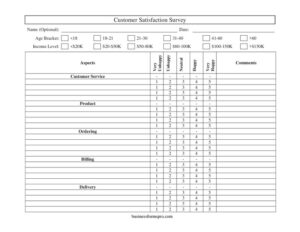
A Customer Satisfaction Survey is a short questionnaire businesses use to measure how happy customers are with their products, service, ordering, billing, and delivery experience. Companies most often use it after a purchase or support interaction to spot problems early and improve retention. You can download this template free in PDF and DOCX formats — no signup required.
What Is a Customer Satisfaction Survey?
A Customer Satisfaction Survey is a structured feedback form that asks customers to rate their experience with a company across several key touchpoints. It is typically issued by a business — through email, a website, a receipt, or in person — and completed by the customer. The form documents how the customer feels about areas such as customer service, the product, ordering, billing, and delivery, usually on a simple rating scale ranging from “Very Unhappy” to “Very Happy.” The goal is to turn subjective opinions into trackable data that managers can use to identify weak points, recognize strengths, and measure progress over time. A good survey is short, clear, and easy to complete in a minute or two.
When Do You Need a Customer Satisfaction Survey?
This form is useful any time you want honest, structured feedback from the people who buy from you. Common scenarios include:
- After a purchase or delivery — to confirm the product arrived on time and met expectations.
- Following a customer service interaction — to gauge whether a support agent resolved the issue satisfactorily.
- Quarterly or annual check-ins — to track satisfaction trends across your customer base over time.
- After launching a new product or service — to capture early reactions before scaling up.
- When complaints or returns rise — to diagnose whether the problem lies in the product, billing, or delivery.
- During market research — to segment feedback by age bracket and income level for clearer insights.
What a Customer Satisfaction Survey Should Have
A complete and effective survey balances simplicity with enough detail to be actionable. The essential elements include an optional space for the respondent’s name and the date of completion, plus optional demographic fields such as age bracket and income level for segmentation. The core of the form is a set of rating questions covering the main experience areas — customer service, product, ordering, billing, and delivery — each measured on a consistent five-point scale from Very Unhappy to Very Happy. Finally, an open-ended comments box lets customers explain their ratings in their own words, which often reveals the most valuable, specific insights. Keeping the scale identical across every category makes the results easy to compare and chart.
How to Fill Out a Customer Satisfaction Survey
Whether you are the customer completing it or the business preparing it for distribution, here is how to work through each field:
- Name (Optional): Enter your name if you wish, or leave it blank to respond anonymously and encourage candor.
- Date: Write the date you complete the survey so the business can match feedback to a specific interaction.
- Age Bracket: Select the range that applies (for example, 18–24 or 35–44). This helps segment results.
- Income Level: Choose the appropriate band if comfortable; this is optional and used only for analysis.
- Customer Service: Rate your experience with staff helpfulness and responsiveness.
- Product: Rate the quality and value of the product itself.
- Ordering: Rate how easy and smooth the ordering process was.
- Billing: Rate the accuracy and clarity of your invoice or payment.
- Delivery: Rate the speed and condition of the delivery.
- Rating scale: For each area, mark one option from Very Unhappy, Unhappy, Neutral, Happy, or Very Happy.
- Comments: Add any specific praise, complaints, or suggestions in the open box.
How to Get More Useful Responses
The value of a survey depends heavily on how — and when — you ask. Send the survey while the experience is still fresh, ideally within a day or two of the interaction. Keep the request short and explain that responses take only a minute. Making the name field optional, as this template does, signals that anonymous feedback is welcome and tends to produce more honest answers. Avoid asking for sensitive demographic details such as income level as required fields; treat them as optional so respondents don’t abandon the form. Finally, always provide the open comments box — the numerical ratings tell you what customers feel, but the written comments tell you why.
Turning Survey Results Into Action
Collecting feedback is only the first step. To get value from a Customer Satisfaction Survey, assign a simple numeric value to each rating (for example, 1 for Very Unhappy through 5 for Very Happy) and calculate an average score for each category. Watch for categories that consistently lag — if billing or delivery scores low while product scores high, you know exactly where to focus. Compare scores across age and income segments to see whether certain groups have different experiences. Read every comment for recurring themes, and close the loop by following up with unhappy customers when they leave their name. Tracking the same survey over months reveals whether your improvements are working.
Common Mistakes to Avoid
- Making the survey too long — adding dozens of questions reduces completion rates dramatically.
- Requiring demographic fields — forcing age or income answers drives people to abandon the form.
- Using inconsistent scales — switching wording between questions makes results hard to compare.
- Ignoring the comments — the written feedback often contains the most actionable insights.
- Asking too late — sending the survey weeks after the experience yields vague, less reliable answers.
- Collecting data and never acting on it — failing to follow up wastes the goodwill of customers who responded.
Frequently Asked Questions
What is a Customer Satisfaction Survey used for? It is used to measure how happy customers are with a business across key areas like service, product, ordering, billing, and delivery. The results help companies identify problems, recognize strengths, and improve the overall customer experience over time.
How do I fill out the rating questions? For each category, choose the single option that best matches your experience, ranging from Very Unhappy to Very Happy. Be honest, and use the comments box to add detail about why you chose a particular rating.
Is the survey anonymous? The name field is optional, so customers can choose to remain anonymous. Many businesses keep it optional on purpose because anonymous responses tend to be more candid and honest.
Do I have to answer the age and income questions? No — these demographic fields are optional and used only to help the business analyze results by group. You can skip them and still submit a complete and useful survey.
How much does this template cost? Nothing. This Customer Satisfaction Survey template is completely free to download in both PDF and DOCX formats, with no signup or payment required.
Can I customize the survey for my business? Yes. The DOCX version is fully editable, so you can rename categories, add your logo, adjust the rating labels, or insert questions that are specific to your products and services.
This Customer Satisfaction Survey template is provided as a general example for informational purposes only. It is not legal, financial, or professional advice, and data-collection and privacy requirements vary by jurisdiction. Consult a qualified professional to ensure your surveys comply with applicable laws and regulations.
Related Forms
- Restaurant Comment Card
- Event Feedback Survey
- Business Customer Survey Card
- Catering Service Feedback
- Bar Your Opinion Card
- Business Suggestion Card
Browse more in Feedback.