
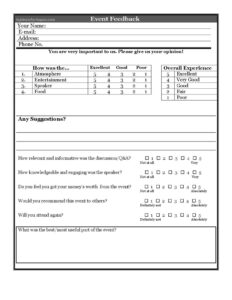
Event Feedback Survey
Download a free Event Feedback Survey template in PDF and DOCX to gather attendee opinions, ratings, and suggestions after your event — free download.
PDF
DOCX
0
likes
Download Files
- DOCX
An Event Feedback Survey is a short questionnaire that organizers hand to attendees after a conference, workshop, seminar, or social gathering to capture their honest opinions about the experience. The most common reason people use it is to measure satisfaction across key areas — atmosphere, speakers, food, and overall value — so future events can be improved. This template is free to download in PDF and DOCX, with no signup required.
What Is an Event Feedback Survey?
An Event Feedback Survey is a structured form issued by event planners, marketing teams, associations, schools, or venues to collect attendee reactions once an event concludes. It documents how participants rated specific elements of the event, whether they felt it was worth the cost, and whether they would return or recommend it. Unlike a casual conversation, the survey records responses in a consistent format that can be tallied and compared across many attendees. The goal is to turn subjective impressions into actionable insight — identifying what worked, what fell flat, and what to change next time. A good survey balances quick rating questions with open-ended prompts that surface ideas you would never think to ask about.
When Do You Need an Event Feedback Survey?
This form is useful any time you want to understand how an audience truly experienced an event rather than guessing. Common scenarios include:
- After a conference or seminar — to gauge whether sessions, speakers, and the Q&A delivered real value to attendees.
- Following a corporate training or workshop — to confirm the content was relevant, informative, and worth participants’ time.
- At the close of a trade show or networking event — to learn whether the atmosphere and logistics encouraged meaningful connections.
- After a paid ticketed event — to ask directly whether guests felt they got their money’s worth.
- Following a community, charity, or social gathering — to measure enjoyment of entertainment and food before planning the next one.
- For recurring events — to track whether attendees would attend again, building a loyal returning audience over time.
What an Event Feedback Survey Should Have
A complete and useful survey blends a few categories of questions. First, an optional contact section — name, email, address, and phone — lets you follow up or invite respondents to future events. Second, rating questions covering the core experience: atmosphere, entertainment, speaker, food, and overall experience. Third, value-focused questions such as whether attendees got their money’s worth, would recommend the event, and will attend again. Finally, open-ended prompts — suggestions and the best or most useful part of the event — give respondents room to explain their scores in their own words. Keeping the survey short and clearly organized increases your completion rate.
How to Fill Out an Event Feedback Survey
Walk through the form field by field so responses are clear and complete:
- Your Name: Enter your full name, or leave it blank if your organizer allows anonymous feedback.
- E-mail: Add your email address if you are open to follow-up messages or future event invitations.
- Address and Phone No.: Provide these only if requested; they help organizers with mailing lists or contact, but are usually optional.
- Atmosphere, Entertainment, Speaker, Food, Overall Experience: Rate each of these elements honestly, reflecting how each part of the event felt to you.
- How relevant and informative was the discussion/Q&A?: Assess whether the content addressed topics you cared about.
- How knowledgeable and engaging was the speaker?: Comment on the presenter’s expertise and delivery.
- Do you feel you got your money’s worth?: Indicate whether the value matched the price or time invested.
- Would you recommend this event to others? / Will you attend again?: Answer these loyalty questions plainly.
- Any Suggestions? / Best or most useful part: Write specific comments so organizers can act on them.
Tips for Getting More Honest, Useful Responses
The quality of feedback depends heavily on how and when you distribute the survey. Hand it out while the experience is still fresh — ideally at the end of the event or within 24 hours by email. Make the contact fields clearly optional so privacy-minded guests still respond. Keep the rating scale consistent across every category so results are easy to compare. Most importantly, treat the open-ended questions as gold: a single suggestion about parking, room temperature, or session length often reveals fixable problems that the numbers alone would hide. Tell attendees their input genuinely shapes the next event, and they will give you richer answers.
Turning Feedback Into Action
Collecting responses is only half the value. After the event, tally the ratings for atmosphere, speaker, food, and overall experience to spot patterns, then read every suggestion before drawing conclusions. Pay special attention to the “money’s worth” and “attend again” answers — these predict whether your event has a sustainable future. Share a short summary with your team, decide on two or three concrete improvements, and reference them when you promote the next event. Following up with respondents who left contact details, thanking them and noting what you changed, builds goodwill and turns one-time attendees into repeat guests.
Common Mistakes to Avoid
- Making the survey too long — fatigue lowers completion rates and answer quality; stick to the essentials.
- Asking only rating questions — without the open-ended “suggestions” and “best part” fields, you miss the why behind the scores.
- Requiring contact details — forcing name, email, address, and phone discourages honest or anonymous responses.
- Waiting too long to distribute it — memories fade fast, so collect feedback while the event is fresh.
- Using vague rating labels — keep your scale clearly defined so “good” means the same thing to everyone.
- Collecting responses and never acting on them — ignored feedback wastes attendees’ time and your opportunity to improve.
Frequently Asked Questions
What is an Event Feedback Survey used for? It is used to gather attendees’ opinions about an event after it ends, covering atmosphere, entertainment, speaker, food, and overall value. Organizers use the results to measure satisfaction and plan better future events. It turns scattered impressions into structured, comparable data.
How do I fill out the Event Feedback Survey? Optionally add your contact details, then rate each listed element such as atmosphere, speaker, and food. Answer the value and loyalty questions about whether you got your money’s worth and would attend again, then write specific comments in the suggestions and “best part” fields. Honest, detailed answers are the most helpful.
Do I have to provide my name and email? Usually no — the contact fields are optional and exist mainly so organizers can follow up or invite you to future events. Many surveys are designed to be completed anonymously. Provide as much or as little personal information as you are comfortable sharing.
Is an Event Feedback Survey confidential? Confidentiality depends on the organizer’s policy, not the form itself. Reputable organizers use feedback internally to improve events and do not publish individual responses. If anonymity matters to you, simply leave the contact fields blank.
When should the survey be distributed? Distribute it at the end of the event or within a day afterward, while the experience is still fresh in attendees’ minds. Prompt distribution leads to higher response rates and more accurate ratings. Waiting too long produces vague or forgotten answers.
How much does this template cost? Nothing — this Event Feedback Survey template is completely free to download here in both PDF and DOCX formats, with no signup required. You can edit the questions and rating scales to match your specific event. Use it as many times as you like.
This Event Feedback Survey template is a general example provided for informational purposes only and does not constitute legal, financial, or professional advice. Data collection and privacy requirements vary by jurisdiction — consult a qualified professional to ensure your survey complies with applicable rules.
Related Forms
- Restaurant Your Opinion Card
- Hotel Your Opinion Card
- Business Suggestion Card
- Product Feedback Form
- Hotel Feedback Card
- Restaurant Suggestion Card
Browse more in Feedback.