
Product Feedback Form
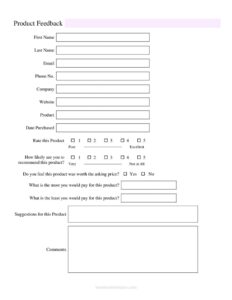
Collect customer ratings, pricing insights, and suggestions with this free Product Feedback Form template, available as a free download in PDF and DOCX.
PDF
DOC
5 downloads
0
likes
Download Files
- DOC
A Product Feedback Form is a structured questionnaire that lets customers rate a product, share pricing opinions, and offer suggestions after a purchase. Businesses most often use it to understand satisfaction and improve their offerings based on real buyer input. This template is free to download in PDF and DOCX, with no signup required.
What Is a Product Feedback Form?
A Product Feedback Form is a document a company sends to or shares with customers to gather their honest opinions about a specific product they bought. It captures who the customer is, what they purchased, how satisfied they are, and how they perceive the product’s value relative to its price. Product managers, marketing teams, customer success staff, and small business owners use it to measure quality, spot recurring problems, and gauge whether buyers would recommend the product to others. Because it combines numeric ratings with open-ended comments, it documents both measurable scores and the context behind them, making it a practical tool for guiding product decisions and prioritizing improvements.
When Do You Need a Product Feedback Form?
This form is useful any time you want to hear directly from the people who actually use your product. Common situations include:
- After a sale or delivery — to confirm the customer is satisfied and surface any issues early.
- Following a product launch — to collect early reactions and validate that the product meets expectations.
- During pricing reviews — to learn what customers think the product is truly worth before adjusting prices.
- When planning a new version or feature — to gather suggestions that shape your roadmap.
- For warranty or quality follow-ups — to identify defects, usability complaints, or shipping problems.
- As part of an ongoing customer satisfaction program — to track ratings and recommendation scores over time.
What a Product Feedback Form Should Have
A complete Product Feedback Form balances easy-to-analyze metrics with room for detail. It should identify the respondent (name, email, and optionally company), pin down exactly which product the feedback is about along with the purchase date, and capture a numeric satisfaction rating. A strong form also asks about the likelihood to recommend, since that signals loyalty and word-of-mouth potential. Pricing questions — whether the product was worth the asking price and the customer’s highest and lowest acceptable price points — add valuable commercial insight. Finally, open fields for suggestions and general comments give customers a place to explain their scores and propose ideas you might never have considered.
How to Fill Out a Product Feedback Form
- Enter your First Name and Last Name so the company knows who is providing the feedback.
- Provide your Email and Phone No. in case the team needs to follow up about your response.
- If applicable, add your Company and Website — useful for business-to-business products.
- Specify the Product you are reviewing and the Date Purchased so feedback is tied to the correct item and timeframe.
- Select a Rate this Product score from 1 to 5, with 5 being the most satisfied.
- Indicate how likely you are to recommend this product on the same 1-to-5 scale.
- Answer whether the product was worth the asking price by choosing Yes or No.
- Enter the most you would pay and the least you would pay for the product to reveal your perceived value range.
- Use the Suggestions for this Product field to recommend improvements or new features.
- Add any final thoughts in the Comments section, then submit the completed form.
Making the Pricing Questions Work for You
The pricing fields on this form are what set it apart from a basic satisfaction survey. Asking whether the product was worth the asking price gives a quick yes/no read on perceived value, while the “most you would pay” and “least you would pay” questions reveal a price range customers consider acceptable. Together these create a simple version of a price-sensitivity check. When you collect enough responses, you can look for patterns: if many satisfied customers say the product was not worth the price, you may have a perception or messaging problem rather than a quality one. Conversely, if buyers consistently say they would pay more than the asking price, you may be underpricing. Always interpret these numbers alongside the written comments for context.
Turning Feedback Into Action
Collecting responses is only half the value — what you do next matters more. Group the numeric ratings to track averages over time and compare products. Read the suggestions and comments to find recurring themes, then route them to the right team: design issues to product, defects to quality control, and pricing concerns to marketing or sales. Whenever a customer leaves contact details and reports a serious problem, follow up promptly; a quick, genuine reply often turns a frustrated buyer into a loyal one. Keeping a log of feedback also helps you measure whether changes you make actually move ratings in the right direction.
Common Mistakes to Avoid
- Leaving the Product or Date Purchased blank — without these, feedback can’t be tied to the right item or batch.
- Giving a rating with no explanation — a score of 2 is far more useful when the Comments field explains why.
- Skipping the pricing questions — these reveal value perception that ratings alone miss.
- Collecting feedback but never reviewing it — responses that sit unread provide no benefit.
- Making every field mandatory — overly long forms discourage customers from finishing.
- Ignoring contact details for follow-up — a provided email or phone number is an invitation to engage.
Frequently Asked Questions
What is a Product Feedback Form used for? It is used to gather customer opinions about a specific product, including satisfaction ratings, likelihood to recommend, pricing perceptions, and open-ended suggestions. Businesses use this information to improve quality, set pricing, and prioritize new features. It helps turn customer experience into measurable, actionable data.
How do I fill out the rating questions? The form uses a 1-to-5 scale for both the product rating and the recommendation question, where 1 is the lowest and 5 is the highest. Choose the number that best reflects your honest experience. Adding a note in the Comments field about why you chose that score makes your feedback far more useful.
Why does the form ask the most and least I would pay? These two pricing fields capture your perceived value range for the product. The company uses the answers to understand whether its current price feels fair, too high, or too low to customers. Your input helps shape future pricing decisions.
Is a Product Feedback Form legally binding? No. This is a customer feedback document, not a contract or agreement, so it does not create legal obligations for either party. It is simply a tool for collecting and organizing opinions about a product.
Can I customize this template for my own products? Yes. You can download the DOCX version and edit field labels, add or remove questions, and apply your branding. You might add product-specific questions or a section for the order number to fit your workflow.
How much does this Product Feedback Form cost? It is completely free to download here in both PDF and DOCX formats, with no signup or payment required. You can use the PDF as-is for quick distribution or edit the DOCX to match your needs.
This Product Feedback Form template is a general example provided for informational purposes only and is not legal, financial, or business advice. Requirements and best practices for collecting customer data vary by jurisdiction — including privacy and data-protection rules — so consult a qualified professional before relying on it for your specific situation.
Related Forms
- Catering Service Customer Survey Card
- Restaurant Comment Card
- Bar Your Opinion Card
- Event Feedback Survey
- Restaurant Suggestion Card
- Customer Feedback Card
Browse more in Feedback.