
Employee Appraisal
Download a free Employee Appraisal form template to rate performance, document accomplishments, and run fair reviews — free PDF and DOCX download.
PDF
DOCX
1 downloads
0
likes
Download Files
- DOCX
An Employee Appraisal form is a structured document supervisors use to evaluate an employee’s job performance across defined categories, assign ratings, and record specific accomplishments and feedback. Managers most often use it during scheduled performance reviews to give clear, consistent assessments that support raises, promotions, and development plans. You can download this template free in both PDF and DOCX formats — no signup required.
What Is an Employee Appraisal?
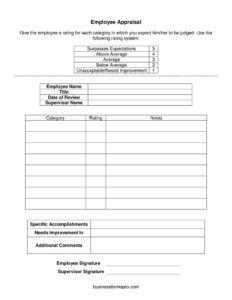
An Employee Appraisal is a written performance review completed by a supervisor or manager to judge how well an employee is meeting the expectations of their role. It documents ratings in several categories using a standardized scale — in this template: surpasses expectations, above average, average, below average, needs improvement, and unacceptable. The form captures who was reviewed, who conducted the review, the date, category-by-category ratings, notes, specific accomplishments, and additional comments. Both the employee and supervisor sign it, creating a shared record of the conversation. Organizations of every size use appraisals to align performance with company goals, justify compensation decisions, and create a fair, paper-trailed basis for advancement or corrective action.
When Do You Need an Employee Appraisal?
This form is useful any time an employee’s performance needs to be formally assessed and documented. Common situations include:
- Annual or semi-annual reviews — the most common use, when you evaluate overall performance for the period and set goals for the next.
- End of a probationary period — confirming whether a new hire has met expectations before becoming a permanent employee.
- Promotion or raise consideration — providing documented evidence that an employee surpasses expectations and is ready for more responsibility.
- Performance improvement — recording areas that need improvement and the support being offered before any disciplinary step.
- Project or quarterly check-ins — giving timely feedback on specific deliverables rather than waiting a full year.
- Transfers or role changes — establishing a baseline assessment when an employee moves to a new team or manager.
What an Employee Appraisal Should Have
A complete appraisal balances objective ratings with written context so the employee understands exactly where they stand. The key elements are clear identifying information (employee name, title, date of review, and supervisor name), a defined rating scale applied consistently, a category-by-category breakdown, and supporting notes that explain each rating. Strong appraisals also list specific accomplishments with concrete examples — completed projects, metrics hit, or skills gained — rather than vague praise. An additional comments field gives room for development goals and the employee’s perspective. Finally, signature lines for both the employee and supervisor confirm the review was discussed. A signature usually acknowledges receipt of the appraisal, not necessarily agreement with every rating.
How to Fill Out an Employee Appraisal
- Employee name and title: Enter the employee’s full name and their current job title so the appraisal is correctly attributed.
- Date of review: Record the date the appraisal meeting takes place or the date the form is completed.
- Supervisor name: Write the name of the manager conducting and signing off on the review.
- Category: For each area you expect to judge — for example quality of work, communication, reliability, teamwork, or job knowledge — list it in the category column.
- Rating: Assign one rating per category from the scale: surpasses expectations, above average, average, below average, needs improvement, or unacceptable.
- Notes: Beside each rating, add a short explanation with examples that justify the score.
- Specific accomplishments: Summarize standout achievements during the review period with measurable detail where possible.
- Additional comments: Note development goals, support needed, or the employee’s own remarks.
- Signatures: Have the employee and supervisor sign and date to confirm the review was held.
Understanding the Rating Scale
The rating scale is the heart of this appraisal, so apply it consistently across employees and categories. Surpasses expectations and above average recognize performance that clearly exceeds the role’s requirements. Average signals solid, reliable work that fully meets expectations — it is not a negative score, though some employees perceive it that way, so use the notes field to clarify. Below average and needs improvement flag gaps that should be paired with concrete, achievable goals. Unacceptable should be reserved for serious, well-documented performance failures. Anchoring each rating to observable behavior and examples keeps the appraisal fair and defensible if it is ever questioned.
Conducting a Productive Review Meeting
The form works best when it supports a two-way conversation, not a one-sided verdict. Share the completed appraisal with the employee, walk through each category, and invite their perspective before finalizing signatures. Lead with specific accomplishments to acknowledge strengths, then address areas needing improvement with clear next steps and a timeline. Keeping a copy in the personnel file builds a consistent record over time, which helps managers spot trends and supports fair compensation and promotion decisions later.
Common Mistakes to Avoid
- Vague ratings with no notes — a rating without examples leaves the employee guessing and is hard to defend later.
- Recency bias — judging the whole period based only on the last few weeks instead of the full review window.
- Inconsistent scale use — rating one employee’s “good” work as “surpasses” and another’s as “average” creates unfairness.
- Skipping accomplishments — focusing only on problems demotivates employees and gives an incomplete picture.
- No development goals — flagging “needs improvement” without offering a path forward.
- Forgetting signatures and dates — an unsigned appraisal weakens the record and may not satisfy HR requirements.
Frequently Asked Questions
What is an Employee Appraisal form? It is a document a supervisor uses to formally evaluate an employee’s performance across set categories using a standardized rating scale. It records ratings, supporting notes, specific accomplishments, and comments, and is signed by both parties. The result becomes part of the employee’s performance record.
How do I fill out an Employee Appraisal? Start with the employee’s name, title, the date of review, and the supervisor’s name. List each performance category, assign a rating from surpasses expectations down to unacceptable, and add notes explaining each score. Finish by summarizing accomplishments, adding comments, and collecting both signatures.
Does the employee have to sign the appraisal? Most organizations ask the employee to sign, but a signature typically means they received and discussed the appraisal — not that they agree with every rating. If an employee disagrees, they can still sign and add their perspective in the comments. Policies vary by employer, so follow your company’s HR procedures.
Is an Employee Appraisal legally binding? It is an internal HR record rather than a contract, but it can carry legal weight as documentation in disputes over promotions, raises, or terminations. Because it may be referenced later, keep ratings objective, factual, and supported by examples. Consult your HR or legal team about retention and policy requirements.
How often should appraisals be done? Many employers conduct formal appraisals annually, often with informal check-ins in between, while others review quarterly or at the end of probation. The right cadence depends on your organization’s goals and the role. More frequent feedback generally leads to better performance and fewer surprises.
How much does this template cost? Nothing — this Employee Appraisal template is completely free to download in PDF and DOCX formats with no signup required. You can edit the categories and rating labels to fit your organization’s review process. Use it as a starting point and adapt it to your internal policies.
This Employee Appraisal template is a general example provided for informational purposes only and is not legal, HR, or professional advice. Employment and performance-review requirements vary by jurisdiction and employer. Consult a qualified HR or legal professional to ensure your appraisal process complies with applicable laws and company policy.
Official resource: for the rules that apply to your situation, see the U.S. Department of Labor.
Related Forms
- Direct Deposit Authorization
- Employee Incident Report Form
- Employee Pay Rate and Title History Change
- Request for Transfer
- Employee Evaluation Form
- Authorization To Travel
Browse more in Employment.