
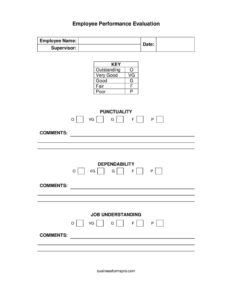
Employee Performance Evaluation
Download a free Employee Performance Evaluation form template to rate staff fairly across key skills, with free PDF and DOCX download.
PDF
DOCX
4 downloads
0
likes
Download Files
- DOCX
An Employee Performance Evaluation is a structured form a supervisor uses to assess an employee’s work over a set review period, scoring key skills and documenting feedback. People most often use it during annual or quarterly reviews to recognize strengths, identify areas for improvement, and create a clear record of performance. This template is free to download in both PDF and DOCX formats with no signup required.
What Is an Employee Performance Evaluation?
An Employee Performance Evaluation is a workplace document that records how well an individual has performed against expectations in their role. It is typically completed by a direct supervisor or manager and reviewed together with the employee. The form rates measurable areas such as punctuality, quality of work, and communication using a simple scale, then captures written notes for context. Once signed by both parties, it becomes part of the employee’s file. Organizations use these evaluations to support promotion and compensation decisions, guide professional development, document ongoing concerns, and ensure feedback is consistent and fair across a team rather than based on memory or impression alone.
When Do You Need an Employee Performance Evaluation?
This form is useful whenever a structured, documented assessment of an employee is appropriate. Common scenarios include:
- Annual or quarterly reviews: Conducting scheduled performance check-ins that feed into raises, bonuses, or development plans.
- End of a probationary period: Deciding whether a new hire has met expectations and should continue in the role.
- Promotion consideration: Providing evidence of leadership, initiative, and consistency when an employee is up for advancement.
- Performance improvement situations: Documenting specific shortfalls in dependability or quality so expectations are clear in writing.
- Role or manager changes: Capturing a baseline assessment before an employee transfers teams or reports to a new supervisor.
- Recognition and retention: Formally acknowledging strong performers to support raises and to keep valued staff engaged.
What an Employee Performance Evaluation Should Have
A complete evaluation balances objective ratings with written explanation. At a minimum it should identify the employee, the supervisor, and the date of the review so the document is properly attributed. It needs a clear rating key—here, outstanding, very good, good, fair, and poor—so everyone interprets the scores the same way. The core of the form is the set of performance categories being rated: punctuality, dependability, job understanding, quality of work, communication skills, initiative, adaptability, leadership, and organization. An effective form also leaves room for additional notes that give context to the scores, and it closes with signature lines for both the supervisor and the employee to confirm the review took place.
How to Fill Out an Employee Performance Evaluation
- Employee name: Enter the full legal or payroll name of the person being reviewed.
- Supervisor: Write the name of the manager completing the evaluation.
- Date: Record the date the review is being conducted or finalized.
- Review the key: Confirm the rating scale—outstanding, very good, good, fair, poor—before scoring so ratings are consistent.
- Punctuality: Rate attendance and timeliness for shifts, meetings, and deadlines.
- Dependability: Assess how reliably the employee follows through on commitments.
- Job understanding: Score their grasp of role duties and processes.
- Quality of work: Evaluate accuracy, thoroughness, and output standards.
- Communication skills: Rate clarity in speaking, writing, and collaboration.
- Initiative, adaptability, leadership, organization: Mark each based on observed behavior over the period.
- Additional notes: Add specific examples, goals, and context behind the ratings.
- Signatures: Have the supervisor and employee sign to confirm the review occurred.
Tips for a Fair and Effective Review
The value of an evaluation depends on how it is conducted, not just the scores entered. Base every rating on specific, observable examples gathered throughout the review period rather than on the most recent few weeks, which can skew results. Use the additional notes field to explain why a category received a particular score—”completed the quarterly migration two days early” is far more useful than a number alone. Where you mark fair or poor, pair the rating with a concrete, achievable goal so the employee leaves with a clear path forward. Aim for consistency: apply the same standard of “outstanding” across everyone on the team so the ratings remain meaningful and defensible.
Making the Most of the Review Meeting
An evaluation works best as a two-way conversation, not a one-sided verdict. Share the completed form with the employee, walk through each category, and invite their perspective before signatures are collected. The employee signature does not necessarily mean they agree with every score—it simply confirms the review was discussed with them. Encourage employees who disagree to add their own comments or submit a written response for the file. Closing the meeting with one or two priorities for the next period turns the document into a forward-looking development tool rather than a static grade.
Common Mistakes to Avoid
- Recency bias: Rating only the last few weeks instead of the entire review period.
- Vague feedback: Leaving the additional notes blank, so ratings have no supporting context.
- Inconsistent standards: Applying the rating key differently from one employee to the next.
- Skipping signatures: Failing to have both parties sign, which weakens the record.
- One-way delivery: Handing over the form without discussing it, missing the chance for dialogue.
- No follow-up goals: Identifying weaknesses but never setting measurable expectations for improvement.
Frequently Asked Questions
What is an Employee Performance Evaluation form used for? It is used to assess and document how well an employee has performed across key areas like punctuality, quality of work, and communication. The completed form supports decisions about raises, promotions, training, and ongoing performance management, and it creates a written record for the employee’s file.
How do I fill out the rating sections? Use the provided key—outstanding, very good, good, fair, or poor—to mark each category such as dependability, initiative, and organization. Base each rating on specific examples from the full review period, and use the additional notes field to explain scores that are especially high or low.
Does the employee have to sign the evaluation? Most organizations ask the employee to sign to confirm they reviewed and discussed the evaluation with their supervisor. Signing usually indicates acknowledgment, not necessarily agreement, and employees who disagree can often add their own written comments.
Is an Employee Performance Evaluation legally binding? The form itself is an internal record rather than a contract, but it can carry legal weight as evidence of documented feedback in employment matters. Because rules vary by jurisdiction and employer policy, follow your organization’s HR procedures when conducting and storing reviews.
How often should performance evaluations be done? Many employers conduct them annually, with some adding quarterly or mid-year check-ins. Probationary reviews and reviews tied to specific performance concerns may happen on a different schedule set by company policy.
Is this template really free to download? Yes. You can download the Employee Performance Evaluation template free in PDF or DOCX with no signup required, and you can edit the categories or rating key to match your organization’s needs.
This template is provided as a general example for informational purposes only and does not constitute legal, HR, or professional advice. Employment and documentation requirements vary by jurisdiction and employer policy—consult a qualified human resources or legal professional before relying on this form for formal evaluations.
Official resource: for the rules that apply to your situation, see the U.S. Small Business Administration.
Related Forms
- Blue Appointment Reminder Card
- Annual Salary Increase
- Return To Work Form
- Meeting Agenda Portrait
- Beauty Salon Appointment
- Appointment Change Form
Browse more in Office.