
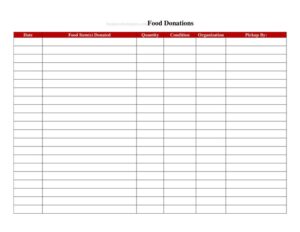
Food Charity Donation Log
Track every food donation accurately with our free Food Charity Donation Log template, available as a free download in PDF and DOCX formats.
PDF
DOCX
3 downloads
0
likes
Download Files
- DOCX
A Food Charity Donation Log is a simple record-keeping sheet that restaurants, cafeterias, and food service operations use to document the food items they donate to charities, food banks, and shelters. The most common reason people use one is to keep an accurate, dated trail of donated goods for tax deductions, food safety compliance, and inventory accountability. It is free to download here in both PDF and DOCX formats, with no signup required.
What Is a Food Charity Donation Log?
A Food Charity Donation Log is a structured document that captures the details of each food donation a business makes to a nonprofit or charitable recipient. It is typically maintained by a restaurant manager, kitchen supervisor, or designated staff member who oversees surplus food handling. The log records what was donated, how much, when, and who received it, creating a paper trail that supports both internal inventory tracking and external reporting. For many food businesses, this single document bridges the gap between reducing waste and proving charitable giving. It is especially valuable when a charity or auditor later asks for verification of the goods that changed hands.
When Do You Need a Food Charity Donation Log?
Any food operation that regularly gives away surplus or unsold inventory benefits from a consistent log. Common scenarios include:
- A restaurant donates leftover prepared meals or unused ingredients to a local shelter at the end of each service.
- A grocery deli or bakery offloads near-date but still safe products to a food bank weekly.
- A catering company has surplus from an event and routes it to a community kitchen.
- A company wants documentation to claim a charitable contribution deduction at tax time.
- A health inspector or charity partner requests proof of safe food handling and transfer dates.
- A corporate office tracks its sustainability and food-waste-reduction goals across multiple locations.
What a Food Charity Donation Log Should Have
To be genuinely useful, the log should capture enough detail to identify and verify each donation. Key elements include the donating business name and location, the date of each donation, a clear description of the items, the quantity or weight, an estimated value, the receiving charity’s name, and a signature or acknowledgment from the person who collected the goods. Including a notes column for storage temperature, packaging, or special handling instructions adds an extra layer of food-safety documentation. A running total at the bottom helps when you need to summarize giving over a reporting period.
How to Fill Out a Food Charity Donation Log
Follow these steps to complete the log accurately each time you donate:
- Enter your business details. At the top, write your restaurant or company name, address, and the name of the staff member responsible for the donation.
- Record the date. Add the calendar date the food left your premises so the timeline is clear for audits and tax records.
- Describe the items. List each food item donated, for example “24 wrapped sandwiches” or “15 lbs mixed produce,” being specific enough to identify the goods.
- Note the quantity or weight. Enter counts, weights, or case quantities so totals can be calculated later.
- Estimate the value. Record a fair market or cost value per line where applicable, useful for tax deduction purposes.
- Identify the recipient. Write the charity, food bank, or shelter name and, if available, a contact person.
- Capture acknowledgment. Have the receiving party sign or initial to confirm pickup, and add any handling notes such as refrigeration requirements.
Food Safety and Handling Notes
Because donated food must remain safe for human consumption, the log doubles as a food-safety record. Use the notes field to mark whether items were kept refrigerated, frozen, or at ambient temperature, and record the time of transfer when perishables are involved. Many jurisdictions encourage or require that donated prepared foods be handled under the same standards as food served to paying customers. Keeping these details in writing protects both your business and the charity, and demonstrates good-faith compliance with safe food donation practices. Note that liability protections for food donors vary by location, so it is worth understanding the rules that apply where you operate.
Using the Log for Tax and Reporting Purposes
Donated food can often qualify for a charitable contribution deduction, and a clean log makes substantiating those donations far easier. Summarize totals at the end of each month or quarter, attach any acknowledgment letters provided by the receiving charity, and store the records alongside your other accounting documents. Because valuation rules and eligibility differ by business structure and jurisdiction, treat the value column as your good-faith estimate and confirm specifics with a tax professional. A well-maintained log also supports grant reporting and corporate sustainability disclosures.
Common Mistakes to Avoid
- Leaving the date blank or filling it in later, which weakens the record for audits and tax claims.
- Writing vague descriptions like “misc. food” instead of identifying the items and quantities.
- Forgetting to get the recipient’s signature or acknowledgment at pickup.
- Omitting temperature or handling notes for perishable and prepared foods.
- Failing to keep copies of the log together with charity receipts and accounting records.
- Inconsistent valuation, such as guessing high values, which can raise questions during a tax review.
Frequently Asked Questions
What is a Food Charity Donation Log used for? It is used to document each food donation a business makes to a charity, food bank, or shelter. The log records what was donated, how much, when, and who received it. This creates a verifiable trail for inventory, food safety, and tax purposes.
How do I fill out a Food Charity Donation Log? Start by entering your business details, then record the date, a clear item description, the quantity or weight, an estimated value, and the receiving charity. Have the recipient sign or acknowledge the pickup and note any special handling requirements. Update the log every time you donate to keep it complete.
Is this donation log legally binding? The log itself is a record-keeping document rather than a contract, so it is not binding in the way a signed agreement is. However, it can serve as supporting evidence for tax deductions and food-safety compliance. Requirements vary by jurisdiction, so check the rules that apply to your business.
Does the recipient need to sign the log? A recipient signature or acknowledgment is highly recommended because it confirms the food was actually transferred and received. While not always legally required, this signature strengthens the record for both parties. Many charities are happy to initial each pickup.
Can I use this log for tax deductions? Yes, a detailed log helps substantiate charitable food donations when claiming deductions. Pair it with any acknowledgment letters from the charity and keep everything with your accounting records. Consult a tax professional to confirm eligibility and valuation rules for your situation.
How much does this template cost? The Food Charity Donation Log is completely free to download from Business Forms Pro. It is available in both PDF and DOCX formats with no signup required. You can print it for manual use or edit the DOCX version to match your operation.
This template is a general example provided for informational purposes only and does not constitute legal, financial, or tax advice. Food donation, safety, and deduction requirements vary by jurisdiction and circumstance. Consult a qualified professional to ensure your records and practices meet the rules that apply to you.
Related Forms
- Drink Menu
- See Host Table Sign
- Wine List
- Service Animals Only Sign
- Shift Request Form
- Seat Yourself Sign
Browse more in Restaurant.