
Grievance Report
Document workplace complaints clearly with our free Grievance Report form template, available as a free download in PDF and DOCX with no signup.
PDF
DOCX
2 downloads
0
likes
Download Files
- DOCX
A Grievance Report is a structured form an employee uses to formally document a workplace complaint or concern so management and HR can investigate and respond. People most often reach for it when an informal conversation hasn’t resolved an issue and a written record is needed. You can download it free in PDF and DOCX here, with no signup required.
What Is a Grievance Report?
A Grievance Report is a written record submitted by an employee that captures the details of a workplace complaint — what happened, when, who was involved, and how the employee would like it addressed. It is typically issued by the company through HR or a supervisor and used to trigger a formal grievance procedure. The form documents the facts in the employee’s own words, identifies any witnesses, and notes who received the report and on what date. By creating a clear paper trail, a Grievance Report protects both the employee and the employer, ensures complaints are handled consistently, and gives the organization a starting point for a fair and timely investigation.
When Do You Need a Grievance Report?
A Grievance Report becomes useful whenever an employee has a concern serious enough to warrant a formal record rather than an off-the-cuff chat. Common situations include:
- Harassment or bullying — when an employee experiences or witnesses inappropriate behavior from a coworker, supervisor, or manager.
- Discrimination concerns — perceived unfair treatment based on a protected characteristic such as age, gender, race, or disability.
- Unsafe working conditions — hazards, equipment problems, or practices that put staff at risk.
- Pay or scheduling disputes — disagreements about wages, overtime, breaks, or unfair shift assignments.
- Conflicts with management — issues with how a supervisor communicates, delegates, disciplines, or makes decisions.
- Policy violations — when an employee believes a company rule or contractual term is being broken.
In each case, the form converts a verbal frustration into a documented, dated complaint that the organization is obligated to review.
What a Grievance Report Should Have
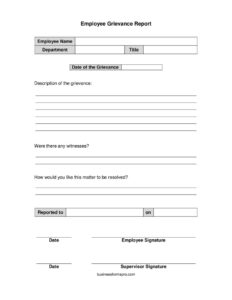
A complete Grievance Report should clearly identify the person filing it and the nature of their complaint. The essential elements are the employee’s full name, their department and job title, and the date the grievance occurred. It should describe the issue in enough detail to be understood by someone who wasn’t there, note whether any witnesses were present, and state the employee’s preferred resolution. Finally, it should record who the report was submitted to, the date of submission, and a signature line. Together these details make the report credible, traceable, and actionable.
How to Fill Out a Grievance Report
- Employee name: Write your full legal name as it appears in company records so the report is correctly linked to your file.
- Department: Enter the department or team you work in, which helps HR route the complaint to the right manager.
- Title: List your current job title to provide context about your role and reporting line.
- Date of the grievance: Record the date the incident or issue occurred — be as precise as possible, including the approximate time if relevant.
- Were there any witnesses? Indicate yes or no, and if yes, list each witness’s name. Witnesses can support your account during an investigation.
- How would you like this matter to be resolved? Describe your desired outcome plainly — an apology, a policy change, mediation, or further investigation.
- Reported to / on: Note the name of the person who received the report and the date you submitted it.
- Signature: Sign and date the final line to confirm the information is accurate and complete.
Writing the Grievance Description Effectively
The strength of a Grievance Report lies in how clearly the issue is described. Stick to facts: state what happened, where, and when, rather than offering interpretations or assumptions. Use specific examples and direct quotes where you can recall them, and present events in chronological order. Avoid emotional language or personal attacks, which can distract from the substance of the complaint. If the issue happened more than once, list each occurrence with its own date. The goal is to give an investigator a clear, neutral picture they can act on without needing to fill in gaps.
What Happens After You Submit
Once a Grievance Report is filed, most employers follow a defined procedure: HR acknowledges receipt, reviews the details, and may interview the employee, witnesses, and anyone named in the complaint. The employee is usually informed of the expected timeline and kept updated as the matter progresses. Depending on the findings, the outcome may involve mediation, corrective action, policy changes, or a formal resolution meeting. Keep a personal copy of your completed form and any related correspondence. If you feel the response is inadequate, many organizations offer an appeal stage or escalation path described in their employee handbook.
Common Mistakes to Avoid
- Being vague: Phrases like “they were rude” are far weaker than a specific account of what was said and done.
- Leaving the date blank: An undated grievance is harder to investigate and may appear less credible.
- Skipping witnesses: Forgetting to name people who saw the incident weakens your support during review.
- Not stating a desired resolution: Without a clear request, HR has to guess what outcome you’re seeking.
- Including unverified accusations: Stick to what you personally observed rather than rumors or secondhand claims.
- Failing to keep a copy: Always retain a dated copy of the signed report for your own records.
Frequently Asked Questions
What is a Grievance Report used for? It is used to formally document a workplace complaint — such as harassment, unfair treatment, or unsafe conditions — so the employer can investigate and respond. It creates a dated, written record that protects both the employee and the organization. It is typically the first step in a company’s formal grievance procedure.
How do I fill out a Grievance Report? Start by entering your name, department, title, and the date the grievance occurred. Then describe the issue clearly, note any witnesses, state how you would like it resolved, and record who you reported it to and when. Finish by signing and dating the form.
Does a Grievance Report need to be witnessed or notarized? No, a Grievance Report does not generally require notarization. It does ask whether there were witnesses to the incident, and naming them can strengthen your account during the investigation. The form itself only needs your signature to confirm the details are accurate.
Is a Grievance Report legally binding? The report itself is a documentation tool rather than a contract, so it is not “binding” in the same way an agreement is. However, it can become an important piece of evidence in internal investigations and, in some cases, legal proceedings. For that reason, you should keep your account truthful and factual.
How much does this Grievance Report template cost? It is completely free to download here in both PDF and DOCX formats, with no signup or payment required. You can edit the DOCX version to match your organization’s branding or grievance policy. Use it as many times as you need.
Can my employer ignore my Grievance Report? Most employers have a documented obligation to acknowledge and review formal grievances, often outlined in the employee handbook. If you believe your report is being ignored, you can usually escalate it through an appeal process or to a higher level of management or HR. Keeping a dated copy of your submitted form helps establish that you raised the issue.
This Grievance Report template is a general example provided for informational purposes only and is not legal, HR, or professional advice. Employment laws and grievance procedures vary by jurisdiction and by employer — consult your company’s policies and a qualified professional for guidance on your specific situation.
Official resource: for the rules that apply to your situation, see the U.S. Department of Labor.
Related Forms
- Employee Pay Rate and Title History Change
- Project Time Card With Approval
- Employee Separation Report
- Interview Invitation
- Notice of Probation
- Salary Verification Request Letter
Browse more in Employment.