
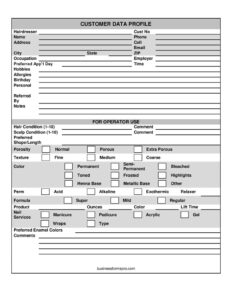
Hairdresser Customer Profile
Download a free Hairdresser Customer Profile template to record client hair history, color formulas, and preferences — free PDF and DOCX download, no signup.
PDF
DOCX
2 downloads
0
likes
Download Files
- DOCX
A Hairdresser Customer Profile is a record card that stores everything a stylist needs to know about a single client — their hair type, color formulas, allergies, and service history — so every appointment delivers consistent, personalized results. Most salons use it to remember exact color recipes and avoid repeating past mistakes. You can download this Hairdresser Customer Profile free in both PDF and DOCX formats, with no signup required.
What Is a Hairdresser Customer Profile?
A Hairdresser Customer Profile is a documentation form completed by a stylist or salon owner and kept on file for each regular client. It captures contact details, hair and scalp characteristics, sensitivities, previous treatments, color and chemical formulas, and notes on what the client liked or disliked. The purpose is simple: to turn a one-time service into a repeatable, professional experience. Rather than relying on memory, a stylist can pull the card before an appointment and instantly recall the developer volume used, the toner that worked, or the products the client took home. It also protects the salon by recording patch-test results and known allergies before any chemical service.
When Do You Need a Hairdresser Customer Profile?
This form is useful any time you want to track a client over multiple visits and keep their service history organized. Common situations include:
- Onboarding a new client — completing a profile during the first consultation to capture goals, hair history, and sensitivities.
- Repeating a custom color — recording the exact formula, brand, developer, and processing time so the shade can be matched perfectly next time.
- Before chemical services — logging patch-test dates and allergy notes prior to color, perms, relaxers, or keratin treatments.
- Building loyalty — noting personal preferences, preferred products, and conversation notes that make returning clients feel remembered.
- Handing off between stylists — allowing another team member to step in seamlessly when the regular stylist is unavailable.
- Tracking treatment progress — monitoring how a scalp condition, color correction, or bond-building program develops over several appointments.
What a Hairdresser Customer Profile Should Have
A complete client card balances personal details with technical service data. The strongest profiles include client contact information, a date for each visit, and a clear description of the hair’s natural state — texture, length, density, porosity, and current color level. They record any allergies, sensitivities, or patch-test outcomes, plus a chemical history covering prior color, lightening, perms, or smoothing treatments. For each service, the card should list the products and formulas used, developer volume, processing time, and the stylist who performed the work. Finally, a notes or preferences section captures what the client wants next time, their lifestyle and maintenance habits, and any product recommendations made at checkout.
How to Fill Out a Hairdresser Customer Profile
- Client details: Enter the client’s full name, phone number, email, and preferred contact method at the top of the card.
- Date and stylist: Record the visit date and the name of the stylist performing the service so the history stays chronological and accountable.
- Hair characteristics: Describe the natural hair — type, texture, density, length, porosity, and current color level — to set a baseline.
- Allergies and sensitivities: Note any known allergies, scalp conditions, and the date and result of any patch test before chemical work.
- Service history: List the service provided (cut, color, treatment) along with prior chemical work that could affect results.
- Formula and products: Write the exact color brand, shade numbers, mixing ratio, developer volume, processing time, and any toner or treatment used.
- Preferences and notes: Capture styling preferences, products purchased, recommendations, and goals for the next appointment.
Organizing and Storing Client Cards
However you complete the form, store it where the right stylist can find it quickly and confidentially. Many independent stylists keep printed cards in an alphabetized binder or file box, while busier salons transfer the same fields into appointment software or a spreadsheet. If you use the DOCX version, you can build a digital library and search by client name in seconds. Because these records contain personal contact details and health-related notes such as allergies, treat them as confidential information: limit access to staff who need it, and dispose of outdated cards securely. Privacy expectations vary by region, so check the data-protection rules that apply to your business.
Why a Color Formula Log Matters
The single most valuable line on this profile is often the color formula. A precise record — brand, shade, ratio, developer, and timing — removes the guesswork from color maintenance and protects you when a client returns weeks later expecting the same result. It also makes color corrections far easier, since you can see exactly what was applied previously. Update the formula every time you adjust it, and note environmental factors like gray coverage percentage or how the previous color faded, so each entry tells the full story of that client’s hair journey.
Common Mistakes to Avoid
- Vague formula notes — writing “brown” instead of the exact brand, shade number, ratio, and developer volume makes the record useless for matching.
- Skipping the patch test entry — failing to log allergy checks and their dates removes an important safety and liability record.
- Not dating each visit — without dates you can’t track how color faded or how a treatment progressed over time.
- Forgetting to update after changes — leaving an old formula on file leads to repeating a result the client no longer wants.
- Storing cards carelessly — leaving profiles with personal data in plain view risks client privacy.
- Omitting the stylist name — when multiple team members serve a client, no name makes it impossible to follow up accurately.
Frequently Asked Questions
What is a Hairdresser Customer Profile used for? It is used to store a single client’s hair information, service history, color formulas, and preferences in one place. This lets a stylist deliver consistent, personalized results across multiple appointments and recall exactly what worked last time.
Is this Hairdresser Customer Profile free to download? Yes. You can download the template completely free in both PDF and DOCX formats from Business Forms Pro, with no signup or payment required. Print it for a binder or edit the DOCX version on your computer.
What information should I record on a client profile? Include contact details, the visit date and stylist, hair characteristics, allergies and patch-test results, service and chemical history, the exact products and formulas used, and notes on the client’s preferences and goals.
Why is recording a color formula so important? A precise formula — brand, shade, mixing ratio, developer volume, and processing time — lets you reproduce or correct a color accurately on the next visit. Without it, you risk inconsistent results and unhappy returning clients.
How should I store these client cards safely? Keep them confidential, since they contain personal contact and health-related details such as allergies. Use a locked file box, a secured binder, or password-protected digital files, and only allow access to staff who need it.
Do I need a client’s consent to keep their information? Many regions require you to inform clients about the personal data you collect and how it is used. Privacy rules vary by location, so check the data-protection requirements that apply to your salon.
This template is a general example provided for informational purposes only and does not constitute legal, health, or professional advice. Salon licensing, product safety, and data-privacy requirements vary by jurisdiction — consult the relevant authorities or a qualified professional to ensure your records and practices comply with applicable rules.
Related Forms
- Phone Message Log
- Monthly Project Timetable
- Inventory Cards Spreadsheet
- Childproofing Checklist
- Social Security Options Planner
- Project Status Report
Browse more in Log and Inventory.