
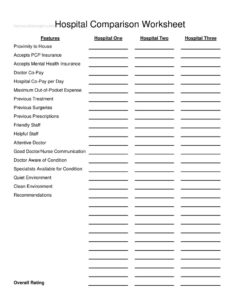
Hospital Comparison
Compare up to three hospitals side by side on cost, location, and care with this free Hospital Comparison Worksheet template — free download in PDF and DOCX.
PDF
DOCX
1 downloads
0
likes
Download Files
- DOCX
A Hospital Comparison Worksheet is a simple side-by-side chart that helps you evaluate up to three hospitals across the factors that matter most — cost, location, insurance acceptance, staff quality, and your own treatment history. Most people use it when choosing where to receive care for a planned procedure or ongoing condition, and it’s free to download here in both PDF and DOCX formats with no signup required.
What Is a Hospital Comparison Worksheet?
A Hospital Comparison Worksheet is an organizational tool — not a medical or legal document — that lets a patient, family member, or caregiver line up several hospital options against a consistent list of features. Instead of relying on memory or scattered notes, you record the same details for Hospital One, Hospital Two, and Hospital Three in parallel columns. The worksheet captures practical concerns like proximity to your house and co-pay amounts alongside experiential factors such as friendly staff and a quiet environment. The result is a clear, at-a-glance picture that makes it easier to weigh trade-offs and arrive at a confident, informed decision about where to seek treatment.
When Do You Need a Hospital Comparison Worksheet?
This worksheet is most valuable whenever you have a real choice between facilities and want to make that choice deliberately rather than by default. Common situations include:
- Planning a scheduled surgery or procedure and deciding which hospital offers the best combination of cost, specialists, and convenience.
- Managing a chronic condition that requires recurring visits, where proximity and whether the doctor is aware of your condition matter for the long term.
- Relocating to a new city and needing to identify a primary hospital that accepts your PCP and mental health insurance.
- Choosing care for an aging parent or dependent, where attentive doctors and clean, quiet environments are top priorities.
- Switching insurance plans and re-checking which nearby hospitals still keep your out-of-pocket costs manageable.
- Gathering second opinions after a diagnosis, comparing how each facility handles your previous treatment, surgeries, and prescriptions.
What a Hospital Comparison Worksheet Should Have
A useful comparison sheet balances hard financial facts with softer quality-of-care impressions. A complete worksheet should capture three categories of information: access and cost (proximity, insurance acceptance, co-pays, and maximum out-of-pocket expense); clinical fit (whether the hospital handled your previous treatment, surgeries, and prescriptions, and whether specialists for your condition are available); and experience (friendly and helpful staff, attentive and good doctors, clear doctor/nurse communication, and a clean, quiet environment). A space for outside recommendations and a single overall rating per hospital ties everything together so you can rank your options quickly.
How to Fill Out a Hospital Comparison Worksheet
- Label the three columns with each candidate facility’s name under Hospital One, Hospital Two, and Hospital Three.
- Record Proximity to House as drive time or distance for each, since travel matters during emergencies and frequent visits.
- Mark whether each hospital Accepts PCP Insurance and Accepts Mental Health Insurance with a yes or no.
- Enter the financial figures: Doctor Co-Pay, Hospital Co-Pay per Day, and Maximum Out-of-Pocket Expense from your plan summary.
- Note your history with each: Previous Treatment, Previous Surgeries, and Previous Prescriptions handled there.
- Score care quality — Friendly Staff, Helpful Staff, Attentive Doctor, Good Doctor/Nurse Communication, Doctor Aware of Condition, and Specialists Available for Condition.
- Rate the setting: Quiet Environment and Clean Environment.
- Add any Recommendations from friends, doctors, or reviews, then assign an Overall Rating to each hospital.
Tips for Scoring Fairly Across Hospitals
The worksheet only works if you apply the same yardstick to every column. Pick a consistent scale for the subjective rows — a simple 1-to-5 score or a high/medium/low rating works well for items like Friendly Staff, Attentive Doctor, and Clean Environment. Fill in the cost and insurance rows first using documents from your insurer, since those are objective and won’t change based on mood or a single visit. For the experience-based fields, gather impressions from more than one source: your own visit, a relative’s experience, and online reviews together give a more balanced picture than a single data point. Date the worksheet, because insurance networks, co-pays, and staff change over time and a comparison made last year may no longer hold.
Reading the Results and Making a Decision
Once every cell is filled, scan across each row rather than down each column — this reveals where one hospital clearly outperforms the others on a factor you care about. Identify your non-negotiables first: if a hospital does not accept your insurance or lacks specialists for your condition, it may be eliminated regardless of how well it scores elsewhere. Then weigh the remaining options by what matters most to you, whether that’s the lowest maximum out-of-pocket expense, the shortest drive, or the strongest doctor communication. The Overall Rating row is your summary judgment, but treat it as a guide rather than the final word — a slightly lower-rated hospital with far better cost coverage may still be the smarter long-term choice.
Common Mistakes to Avoid
- Using outdated insurance figures — confirm co-pays and network status directly with your insurer before relying on them.
- Comparing on different scales — rating one hospital out of 5 and another out of 10 makes the columns meaningless.
- Ignoring proximity — a great hospital that’s an hour away can be impractical for frequent or emergency care.
- Leaving cells blank — an empty field hides a real difference; mark “unknown” and follow up rather than skipping it.
- Weighting everything equally — decide which factors are deal-breakers versus nice-to-haves before you score.
- Relying on a single visit or review — gather impressions from several sources for the experience-based rows.
Frequently Asked Questions
What is a Hospital Comparison Worksheet used for? It is a planning tool that lets you evaluate up to three hospitals side by side on cost, location, insurance acceptance, care quality, and your treatment history. People use it most often when choosing where to have a planned procedure or manage an ongoing condition. The goal is to turn scattered information into a single clear chart you can act on.
How do I fill it out? Name each hospital at the top of the three columns, then work down the feature rows entering objective facts like proximity and co-pays first. Use a consistent rating scale for the subjective rows such as friendly staff and clean environment, and finish with an overall rating for each. Filling every cell with the same yardstick is what makes the comparison reliable.
Is this a medical or legal document? No. It is purely an organizational worksheet for your own decision-making and carries no official or binding status. It does not replace professional medical advice, and you should still discuss your choice with your doctor or care team before committing.
How much does the template cost? Nothing — it is a free download here in both PDF and DOCX formats with no signup required. The DOCX version lets you rename rows, add facilities, or adjust the scoring system to fit your situation.
Can I compare more than three hospitals? The template is built for three columns, which suits most decisions, but the editable DOCX version lets you add extra columns easily. If you are weighing many options, consider doing a quick first pass to eliminate clear non-fits, then comparing your top three in detail.
Where do I get the cost and insurance information? The most accurate source is your own insurance plan documents and your insurer’s provider directory, which list co-pays, network status, and your maximum out-of-pocket limit. You can also call the hospital’s billing department or your plan’s customer service line to confirm details before recording them.
This Hospital Comparison Worksheet template is a general example provided for informational and organizational purposes only. It is not medical, insurance, financial, or legal advice, and coverage details and care quality vary by provider and by region. Always confirm specifics with your insurer and consult a qualified healthcare professional before making decisions about your care.
Related Forms
- Pre-Trip Vehicle Inspection Checklist
- Office Supplies Inventory
- Laundry Dry Cleaning Form
- List of Home Services
- Conference Call Log
- Project To Do List
Browse more in Log and Inventory.