
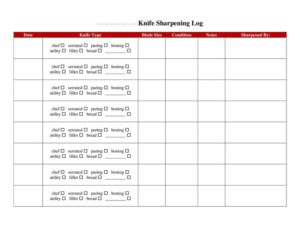
Knife Sharpening Log
Track blade maintenance with a free Knife Sharpening Log template that logs dates, knife IDs, and technicians — free download in PDF and DOCX.
PDF
DOCX
7 downloads
0
likes
Download Files
- DOCX
A Knife Sharpening Log is a simple maintenance record kitchens use to track when each blade was sharpened, who did the work, and when the next service is due. It is most often used to keep cutlery consistently sharp, reduce accidents from dull blades, and demonstrate a routine maintenance system during health and safety inspections. You can download it free below in both PDF and DOCX formats, with no signup required.
What Is a Knife Sharpening Log?
A Knife Sharpening Log is a structured tracking sheet that documents the ongoing maintenance of a kitchen’s knives and cutting tools. It is typically maintained by a head chef, sous chef, kitchen manager, or a designated equipment steward, and may also be completed by an outside sharpening service that visits on a schedule. The log records each sharpening event — the date, which knife was serviced, the method or technician used, and the condition of the blade. Over time it becomes a complete maintenance history that shows blades are kept in safe working order. In professional kitchens, butcher shops, and catering operations, this record supports both staff safety and food quality, since clean cuts depend on properly maintained edges.
When Do You Need a Knife Sharpening Log?
A sharpening log is useful any time a kitchen relies on multiple knives that see heavy daily use. Common situations include:
- Routine restaurant maintenance — rotating chef’s knives, boning knives, and slicers through a regular honing and sharpening schedule.
- Outside sharpening services — tracking which blades were collected, serviced, and returned by a third-party vendor.
- Health and safety audits — showing inspectors a documented program that keeps blades sharp and reduces slip-and-cut incidents.
- Multi-station kitchens — logging knives assigned to specific prep, line, or butchery stations so none are overlooked.
- Equipment accountability — identifying knives by number or label so expensive cutlery is tracked and not lost or misused.
- Onboarding and training — teaching new kitchen staff the maintenance routine and the difference between honing and full sharpening.
What a Knife Sharpening Log Should Have
An effective log captures enough detail to be useful without being burdensome to fill in during a busy shift. The core elements are a clear knife identifier, the date of service, the type of maintenance performed (honing, whetstone sharpening, electric sharpener, or professional service), the name or initials of the person who did the work, a note on blade condition before and after, and the date the knife is next due for attention. A header section identifying the kitchen, location, and the period the sheet covers ties the records together. Space for general comments lets staff flag chips, bent tips, or blades that need replacement rather than re-sharpening.
How to Fill Out a Knife Sharpening Log
Because this template is a flexible grid, complete one row per sharpening event. Follow these steps:
- Fill in the header — write your kitchen or business name, location or station, and the date range the sheet covers.
- Enter the date — record the day the sharpening or honing was performed.
- Identify the knife — note the knife number, label, or description (for example, “#4 — 10″ chef’s knife” or “boning knife, station 2”).
- Record the service type — indicate whether it was honed, sharpened on a stone, run through an electric sharpener, or sent to a professional service.
- Note the blade condition — briefly describe the edge before and after, flagging any chips or damage.
- Add who performed the work — write the name or initials of the staff member or vendor.
- Set the next due date — based on usage, schedule when the blade should be checked again.
- Use the comments field for any follow-up, such as “needs replacement” or “handle loose.”
Honing Versus Sharpening: What to Record
Many kitchen staff confuse honing with sharpening, and the log should make the distinction clear. Honing realigns the blade’s existing edge using a steel and should happen frequently — often daily or before each shift. Sharpening actually removes metal to create a new edge using a whetstone, electric sharpener, or professional service, and is done far less often. A good log lets you mark which action was taken so you can see, at a glance, whether a knife is simply being maintained day to day or has reached the point of needing a full sharpen. This pattern also reveals which blades wear fastest and may need replacement.
Tips for an Effective Sharpening Routine
Assign permanent numbers or colored handle bands to each knife so the same blade is always logged consistently. Keep the log near the sharpening station on a clipboard or in a binder so entries happen in the moment rather than from memory. Build a rotation schedule based on how heavily each knife is used — a line cook’s chef’s knife may need attention far more often than a rarely used cleaver. Review the log monthly to spot knives that are sharpened too frequently (a sign of poor technique or low-quality steel) and to plan vendor visits. Pair the log with basic blade safety training for the whole team.
Common Mistakes to Avoid
- Vague knife identifiers — writing “chef knife” when you own six makes the record useless; always use a number or label.
- Skipping the next-due date — without it, the log becomes a history book instead of a planning tool.
- Confusing honing with sharpening — failing to distinguish the two hides how often blades truly need re-edging.
- Filling it in after the fact — logging from memory at the end of the week leads to errors and missed entries.
- Ignoring the comments field — failing to flag chips or loose handles lets small problems become safety hazards.
- Letting the log lapse — an abandoned sheet offers no protection during a safety inspection.
Frequently Asked Questions
What is a Knife Sharpening Log used for? It is used to document when each kitchen knife was honed or sharpened, who performed the work, and when service is next due. The log keeps blades consistently sharp, supports staff safety, and provides a maintenance record for health and safety audits.
How often should knives be sharpened? It depends on use and steel quality, but heavily used blades are typically honed daily and fully sharpened every few weeks to a few months. The log helps you find the right rhythm for each individual knife by showing its actual wear pattern over time.
Who should fill out the log? Usually the head chef, kitchen manager, or a designated steward maintains it, though any trained staff member or an outside sharpening vendor can complete entries. The key is consistency, so the same identifiers and service types are recorded the same way each time.
Does a Knife Sharpening Log need to be notarized or witnessed? No. It is an internal maintenance record, not a legal contract, so it requires no notarization or witnesses. It simply needs to be filled out accurately and kept accessible for staff and inspectors.
Is this template legally binding? No, it is an operational tracking document rather than a binding agreement. That said, a well-kept log can serve as helpful evidence of a maintenance program during a health inspection or in response to a workplace safety question.
How much does this template cost? It is completely free to download here in both PDF and DOCX formats, with no signup or payment required. You can print the PDF for clipboard use or edit the DOCX to add your own knife numbers, columns, and branding.
This template is provided as a general example for informational purposes only and does not constitute legal, food-safety, or regulatory advice. Health and safety requirements vary by jurisdiction and establishment — consult the appropriate authority or a qualified professional to confirm your obligations.
Related Forms
- Brunch Menu
- No Outside Food Or Drink Sign
- Lunch Menu
- Specials Menu
- Breakfast Menu
- Recipe Food Costing Worksheet
Browse more in Restaurant.