
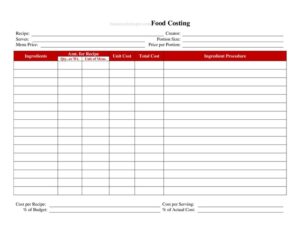
Recipe Food Costing Worksheet
Use this free Recipe Food Costing Worksheet template to calculate plate cost, food cost percentage, and menu pricing accurately — free download in PDF & DOCX.
PDF
DOCX
7 downloads
0
likes
Download Files
- DOCX
A Recipe Food Costing Worksheet is a simple tool that breaks a single dish down into its ingredients so you can calculate exactly what it costs to make and what you should charge for it. Restaurants, cafes, caterers, and home-based food businesses use it to protect their profit margins on every plate they serve. It’s free to download here in both PDF and DOCX formats, with no signup required.
What Is a Recipe Food Costing Worksheet?
A Recipe Food Costing Worksheet is a structured document used by chefs, kitchen managers, and food business owners to itemize every ingredient in a recipe, record its purchase cost and the portion used, and total the cost to produce one batch or one plate. From that total, the worksheet helps you derive the cost per serving, your food cost percentage, and a suggested selling price. It turns vague guesswork about menu pricing into a precise, repeatable calculation. Whether you run a busy restaurant kitchen or sell baked goods from home, the worksheet documents the true cost behind a recipe so pricing decisions are based on real numbers rather than estimates.
When Do You Need a Recipe Food Costing Worksheet?
This worksheet is useful any time the price of a dish needs to reflect what it actually costs to make. Common situations include:
- Setting menu prices for a new restaurant, food truck, or cafe before opening day.
- Re-pricing existing dishes when ingredient or supplier costs rise and your margins start shrinking.
- Preparing catering quotes where you must price per head and still leave room for profit.
- Evaluating menu profitability to identify which dishes are high-margin stars and which are losing money.
- Standardizing recipes across locations so every kitchen uses the same portions and costs.
- Launching a home food or bakery business and needing to price products competitively while covering ingredients.
What a Recipe Food Costing Worksheet Should Have
A complete costing worksheet should capture enough detail that anyone can reproduce the calculation. Essential elements include the recipe or menu item name, the number of portions (yield) the recipe produces, and a line-by-line list of every ingredient. Each ingredient line should show the quantity used, the unit of measure, the purchase price (often per pack or per pound), and the calculated cost for the amount actually used. The worksheet should total all ingredient costs to give a batch cost, then divide by yield to produce a cost per portion. Finally, it should include space for your target food cost percentage and a suggested selling price so the numbers translate directly into a menu decision.
How to Fill Out a Recipe Food Costing Worksheet
- Name the recipe. Enter the menu item or dish name at the top so the worksheet is easy to file and find later.
- Record the yield. Write how many portions or servings the full recipe produces — this is the basis for the per-plate cost.
- List each ingredient. Add one line per ingredient, exactly as the recipe uses them.
- Enter quantity and unit. For each ingredient, note the amount used and the unit (grams, ounces, cups, each).
- Add the purchase cost. Record what you paid for the ingredient and its purchase size (for example, $4.00 per 16 oz).
- Calculate the used cost. Convert the purchase price to the cost of the portion you actually used, and enter that figure per line.
- Total the recipe cost. Add every line to get the full batch cost.
- Divide by yield. Divide the batch cost by the number of portions to find the cost per serving.
- Set your price. Apply your target food cost percentage to suggest a selling price, then round it sensibly for your menu.
Understanding Food Cost Percentage
Food cost percentage is the heart of menu pricing, and the worksheet is built around it. The formula is straightforward: divide the cost of a dish by its selling price, then multiply by 100. For example, if a plate costs $3.00 to make and sells for $12.00, the food cost percentage is 25 percent. Many operators aim for a food cost between 28 and 35 percent, though the right target depends on your concept, location, and overhead. To work backward to a price, divide the plate cost by your target percentage — a $3.00 plate at a 30 percent target suggests a $10.00 price. Tracking this number per dish lets you spot items that are squeezing your margins.
Tips for Accurate Costing
Accuracy comes from consistency. Always cost ingredients in the same unit you buy them, and convert carefully — a recipe that calls for 4 ounces of cheese from a 16-ounce $5.00 block costs $1.25, not $5.00. Update the worksheet whenever supplier prices change, ideally on a regular schedule. Remember to account for yield loss and trim waste on items like produce and proteins, since you rarely use 100 percent of what you buy. Don’t forget small items like oil, salt, and garnish; individually they’re cheap, but they add up across a busy service. Keeping a completed worksheet for each menu item creates a library of standardized recipes that makes future re-pricing fast.
Common Mistakes to Avoid
- Forgetting minor ingredients like spices, oil, and garnishes that quietly erode margins.
- Mismatching units — pricing a recipe in ounces while buying in pounds without converting.
- Ignoring waste and trim, which makes the real cost per usable portion higher than it appears.
- Using outdated prices and not revisiting the worksheet when supplier costs change.
- Pricing on cost alone while ignoring labor, overhead, and what the market will bear.
- Confusing batch cost with portion cost, leading to dramatically underpriced menu items.
Frequently Asked Questions
What is a Recipe Food Costing Worksheet used for? It is used to calculate the exact cost of producing a dish by itemizing each ingredient, then converting that into a cost per serving and a suggested menu price. Restaurants and food businesses rely on it to protect profit margins and price menu items confidently.
How do I calculate food cost percentage? Divide the cost of the dish by its selling price and multiply by 100. For instance, a plate that costs $4.00 and sells for $16.00 has a 25 percent food cost. The worksheet helps you gather the cost figure needed for this calculation.
What food cost percentage should I aim for? Many restaurants target somewhere between 28 and 35 percent, but the right number depends on your concept, rent, labor, and local market. Use the worksheet to test prices and find a percentage that keeps you profitable.
Do I need to update the worksheet often? Yes. Ingredient prices fluctuate with seasons and suppliers, so review your worksheets regularly and re-cost any dish when its key ingredients change in price. Outdated numbers lead to underpriced menu items.
Can I use this for a home or catering business? Absolutely. The worksheet works for any food operation — home bakeries, caterers, food trucks, and full restaurants all benefit from knowing the true cost of each item before setting prices.
Is this Recipe Food Costing Worksheet free to download? Yes, it is completely free to download in both PDF and DOCX formats with no signup required. You can edit the DOCX version to match your own ingredients, units, and target margins.
This template is provided as a general example for informational purposes only and does not constitute financial, accounting, or business advice. Costing methods, tax treatment, and pricing requirements vary by business and jurisdiction — consult a qualified accountant or business professional before making pricing decisions.
Related Forms
- Breakfast Menu Casual
- Cafe Menu
- Food Charity Donation Log
- Freezer Inventory Log
- Reservation Form
- Coffee Menu
Browse more in Restaurant.